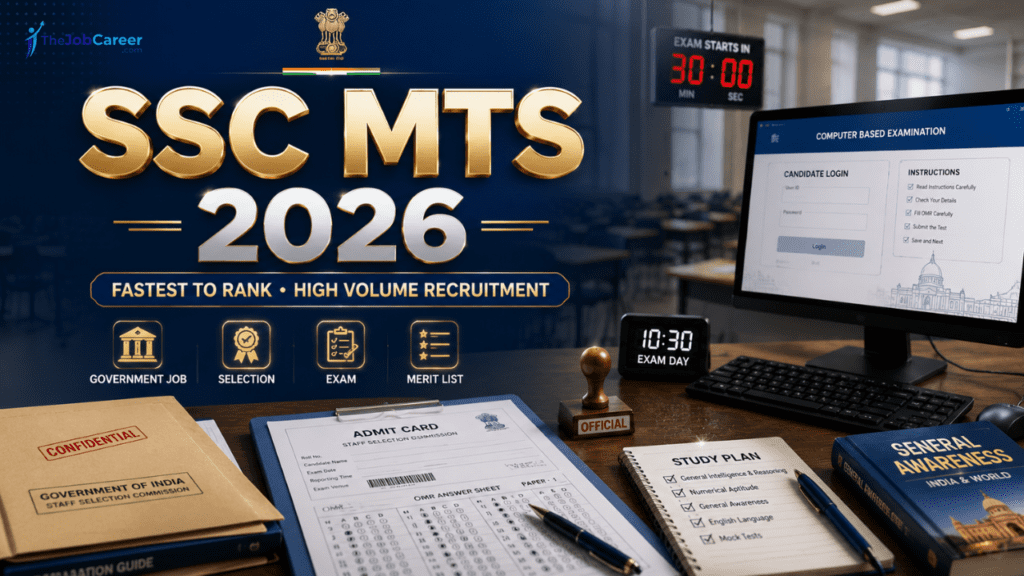

If you have passed Class 10 and want a permanent central government job with a monthly salary, job security, pension, free medical benefits, and a structured career path — SSC MTS 2026 is one of the most important opportunities available to you this year. The Staff Selection Commission (SSC) has officially released the SSC MTS 2026 Notification on June 30, 2026, opening applications for Multi-Tasking Staff (Non-Technical) and Havaldar posts across central government departments all over India. The application window is open until July 31, 2026, and the Computer Based Examination (CBE) is scheduled between September and November 2026.
SSC MTS is one of the few central government recruitment exams in India that requires only a Class 10 pass certificate — no degree, no diploma, no age bar beyond the standard 18–27 years. And yet, it offers everything that lakhs of aspirants look for in a government career: a permanent central government job, a monthly in-hand salary of Rs. 27,000 to Rs. 34,000 depending on city of posting, free railway travel benefits, medical facilities for the entire family, and a clear promotion path that can eventually take you from MTS to a gazetted level officer over a career spanning 25–30 years.
In the last recruitment cycle, SSC announced 7,948 vacancies — 6,810 for MTS posts and 1,138 for Havaldar (CBIC & CBN). The 2026 vacancy count will be officially announced with the notification on June 30, but based on historical trends and departmental manpower requirements, a similar or higher count is expected. This complete guide covers everything you need to know — from eligibility and important dates to exam pattern, syllabus, salary breakdown, Havaldar PET/PST physical standards, previous year cut-offs, and a month-by-month preparation strategy to clear SSC MTS 2026 in your very first attempt.
What is SSC MTS? Overview
SSC MTS stands for Staff Selection Commission Multi-Tasking Staff (Non-Technical) Examination. It is conducted by the Staff Selection Commission — the central government body that recruits personnel for various Group B and Group C posts under the Government of India.
| Parameter | Details |
|---|---|
| Full Form | Staff Selection Commission — Multi-Tasking Staff (Non-Technical) |
| Conducting Body | Staff Selection Commission (SSC) |
| Post Type | Group C — Non-Gazetted, Non-Ministerial |
| Posts Recruited | Multi-Tasking Staff (MTS) + Havaldar (CBIC & CBN) |
| Minimum Qualification | Class 10 Pass (Matriculation) |
| Age Limit | 18 to 27 years (relaxation for reserved categories) |
| Pay Level | Level 1 (7th CPC) — Basic Pay Rs. 18,000 |
| Exam Mode | Computer Based Examination (CBE) |
| Official Website | ssc.gov.in |
MTS recruits are posted across central government ministries, departments, and offices all over India — Ministry of Finance, Ministry of Home Affairs, Ministry of Defence, Railways Board, various PSUs attached to central ministries, and more. The Havaldar posts are specifically under the Central Board of Indirect Taxes and Customs (CBIC) and the Central Bureau of Narcotics (CBN) — both under the Ministry of Finance.
MTS vs Havaldar — What Is the Difference?
| Factor | MTS (Multi-Tasking Staff) | Havaldar (CBIC & CBN) |
|---|---|---|
| Posting | Various central government departments | CBIC and CBN offices only |
| Work Nature | Clerical support, office maintenance, peon, dispatch, record keeping | Watch and ward duties, custodial work, escorting goods |
| Physical Test | Not required | PET/PST mandatory after CBE |
| Age Limit | 18–25 or 18–27 (post-wise) | 18–25 years |
| Pay Level | Level 1 (Rs. 18,000 basic) | Level 1 (Rs. 18,000 basic) |
| Uniform | No | Yes — uniform provided |
| Promotion Path | LDC → UDC → Assistant → Section Officer | Havaldar → Head Havaldar → Inspector (customs/narcotics) |
| Additional Allowances | Standard central govt allowances | Uniform allowance + risk allowance (specific to department) |
SSC MTS 2026: Important Dates
| Event | Date |
|---|---|
| Official Notification Released | June 30, 2026 |
| Online Application Opens | June 30, 2026 |
| Last Date to Apply Online | July 31, 2026 |
| Application Fee Payment Deadline | July 31, 2026 |
| Application Correction Window | First week of August 2026 (expected) |
| Admit Card / Hall Ticket Release | 2–3 weeks before CBE (August–September 2026) |
| CBE (Computer Based Examination) | September to November 2026 |
| CBE Result Declaration | December 2026 – January 2027 (expected) |
| Havaldar PET/PST | After CBE result — February–March 2027 (expected) |
| Document Verification | After PET/PST or final merit |
| Final Result and Appointment | 2027 |
🚨 Critical Deadline: The application closes on July 31, 2026. Do not wait for the last day — SSC portals experience heavy traffic near deadlines and technical issues are common. Apply within the first week of July.
SSC MTS 2026: Eligibility Criteria
Educational Qualification
| Post | Minimum Qualification |
|---|---|
| MTS (Multi-Tasking Staff) | Matriculation (Class 10) pass from a recognised board |
| Havaldar (CBIC & CBN) | Matriculation (Class 10) pass from a recognised board |
Any recognised board is acceptable — CBSE, ICSE, all state boards (Gujarat Board / GSEB, UP Board, Maharashtra Board, Rajasthan Board, etc.), NIOS, and open school certificates. There is no minimum percentage requirement. A simple pass in Class 10 is sufficient.
Important: Candidates who are appearing in Class 10 exams in 2026 are not eligible to apply. You must have your Class 10 pass certificate in hand at the time of document verification.
Age Limit (As on January 1, 2026)
| Post | Age Group | Age Limit |
|---|---|---|
| MTS | Group A | 18 to 25 years |
| MTS | Group B | 18 to 27 years |
| Havaldar (CBIC & CBN) | — | 18 to 25 years |
Age relaxation for reserved categories:
| Category | Age Relaxation | Effective Upper Age (MTS Group A) |
|---|---|---|
| OBC (Non-Creamy Layer) | +3 years | 28 years |
| SC / ST | +5 years | 30 years |
| PwBD (General) | +10 years | 35 years |
| PwBD (OBC) | +13 years | 38 years |
| PwBD (SC/ST) | +15 years | 40 years |
| Ex-Servicemen | Reduction of military service + 3 years | As per guidelines |
| J&K Domicile (1980–89) | +5 years | 30 years |
Note: Age is calculated as on January 1, 2026 for SSC MTS 2026. Verify your exact date of birth calculation against this cut-off date in the official notification.
Nationality
Candidates must be citizens of India, subjects of Nepal or Bhutan, Tibetan refugees settled in India before January 1, 1962, or persons of Indian origin from specified countries who have obtained eligibility certificates from the Government of India.
SSC MTS 2026: Vacancies
The official vacancy count for 2026 will be released with the notification on June 30, 2026. Based on the previous cycle and departmental requirements:
Previous Year Vacancy Trend
| Year | MTS Vacancies | Havaldar Vacancies | Total |
|---|---|---|---|
| 2020 | 5,895 | 667 | 6,562 |
| 2021 | 7,301 | 555 | 7,856 |
| 2022 | 10,880 | 1,198 | 12,078 |
| 2023 | 8,326 | 1,010 | 9,336 |
| 2024–25 | 6,810 | 1,138 | 7,948 |
| 2026 (Expected) | 7,000 – 9,000 | 1,000 – 1,200 | ~8,000 – 10,000 |
MTS 2024–25 Vacancy Breakdown by Age Group:
| Age Category | Vacancies |
|---|---|
| MTS (Age group 18–25) | 6,078 |
| MTS (Age group 18–27) | 732 |
| Havaldar (CBIC) | Majority of 1,138 |
| Havaldar (CBN) | Minority of 1,138 |
The post preference and department preference system means candidates who score higher in the CBE can choose preferred departments during document verification. Popular department choices among MTS candidates include Ministry of Finance offices, Income Tax departments, and Ministry of Home Affairs postings in metro cities.
SSC MTS 2026: Application Process (Step by Step)
Step 1: Register on SSC OTR Portal
Before applying, all candidates must complete One Time Registration (OTR) on the SSC official portal at ssc.gov.in. If you have previously registered for any SSC exam (CGL, CHSL, GD), your OTR is already active — do not re-register.
Step 2: Fill the Application Form
| Information Required | Details |
|---|---|
| Personal details | Name, Date of Birth, Father/Mother name, Gender, Category |
| Educational details | Board name, passing year, percentage/grade |
| Contact information | Mobile number, email ID (active — all notifications sent here) |
| Identity document | Aadhaar / PAN / Voter ID / Passport — one mandatory |
| Post preference | MTS, Havaldar (CBIC), Havaldar (CBN) — rank your preference |
| Exam centre preference | Up to 3 cities — choose carefully, changes rarely permitted |
| Photo upload | Recent passport size, white background, clear face |
| Signature upload | Black ink on white paper |
Step 3: Pay Application Fee
| Category | Application Fee |
|---|---|
| General / EWS / OBC | Rs. 100 |
| SC / ST | Exempt (no fee) |
| Female (all categories) | Exempt (no fee) |
| PwBD | Exempt (no fee) |
| Ex-Servicemen | Exempt (no fee) |
Payment modes: Net Banking, Credit Card, Debit Card, UPI. Keep the transaction receipt — it serves as proof of payment if any issue arises.
Step 4: Submit and Download Confirmation
After submission, download and print the application confirmation page. Keep it safely — the application number / registration ID is required for all future correspondence including admit card download, result checking, and document verification.
SSC MTS 2026: Selection Process
The selection process has two stages for MTS and three stages for Havaldar:
For MTS Posts
| Stage | Name | Nature |
|---|---|---|
| Stage 1 | Computer Based Examination (CBE) | Merit-determining |
| Stage 2 | Document Verification | Qualifying |
For Havaldar Posts (CBIC & CBN)
| Stage | Name | Nature |
|---|---|---|
| Stage 1 | Computer Based Examination (CBE) | Merit-determining |
| Stage 2 | Physical Efficiency Test (PET) + Physical Standard Test (PST) | Qualifying |
| Stage 3 | Document Verification | Final |
SSC MTS 2026: Exam Pattern (CBE)
The Computer Based Examination is divided into two separate sessions conducted on the same day. Both sessions are compulsory — missing either session results in automatic disqualification.
Session I — Qualifying in Nature
| Subject | Number of Questions | Total Marks | Duration |
|---|---|---|---|
| Numerical and Mathematical Ability | 20 | 60 | — |
| Reasoning Ability and Problem Solving | 20 | 60 | — |
| Total Session I | 40 | 120 | 45 minutes |
Critical rules for Session I:
- Each correct answer: +3 marks
- Wrong answer: No negative marking ✅
- Session I is qualifying in nature — marks do not count toward final merit
- Minimum qualifying marks determined by SSC based on category
- Attempt all 40 questions since there is no penalty for wrong answers
Session II — Merit Determining
| Subject | Number of Questions | Total Marks | Duration |
|---|---|---|---|
| English Language and Comprehension | 25 | 75 | — |
| General Awareness | 25 | 75 | — |
| Total Session II | 50 | 150 | 45 minutes |
Critical rules for Session II:
- Each correct answer: +3 marks
- Each wrong answer: −1 mark (negative marking applies ⚠️)
- Session II marks determine your final merit list and ranking
- No negative marking in Session I but Session II is the real battle
- Total CBE marks: Session I (120) + Session II (150) = 270 marks
CBE vs Previous Pattern — What Changed
| Factor | Old Pattern (up to 2022) | New Pattern (2023 onwards) |
|---|---|---|
| Stages | Paper 1 (Objective) + Paper 2 (Descriptive) | Single CBE — two sessions on same day |
| Paper 2 | English descriptive writing — 25 marks | Abolished — no descriptive paper |
| Marking | Paper 1: -0.25/wrong | Session 1: No negative marking; Session 2: -1/wrong |
| Language | Bilingual | 15 languages (English, Hindi + 13 regional) |
| Mode | OMR based earlier | Fully computer based |
Important shift: The new pattern is entirely objective (MCQ) — no essay writing, no letter writing. This benefits candidates who were struggling with descriptive paper writing but have solid subject knowledge.
SSC MTS 2026: Complete Syllabus
Session I — Numerical and Mathematical Ability
| Topic | Expected Questions | Difficulty |
|---|---|---|
| Number System, LCM and HCF | 2–3 | Easy |
| BODMAS and Simplification | 2–3 | Easy |
| Fractions and Decimals | 1–2 | Easy |
| Percentage | 2–3 | Easy–Moderate |
| Ratio and Proportion | 1–2 | Easy |
| Profit and Loss | 2–3 | Easy–Moderate |
| Simple Interest and Compound Interest | 1–2 | Moderate |
| Averages | 1–2 | Easy |
| Time and Work | 1–2 | Moderate |
| Time and Distance / Speed | 1–2 | Moderate |
| Mensuration (Area, Perimeter, Volume) | 1–2 | Moderate |
| Data Interpretation — Tables, Bar Graphs | 1–2 | Moderate |
Syllabus standard: Class 8–10 level NCERT Mathematics. No trigonometry, no algebra beyond basic equations, no coordinate geometry. Pure arithmetic — fast calculation matters more than complex concepts.
Session I — Reasoning Ability and Problem Solving
| Topic | Expected Questions | Difficulty |
|---|---|---|
| Number Series | 2–3 | Easy |
| Alphabetical Series | 2–3 | Easy |
| Coding and Decoding | 2–3 | Easy–Moderate |
| Analogies (Number, Letter, Word) | 2–3 | Easy |
| Odd One Out | 2 | Easy |
| Blood Relations | 1–2 | Moderate |
| Direction and Distance | 1–2 | Moderate |
| Mirror Images | 1–2 | Easy |
| Embedded Figures | 1–2 | Easy–Moderate |
| Syllogism | 1–2 | Moderate |
| Venn Diagrams | 1–2 | Easy |
| Mathematical Operations | 1–2 | Easy |
Key insight: SSC MTS reasoning is significantly easier than SSC CGL or CHSL reasoning. Questions are standard, pattern-based, and predictable. Practice 30–40 questions per day for 30 days and this section becomes your highest-scoring zone.
Session II — English Language and Comprehension
| Topic | Expected Questions | Difficulty |
|---|---|---|
| Reading Comprehension | 5–7 | Moderate |
| Fill in the Blanks (Grammar) | 3–4 | Easy–Moderate |
| Synonyms and Antonyms | 3–4 | Easy |
| One Word Substitution | 2–3 | Moderate |
| Spotting Errors | 3–4 | Moderate |
| Sentence Rearrangement / Jumbled Sentences | 2–3 | Moderate |
| Idioms and Phrases | 2–3 | Moderate |
| Cloze Test | 3–5 | Moderate |
| Spelling Correction | 1–2 | Easy |
Standard: Class 10 English level. No advanced grammar. Focus heavily on vocabulary, basic grammar rules, and reading comprehension strategies. Session II English has negative marking — do not guess.
Session II — General Awareness
| Topic | Expected Questions | Difficulty |
|---|---|---|
| History — Ancient, Medieval, Modern India | 3–5 | Easy–Moderate |
| Geography — Physical, Economic India | 3–4 | Easy–Moderate |
| Indian Polity and Constitution | 3–4 | Easy |
| Indian Economy — Basics | 2–3 | Easy |
| General Science — Physics, Chemistry, Biology | 4–6 | Easy–Moderate |
| Current Affairs — last 6–12 months | 5–7 | Variable |
| Static GK — Awards, Books, Sports, Days | 3–4 | Easy |
| Science and Technology | 2–3 | Easy–Moderate |
| Computer Basics | 1–2 | Easy |
| Indian Culture and Heritage | 1–2 | Easy |
Most important section of Session II. 25 questions, 75 marks, and these are often the most predictable questions in the paper. A candidate who reads daily current affairs for 20 minutes and covers Class 10 NCERT History, Geography, Science, and Polity can score 20+ out of 25 in this section consistently.
Havaldar PET/PST Physical Standards (CBIC & CBN)
For Havaldar posts only, candidates who qualify the CBE must also clear a Physical Efficiency Test (PET) and Physical Standard Test (PST). These are qualifying — no marks are added to your CBE score.
Physical Standard Test (PST) — Height and Chest
| Category | Height (Male) | Height (Female) | Chest (Male — unexpanded / expanded) |
|---|---|---|---|
| General / OBC / EWS | 157.5 cm | 152 cm | 76 cm / 81 cm |
| SC / ST | 152 cm | 147 cm | 74 cm / 79 cm |
| Hill Areas / Tribal | 152 cm | 147 cm | 74 cm / 79 cm |
Physical Efficiency Test (PET) — Running
| Gender | Distance | Time Limit |
|---|---|---|
| Male candidates | 1,600 metres (1.6 km) | Within 15 minutes |
| Female candidates | 1 km (1,000 metres) | Within 20 minutes |
PET exemptions: PwBD candidates who are orthopedically handicapped (OH) are exempted from PET as per SSC guidelines. Other PwBD categories must verify exemption status in the official notification.
Important for Havaldar aspirants: If you plan to apply for Havaldar posts, start physical preparation now — 1.6 km in 15 minutes requires a consistent jogging routine, especially for candidates who are not regularly active. Do not leave physical preparation until after the CBE result.
SSC MTS 2026: Salary Structure
SSC MTS and Havaldar posts fall under Pay Level 1 of the 7th Central Pay Commission (7th CPC) Pay Matrix. Here is the complete salary breakdown:
Basic Pay Structure (Pay Level 1)
| Parameter | Details |
|---|---|
| Pay Level | Level 1 (7th CPC Pay Matrix) |
| Entry Basic Pay | Rs. 18,000 per month |
| Maximum Basic Pay | Rs. 56,900 per month (after full career increments) |
| Annual Increment | 3% of basic pay — added every July 1 |
| Grade Pay (old structure) | Rs. 1,800 (reference only — now replaced by Pay Level system) |
In-Hand Salary by City Category (2026)
| Component | X Cities (Metro) | Y Cities (Big) | Z Cities (Small) |
|---|---|---|---|
| Basic Pay | Rs. 18,000 | Rs. 18,000 | Rs. 18,000 |
| Dearness Allowance (DA @ ~58–60%) | Rs. 10,440 – 10,800 | Rs. 10,440 – 10,800 | Rs. 10,440 – 10,800 |
| House Rent Allowance (HRA) | Rs. 4,320 (24%) | Rs. 2,880 (16%) | Rs. 1,440 (8%) |
| Transport Allowance (TA) | Rs. 1,350 | Rs. 900 | Rs. 900 |
| Gross Salary | ~Rs. 34,110 | ~Rs. 32,220 | ~Rs. 30,780 |
| Deductions (NPS ~10%, CGEGIS, CGHS) | ~Rs. 2,500 – 3,500 | ~Rs. 2,200 – 3,000 | ~Rs. 2,000 – 2,800 |
| Net In-Hand Salary | ~Rs. 30,000 – 32,000 | ~Rs. 28,000 – 30,000 | ~Rs. 27,000 – 29,000 |
X cities: Delhi, Mumbai, Chennai, Kolkata, Bengaluru, Hyderabad, Ahmedabad, Pune Y cities: Lucknow, Jaipur, Chandigarh, Bhopal, Patna, Surat, Vadodara, Nagpur, Indore, and other major cities Z cities: All remaining smaller towns and cities
Salary Growth Over Career
| Years of Service | Basic Pay | Approx. Gross Salary |
|---|---|---|
| Entry Level | Rs. 18,000 | Rs. 30,000 – 34,000 |
| After 3 years | Rs. 19,700 | Rs. 33,000 – 37,000 |
| After 5 years | Rs. 20,900 | Rs. 35,000 – 40,000 |
| After 10 years | Rs. 24,200 | Rs. 40,000 – 45,000 |
| After 20 years (promotion to LDC) | Rs. 25,500 (Level 2) | Rs. 45,000 – 52,000 |
| Maximum (end of career) | Rs. 56,900 | Rs. 80,000 – 90,000 |
Benefits and Perks Beyond Salary
| Benefit | Details |
|---|---|
| National Pension System (NPS) | Government contributes 14% of basic pay; employee contributes 10% |
| CGHS (Central Govt Health Scheme) | Self + dependent family — OPD, hospitalisation, medicines |
| Leave | 30 days Earned Leave + 8 days Casual Leave + Medical Leave per year |
| LTC (Leave Travel Concession) | Subsidised travel for self and family to home town — every 2 years |
| CGEGIS | Central Government Employees Group Insurance Scheme |
| Children Education Allowance | Up to 2 children per year |
| Government Accommodation | On availability — or HRA in lieu |
| Job Security | Permanent central government employee — cannot be removed without due process |
| Pension (Pre-2004 joiners rule does not apply — NPS for new joiners) | NPS with government 14% contribution — still a strong retirement corpus |
SSC MTS 2026: Career Growth and Promotion Path
One of SSC MTS’s most underappreciated aspects is the promotion path. Many candidates assume MTS is a dead-end entry level post. It is not. Here is the complete promotion ladder:
MTS Promotion Path
| Stage | Designation | Pay Level | Timeline |
|---|---|---|---|
| Entry | Multi-Tasking Staff (MTS) | Level 1 | On joining |
| Promotion 1 | Lower Division Clerk (LDC) | Level 2 | 5–8 years (LDCE/DPC) |
| Promotion 2 | Upper Division Clerk (UDC) | Level 4 | 5–8 more years |
| Promotion 3 | Assistant Section Officer (ASO) | Level 6 | 8–12 more years |
| Promotion 4 | Section Officer | Level 7 | 10–15 more years |
| Exceptional | Under Secretary / Deputy Secretary | Level 10–11 | Through DOPT seniority |
MTS → LDC promotion route: MTS employees can appear for the Limited Departmental Competitive Examination (LDCE) for promotion to LDC posts. This is the most common and fastest promotion route. Candidates who appear consistently and score well can reach LDC within 5 years of joining.
Havaldar Promotion Path (CBIC/CBN)
| Stage | Designation | Pay Level | Timeline |
|---|---|---|---|
| Entry | Havaldar | Level 1 | On joining |
| Promotion 1 | Head Havaldar | Level 2 | 5–8 years |
| Promotion 2 | Tax Assistant / Inspector (Customs/Central Excise) | Level 4–7 | 10–15 years via LDCE |
| Promotion 3 | Superintendent | Level 8 | Further seniority |
Previous Year Cut-offs: SSC MTS
Understanding previous cut-offs is essential for setting a realistic target score. All cut-offs below are for Session II (the merit-determining session), out of 150 marks.
SSC MTS Cut-off (CBE Session II) — 2023 Cycle
| Category | Expected Range (out of 150) | Score Required |
|---|---|---|
| General / UR | 95 – 110 | Aim for 120+ |
| EWS | 90 – 105 | Aim for 115+ |
| OBC | 85 – 100 | Aim for 110+ |
| SC | 75 – 90 | Aim for 100+ |
| ST | 65 – 80 | Aim for 90+ |
SSC MTS Cut-off Trend (2019 – 2023)
| Year | General (Approx.) | OBC (Approx.) | SC (Approx.) | ST (Approx.) |
|---|---|---|---|---|
| 2019 | 100.88 | 89.27 | 79.58 | 63.02 |
| 2020–21 | 114.42 | 103.87 | 93.14 | 80.27 |
| 2022 | 117.50 | 108.00 | 96.75 | 82.50 |
| 2023 | 105.00 | 95.00 | 83.00 | 72.00 |
| 2026 Target (General) | 110 – 120 | — | — | — |
Key observation: Cut-offs fluctuate based on total candidates, number of vacancies, and exam difficulty. A score of 120+ out of 150 in Session II puts General category candidates in a comfortable position in most zones. In high-competition states like UP, Bihar, Rajasthan, and MP, aim for 125+ to be safe.
Preparation Strategy: How to Clear SSC MTS 2026 in First Attempt
Study Plan Overview (July – November 2026)
| Phase | Period | Focus |
|---|---|---|
| Phase 1: Foundation | July 2026 (4 weeks) | NCERT revision, basic concepts, topic-wise study |
| Phase 2: Intensive Practice | August 2026 (5 weeks) | Chapter-wise questions, previous year papers, timed practice |
| Phase 3: Full Mock Tests | September–October 2026 | 2 full mocks per week, weak area revision |
| Phase 4: Revision Sprint | 10 days before exam | Only revision, GK updates, error diary |
How to Prepare: General Awareness (Highest Return Section)
General Awareness has 25 questions worth 75 marks in Session II — the highest marks per question of any section. This is where toppers separate themselves from the crowd.
What to study:
- History: NCERT Class 6–10 History books — focus on Modern India (Freedom struggle, 1857 revolt, major leaders, important events). Ancient and Medieval history — 2–3 questions typically
- Geography: NCERT Class 9–10 Geography — India’s rivers, mountains, states, agriculture, climate, wildlife sanctuaries, national parks
- Polity: Class 9–10 Civics NCERT — fundamental rights, DPSP, Parliament structure, President vs PM powers, Panchayati Raj, Election Commission
- Science: Class 9–10 Science NCERT — human body systems, diseases, physics laws (Newton, Archimedes), chemical reactions, periodic table basics
- Current Affairs: June 2025 to October 2026 — read Adda247 monthly PDF, GK Today, or one national newspaper app daily (20 minutes maximum)
- Static GK: India’s important dams, national symbols, first persons in Indian history, major awards (Bharat Ratna, Padma Awards, Nobel), capital cities, currencies, sports championships
Best resource for GK: Lucent’s General Knowledge (Hindi or English) — covers all static GK in one book. Combine with a monthly current affairs PDF.
How to Prepare: English Language (Session II — Negative Marking)
English is in Session II with negative marking. This means accuracy is more important than attempting all 25 questions blindly.
Topic-wise strategy:
| Topic | Approach |
|---|---|
| Reading Comprehension | Read the questions first, then find answers in the passage — saves time |
| Vocabulary (Synonyms/Antonyms) | Learn 10 new words daily from Wren & Martin Word Power sections |
| Grammar (Fill in blanks, Spotting Errors) | Study Wren and Martin Grammar — Chapters on Tenses, Subject-Verb Agreement, Articles |
| One Word Substitution | Maintain a personal list — SSC repeats many OWS across exams |
| Idioms and Phrases | Use Kiran’s SSC English book — has comprehensive idioms list |
| Cloze Test | Practice daily — understand the tone and context of the passage before filling |
Golden rule for English Session II: Only attempt if you are at least 80% confident. Skip genuinely uncertain questions. Getting 18–20 correct with zero negatives is better than attempting all 25 and getting 22 correct with 5 wrong — the net difference can be 5 marks.
How to Prepare: Mathematics (Session I — No Negative Marking)
Since Session I has no negative marking, attempt all 20 maths questions. Even for topics you are uncertain about, an educated guess is always better than leaving it blank.
Focus on speed:
- Number System: Practice 20 questions daily on HCF, LCM, BODMAS, fractions
- Percentage and Ratio: Most frequently asked — master the formula and shortcut method
- Profit and Loss: Learn percentage-based shortcuts — most MTS questions use 10%, 20%, 25% figures
- Time and Work: Fraction method and LCM method — practice 10 questions daily
- SI and CI: Direct formula application — CI vs SI difference questions appear often
- Mensuration: Rectangle, square, circle, triangle areas and perimeters — quick formula recall
Target: Complete all 20 maths questions in 15–18 minutes, leaving time for reasoning.
How to Prepare: Reasoning (Session I — No Negative Marking)
Reasoning is the highest-scoring section in Session I for most prepared candidates. The questions are standard, pattern-based, and predictable.
Daily practice plan:
- Series (Number and Alphabet): 10 questions daily — after 15 days you will recognise all pattern types
- Coding-Decoding: 5 types — letter shift, reversal, number coding, symbol coding, mixed coding — master all 5
- Analogies: Pair relationship — same as SSC CGL but simpler. Practice 10 daily
- Direction-Distance: Draw the path on paper — never solve mentally for complex questions
- Blood Relations: Family tree method — draw it every time
Target: Solve all 20 reasoning questions in 20–22 minutes.
Best Books for SSC MTS 2026 Preparation
| Subject | Book | Author / Publisher |
|---|---|---|
| Mathematics | Arithmetic (MTS level) | R.S. Aggarwal |
| Mathematics | Kiran’s SSC Mathematics Chapterwise | Kiran Publications |
| Reasoning | A Modern Approach to Verbal & Non-Verbal Reasoning | R.S. Aggarwal |
| English | Objective General English | S.P. Bakshi (Arihant) |
| English | Plinth to Paramount (English) | Neetu Singh (KD Campus) |
| General Awareness | Lucent’s General Knowledge | Lucent Publications |
| General Awareness | Monthly Current Affairs PDF | Adda247 / GK Today (Free) |
| NCERT (all subjects) | Class 6–10 History, Geography, Science, Civics | NCERT (free at ncert.nic.in) |
| Previous Papers | SSC MTS Previous Year Papers (10 Years) | Kiran Publications |
| Complete Guide | SSC MTS Complete Guide | Arihant |
| Mock Tests | Online test series | Testbook / Adda247 / PW |
Month-by-Month Study Timetable (3 Months)
| Week | Session I Focus | Session II Focus | Daily Practice |
|---|---|---|---|
| Week 1–2 (July) | Number System, BODMAS, Fractions | GK — History (NCERT Class 6–8) | 50 questions/day |
| Week 3–4 (July) | Percentage, Ratio, Profit-Loss | GK — History (NCERT Class 9–10), Current Affairs | 60 questions/day |
| Week 5–6 (August) | SI/CI, Averages, Time-Work | GK — Geography (NCERT), Polity (NCERT) | 70 questions/day |
| Week 7–8 (August) | Time-Distance, Mensuration, DI | English — Grammar, Vocabulary, RC | 75 questions/day |
| Week 9–10 (August–September) | Series, Coding-Decoding, Analogies | English — One Word Sub, Idioms, Cloze | 80 questions/day |
| Week 11–12 (September) | Full Revision Session I topics | Full Revision Session II + Current Affairs update | 2 full mocks/week |
| Exam Month (September–November) | Mock analysis + targeted revision | Current Affairs daily, error diary review | 3 full mocks/week |
Common Mistakes SSC MTS Aspirants Make
❌ Mistake 1: Attempting all questions in Session II without accuracy check Session II has negative marking of 1 mark per wrong answer. Attempting all 50 questions with 60% accuracy means getting 30 right (+90) and 20 wrong (-20) — net 70 out of 150. Attempting 38 with 85% accuracy means 32 right (+96) and 6 wrong (-6) — net 90. Accuracy beats blind coverage in Session II every time.
❌ Mistake 2: Ignoring Session I because it is “only qualifying” Session I is qualifying — but failing to qualify Session I means all your Session II marks are void. Qualify comfortably in Session I rather than just scraping through. Aim for 80+ out of 120 in Session I even though it does not count in merit.
❌ Mistake 3: Neglecting current affairs preparation Current affairs typically provides 5–7 questions in Session II General Awareness — that is 15–21 marks. Candidates who skip current affairs are leaving these marks on the table. Just 20 minutes of daily reading from a reliable source is enough.
❌ Mistake 4: Applying for Havaldar without checking physical standards first Many candidates apply for Havaldar preference without verifying whether they meet the height and chest requirements or can complete the running test. Check your physical measurements before applying.
❌ Mistake 5: Starting preparation only after the admit card The CBE is in September–November 2026. The notification is out now (June 30). That gives you 3–4 months of preparation time. Candidates who start on day one of the notification have a massive advantage over those who wait until 30 days before the exam.
❌ Mistake 6: Using outdated study material SSC MTS changed its exam pattern in 2023 — the descriptive Paper 2 was removed. Books and mock tests printed before 2023 follow the old pattern. Only use updated 2025–26 editions and online test series that reflect the current two-session CBE format.
Frequently Asked Questions
Q1. Is SSC MTS a good job? Is it worth it?
Yes — especially for 10th pass candidates or those who want a secure central government job without spending years in competitive exam preparation. SSC MTS offers a permanent central government post, monthly salary of Rs. 27,000–34,000 in-hand, free medical for family, annual increments, LTC benefits, and a clear promotion path to LDC and beyond. It is one of the best entry-level central government jobs available on a Class 10 qualification in India.
Q2. Can graduates apply for SSC MTS 2026?
Yes. The minimum qualification is Class 10 pass, but there is no maximum educational qualification bar. Graduates, post-graduates, and even engineers can and do apply for SSC MTS. However, if you hold a graduation degree, you should also explore SSC CHSL, SSC CGL, IBPS Clerk, and RRB NTPC, which offer higher pay levels suited to your qualification.
Q3. How many times can I apply for SSC MTS?
There is no restriction on the number of attempts for SSC MTS — you can apply every year as long as you meet the age and eligibility criteria. The only limit is age — once you cross the upper age limit (27 years for General category), you are no longer eligible regardless of how many times you have previously applied.
Q4. What is the difference between SSC MTS and SSC CHSL?
| Factor | SSC MTS | SSC CHSL |
|---|---|---|
| Minimum Qualification | Class 10 | Class 12 |
| Pay Level | Level 1 (Rs. 18,000 basic) | Level 4–5 (Rs. 25,500–29,200 basic) |
| Posts | MTS, Havaldar | LDC, JSA, PA, DEO |
| Exam Difficulty | Easier | Moderately Harder |
| Typing Requirement | No | Yes (for LDC/JSA/DEO posts) |
If you are 12th pass, apply for SSC CHSL — the higher pay level and clerical/ministerial posts are worth the additional effort.
Q5. Is there a medical test for SSC MTS?
Yes. All selected candidates undergo a medical examination before final appointment. For MTS posts, the standard is basic fitness — no colour blindness in certain departments, normal hearing, no major physical disability for operational roles. Havaldar posts have more stringent medical standards given the physical nature of the work.
Q6. Can SSC MTS employees work from home?
No. SSC MTS is a field/office-based central government posting. All work is done from the assigned government office. Work-from-home is generally not applicable to Group C non-gazetted positions under the central government.
Q7. What happens if I score well in CBE but fail the Havaldar PET/PST?
If you applied with Havaldar as your preference and fail the PET/PST, you lose the Havaldar post. However, if you also gave MTS as a preference and your CBE score is above the MTS cut-off, you may still be considered for MTS posts in that region, subject to vacancies. This is why it is recommended to keep MTS as your first preference if you are not physically certain about clearing the Havaldar PET/PST.
Current Status: SSC MTS 2026 at a Glance (June 2026)
| Stage | Status |
|---|---|
| SSC MTS 2026 Notification | ✅ Released — June 30, 2026 |
| Online Application | 🔄 OPEN — Till July 31, 2026 |
| Application Fee Payment | 🔄 OPEN — Till July 31, 2026 |
| CBE (Computer Based Exam) | ⏳ Scheduled — September to November 2026 |
| Havaldar PET/PST | ⏳ After CBE result — 2027 |
| Final Result | ⏳ 2027 |
If you have not applied yet — do it today. The window is open. The notification is fresh. Every day you delay is a day less for preparation. With 3–4 months between now and the exam, candidates starting preparation today have the best possible chance of clearing in the first attempt.
Your SSC MTS 2026 Action Plan
SSC MTS is often called the gateway government job — the entry point for lakhs of aspirants from Class 10 backgrounds into the central government. It is not the highest-paying government job. But it is one of the most accessible, most stable, and most life-changing opportunities available to a 10th pass candidate in India. A permanent central government job changes a family’s trajectory — education for children, medical security for parents, housing stability, social respect, and a pension at the end of a career.
Here is what to do right now:
- Apply immediately — Go to ssc.gov.in, complete your OTR if not done, and submit the MTS 2026 application before July 31. Do not wait for the last day.
- Buy Lucent’s GK and start reading today — GK preparation takes the most time and gives the most returns. Start with Modern India history and current events.
- Download Class 10 NCERT PDFs — Free at ncert.nic.in — History, Geography, Science, Civics. These four books form the backbone of SSC MTS General Awareness.
- Start 50 MCQs daily from day one — Mix of all four subjects. Consistency of 50 questions per day for 90 days = 4,500 questions before the exam. That is genuine preparation.
- Join a free online test series — Testbook and Adda247 both offer free SSC MTS mock tests. Take one full mock per week from August onwards.
- If targeting Havaldar — Start a daily morning run. 1.6 km in 15 minutes is achievable with 8–10 weeks of consistent practice.
- Aim for 120+ in Session II — Do not settle for just clearing the cut-off. A high score gives you better department preference during document verification — and better departments often mean better cities and better working conditions.
Every great government career starts with one exam. For lakhs of people across India, SSC MTS is that exam. The notification is out. The window is open. Your preparation starts today.
Jai Hind! All the best! 🇮🇳
Related Exam Articles:
- SSC CGL 2026: Complete Preparation Guide (Tier 1 to Tier 4)
- SSC CHSL 2026: How to Prepare in 3 Months and Score 160+
- RRB NTPC 2026: Graduate Level Posts — Complete Guide
- Post Office Recruitment 2026: GDS, Postman, MTS Complete Guide
- NDA 2026: Eligibility, Exam Pattern and Complete Preparation Guide
- Top 10 Free Apps for Government Exam Preparation in 2026
Related Job Articles:
- 12th Pass Government Jobs 2026: Latest Vacancies and How to Apply
- Diploma Holder Government Jobs 2026: Engineering and Non-Engineering Posts
- Top 10 High-Paying Jobs in India in 2026 (With Salary Breakdown)
- How to Apply for Government Jobs in India Step by Step
- Free vs Paid Coaching for Government Exams: What Actually Works in 2026
Official Resources:
- SSC Official Website: https://ssc.gov.in
- SSC OTR Registration: https://ssc.gov.in/otr
- SSC Exam Calendar 2026–27: https://ssc.gov.in/exam-calendar
- SSC MTS Official Notification PDF: https://ssc.gov.in/notices
- Employment News: https://employmentnews.gov.in