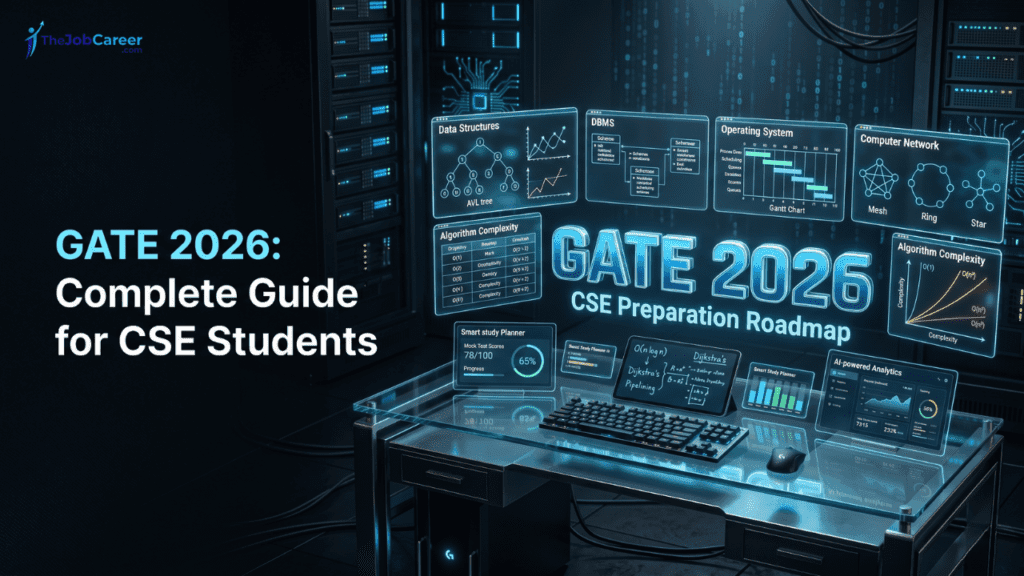

The Graduate Aptitude Test in Engineering, commonly known as GATE, is one of the most prestigious and competitive examinations in India. For Computer Science and Engineering students, cracking GATE 2026 opens doors to two of the most sought-after career paths in the country — admission to M.Tech programmes at IITs and IISc, and direct recruitment into top Public Sector Undertakings (PSUs) with salaries ranging from 10 to 15 lakhs per annum. With GATE 2026 conducted by IIT Guwahati and the result already declared on March 19, 2026, the scorecard you now hold is valid for the next three years — meaning it remains useful until 2028.
Whether you are planning to appear for GATE 2027 or are someone who appeared in GATE 2026 and is evaluating your options, this guide covers everything you need to know. From the detailed CSE syllabus and exam pattern to subject-wise preparation strategy, recommended books, PSU recruitment details, and IIT cutoffs — this is the most comprehensive GATE 2026 CSE resource you will find. The competition is intense, but with the right roadmap and consistent effort, a high GATE score is absolutely achievable.
Every year, lakhs of engineering graduates and final-year students appear for GATE. The CSE paper remains one of the most competitive branches, with candidates vying for limited M.Tech seats at IITs and coveted PSU positions. Understanding the exam inside and out before you begin preparation is not just helpful — it is essential.
What is GATE 2026 and Why Does It Matter for CSE Students
GATE stands for Graduate Aptitude Test in Engineering. It is a national-level examination jointly administered by the seven IITs and IISc Bangalore on a rotational basis. GATE 2026 was conducted by IIT Guwahati, and the official website for GATE 2026 was gate2026.iitg.ac.in.
For CSE students specifically, GATE 2026 unlocks three major pathways. The first is M.Tech admission at IITs, IISc, NITs, IIITs, and other government-funded institutions through COAP (Centralized Offer Acceptance Platform for IITs) and CCMT (Centralized Counselling for M.Tech). The second is PSU recruitment, where companies like NTPC, ONGC, IOCL, BHEL, GAIL, NPCIL, and PGCIL hire engineers directly based on their GATE score. The third is research opportunities at premier institutions, including Ph.D. programmes at IITs and IISc.
GATE scores are valid for three years. A candidate who appeared in GATE 2026 can use their scorecard for admissions and PSU recruitment until 2028. This makes it worthwhile to aim for the highest score possible rather than just clearing the qualifying cutoff.
GATE 2026 CSE Exam Pattern: Everything You Need to Know
Before diving into the syllabus, understanding the exam pattern is the first step in building a smart preparation strategy.
Basic Structure
The GATE 2026 CSE paper consists of 65 questions carrying a total of 100 marks. The duration of the exam is three hours, and the mode is completely computer-based (online). The CSE exam for GATE 2026 was held on February 8, 2026.
Types of Questions
There are three types of questions in the GATE CSE paper.
Multiple Choice Questions (MCQ) are the traditional single-correct-answer format. Each MCQ carries either 1 mark or 2 marks. Negative marking applies: 1/3 mark is deducted for a wrong answer on a 1-mark MCQ, and 2/3 marks are deducted for a wrong 2-mark MCQ.
Multiple Select Questions (MSQ) have more than one correct answer. Candidates must select all correct options. There is no negative marking for MSQ questions, which makes them a strategic opportunity during the exam.
Numerical Answer Type (NAT) questions require candidates to type the exact numerical answer using a virtual keypad. There is no negative marking for NAT questions, making them safer to attempt even when unsure.
Marks Distribution by Section
The 100 marks are divided as follows: General Aptitude contributes 15 marks (15% of the paper), Engineering Mathematics contributes 13 marks (13%), and the remaining 72 marks (72%) come from Core CSE subjects. This distribution makes it clear that while core subjects dominate the paper, General Aptitude and Mathematics together account for 28 marks — enough to make or break a candidate’s rank.
GATE 2026 CSE Qualifying Cutoff
The GATE 2026 CSE qualifying cutoff for the General category was set at 30 marks out of 100, slightly up from 29.2 in 2025. For the OBC and EWS categories, the cutoff was 27 marks, and for SC, ST, and PwD candidates, it was 20 marks. Remember, qualifying the exam is only the first step. The actual competition for IIT seats and PSU jobs requires a significantly higher score.
GATE 2026 CSE Syllabus: Complete Subject-wise Breakdown
The GATE 2026 CSE syllabus comprises 11 sections. IIT Guwahati released the official syllabus PDF on gate2026.iitg.ac.in, and it covers the following areas in detail.
General Aptitude (15 Marks)
General Aptitude is mandatory for all GATE papers and covers two broad areas.
Verbal Ability includes English grammar, sentence completion, word groups, instructions, critical reasoning, and verbal deduction. This section tests language skills and the ability to understand and analyse written text.
Numerical Ability includes numerical computation, numerical estimation, numerical reasoning, and data interpretation. Questions involve basic arithmetic, percentages, ratios, data tables, and graphs.
General Aptitude is considered a scoring section relative to the effort required. Many candidates neglect it in favour of technical subjects — a mistake that can cost valuable marks and rank positions.
Engineering Mathematics (13 Marks)
Discrete Mathematics is the most important topic in Engineering Mathematics for GATE CSE. It includes propositional and first-order logic, sets, relations, functions, partial orders, lattices, graphs, monoids, and groups. Combinatorics and recurrence relations also feature regularly.
Linear Algebra covers systems of linear equations, matrices, determinants, eigenvalues and eigenvectors, and LU decomposition.
Calculus includes limits, continuity, differentiability, maxima and minima, mean value theorem, integration, and sequences and series.
Probability and Statistics covers random variables, uniform, normal, exponential, Poisson and binomial distributions, conditional probability, Bayes’ theorem, mean, median, mode, and standard deviation.
Core CSE Subjects (72 Marks)
Digital Logic covers Boolean algebra, combinational circuits (multiplexers, decoders, adders), sequential circuits (flip-flops, latches, counters, shift registers), Karnaugh maps, and minimization of logical functions. This subject consistently appears with high weightage in GATE CSE papers and should not be underestimated.
Computer Organization and Architecture includes machine instructions and addressing modes, ALU and data path design, CPU control and pipelining, memory hierarchy, cache memory, main memory, secondary storage, and I/O interface. Understanding how a processor works at the architectural level is essential for this section.
Programming and Data Structures is one of the highest-weightage sections. It covers C programming fundamentals, arrays, linked lists, stacks, queues, trees (binary trees, BST, AVL), graphs, and hashing. GATE regularly tests both theoretical understanding and code trace questions in this section.
Algorithms pairs closely with Programming and Data Structures. It covers searching and sorting algorithms, asymptotic complexity analysis using Big-O notation, graph traversal algorithms (BFS and DFS), dynamic programming, greedy algorithms, and divide and conquer. NP-completeness concepts are also part of the syllabus. This section rewards candidates who practise problems consistently rather than memorising theory.
Theory of Computation is a section that many candidates find abstract and challenging. It includes regular expressions and finite automata, context-free grammars and push-down automata, Turing machines, decidability and undecidability, and NP-completeness. Mastering this topic requires patience and a strong conceptual foundation.
Compiler Design covers the phases of compilation: lexical analysis, syntax analysis (LL and LR parsing), semantic analysis, syntax-directed translation, intermediate code generation, and code optimization. Understanding how a compiler works from source code to machine code is the core of this section.
Operating Systems is a high-weightage, practical subject. It covers processes and threads, CPU scheduling algorithms, process synchronization and deadlocks, memory management (paging, segmentation, virtual memory), file system implementation, and disk scheduling. Real-world OS concepts make this section both interesting and important.
Databases covers the ER model and relational model, relational algebra and calculus, SQL queries (including joins, subqueries, and aggregations), functional dependencies and normalization (up to BCNF), transactions and ACID properties, concurrency control, and indexing and B+ trees. SQL-based questions appear frequently and require hands-on practice.
Computer Networks covers the OSI and TCP/IP reference models, application layer protocols (HTTP, FTP, SMTP, DNS, DHCP), transport layer (TCP and UDP, flow control, congestion control), network layer (IP addressing, subnetting, routing algorithms like Dijkstra and Bellman-Ford), and data link layer (MAC protocols, error detection). Networking questions often involve numerical problem-solving on subnetting and routing, so practise extensively.
Subject-wise Weightage and High-Priority Topics for GATE 2026 CSE
Based on previous year analysis and the GATE 2026 CSE paper trend, the following subjects carry the highest weightage and deserve maximum preparation time.
Algorithms and Data Structures together typically account for 15 to 20 marks. Operating Systems usually carries 8 to 10 marks. Computer Networks and Databases each contribute around 7 to 9 marks. Theory of Computation, Compiler Design, and Computer Organization and Architecture each contribute around 6 to 8 marks. Digital Logic and Engineering Mathematics contribute around 5 to 7 marks each. General Aptitude is fixed at 15 marks.
High-priority topics that appear almost every year include: pipelining in COA, CPU scheduling algorithms and deadlock in OS, normalization and SQL in DBMS, parsing techniques in Compiler Design, regular languages and NP-completeness in TOC, and sorting algorithms and dynamic programming in Algorithms.
Recommended Books for GATE 2026 CSE Preparation
Choosing the right study materials is as important as the preparation strategy itself. Here are the most trusted books for each section.
Algorithms: Introduction to Algorithms by Cormen, Leiserson, Rivest, and Stein — commonly called CLRS — is the gold standard for this subject. Algorithm Design by Kleinberg and Tardos is excellent for deeper understanding.
Operating Systems: Operating System Concepts by Abraham Silberschatz and Peter Galvin (commonly called the Galvin book) is the most recommended resource for GATE OS preparation.
Databases: Database System Concepts by Silberschatz, Korth, and Sudarshan covers both theory and SQL practice comprehensively.
Computer Networks: Computer Networks by Andrew Tanenbaum and Data Communications and Networking by Behrouz Forouzan are both widely used for GATE preparation.
Theory of Computation: Introduction to Automata Theory, Languages, and Computation by Hopcroft, Motwani, and Ullman is the definitive reference for this subject.
Compiler Design: Compilers: Principles, Techniques, and Tools by Aho, Lam, Sethi, and Ullman — popularly known as the Dragon Book — is the standard reference.
Digital Logic: Digital Design by Morris Mano is the most recommended book for this section.
Computer Organization and Architecture: Computer Organization by Carl Hamacher and Computer Organization and Architecture by William Stallings are both excellent choices.
Engineering Mathematics: Higher Engineering Mathematics by B.S. Grewal covers all the GATE mathematics topics comprehensively.
General Aptitude: Verbal and Non-Verbal Reasoning by R.S. Aggarwal is widely used for aptitude preparation.
In addition to these books, previous year GATE CSE question papers from the last 10 to 15 years are the single most valuable practice resource. Solving them under timed conditions is non-negotiable.
Step-by-Step GATE 2026 CSE Preparation Strategy
Step 1: Understand the Syllabus and Exam Pattern Thoroughly
Before starting preparation, download the official GATE CSE syllabus PDF from gate2026.iitg.ac.in and read it carefully. Map out which topics fall under which sections and understand the marks distribution. Many candidates waste months on topics that are not in the GATE syllabus. A clear understanding of what is and is not in scope saves enormous time.
Step 2: Assess Your Strengths and Identify Weak Areas
Take one previous year GATE CSE paper without preparation. This diagnostic test reveals which subjects feel familiar and which feel unfamiliar. Prioritise the high-weightage subjects where you are currently weak — addressing those gaps gives you the highest return on time invested.
Step 3: Build Conceptual Foundation Subject by Subject
Study each subject from the recommended standard textbook rather than short notes alone. GATE questions test deep understanding, not surface memorisation. For each subject, study the theory, understand the derivations and proofs, and immediately solve related GATE previous year questions to test your understanding.
Step 4: Practise Previous Year GATE CSE Questions Topic-wise
Once you have completed each topic, solve all GATE previous year questions from that topic. This is not optional — it is the core of GATE preparation. Previous year questions reveal the exact type of problems GATE asks, the depth of understanding required, and the traps to avoid. Many questions repeat with minor variations.
Step 5: Take Regular Full-Length Mock Tests
After completing the syllabus, begin taking full-length mock tests under exam conditions — 3 hours, no breaks, computer-based simulation. Analyse every mock test to identify: which subjects are still weak, where time was wasted, and whether the attempt strategy (which questions to skip and revisit) needs improvement. Most coaching platforms offer high-quality GATE mock tests.
Step 6: Revise, Revise, Revise
The final phase of preparation is revision. Create short notes for every subject covering key formulas, important theorems, and commonly tested concepts. In the last month before the exam, focus entirely on revision and mock tests rather than new topics. Multiple rounds of revision of the core syllabus is far more effective than attempting to cover new material at the last moment.
Step 7: Strategise Your Exam Attempt
On the day of the exam, start with General Aptitude to quickly secure 15 marks. Then move to Engineering Mathematics. Tackle the core subjects in order of your confidence — start with your strongest subjects to build momentum, then return to harder questions. Never spend more than 3 to 4 minutes on any single question during the first pass. Mark uncertain questions for review and return to them in the remaining time.
GATE 2026 Score vs Rank vs Opportunity: What to Target
Understanding the relationship between your GATE score, rank, and the opportunities available is crucial for setting realistic preparation goals.
A GATE score above 800 (out of 1000) for CSE opens doors to M.Tech programmes at old IITs including IIT Bombay, IIT Delhi, IIT Madras, IIT Kharagpur, and IIT Kanpur. IISc Bangalore and the top old IITs typically require GATE scores close to 850 or above for CSE. NITs offer M.Tech CSE admission in the GATE score range of 650 to 850, with top NITs like NIT Trichy, NIT Warangal, and NIT Surathkal requiring scores above 750.
In terms of marks and rank: scoring 75 or more marks typically places you in the top 50 ranks nationally. Scoring 65 to 75 marks corresponds to ranks between 50 and 200. Scoring 55 to 65 marks places you in the rank range of 200 to 1000. For PSU recruitment, target a GATE score of 700 or above for shortlisting at top PSUs.
M.Tech students admitted to IITs through GATE are eligible for the MHRD scholarship of 12,400 rupees per month — a significant financial benefit that makes further studies accessible.
PSU Recruitment Through GATE 2026 for CSE Students
One of the biggest advantages of a strong GATE score for CSE students is PSU recruitment. Public Sector Undertakings hire engineers directly based on their GATE score, without requiring a separate written examination in most cases.
NTPC (National Thermal Power Corporation) hires CSE engineers for IT and digital transformation roles. It is one of the most preferred PSUs with excellent job security and growth.
ONGC (Oil and Natural Gas Corporation) recruits CSE graduates for IT systems management and digital infrastructure roles.
IOCL (Indian Oil Corporation Limited) offers positions to CSE candidates in information technology divisions.
BHEL (Bharat Heavy Electricals Limited) recruits engineers including CSE graduates for IT and automation roles.
GAIL (Gas Authority of India Limited) and NPCIL (Nuclear Power Corporation of India Limited) also hire CSE graduates through GATE scores.
PGCIL (Power Grid Corporation of India Limited) recruits for IT and communication roles.
The starting salary at top PSUs for CSE engineers ranges from 50,000 to 80,000 rupees per month gross, which translates to approximately 10 to 15 lakhs per annum CTC. When allowances such as HRA (House Rent Allowance), medical benefits for the entire family, Leave Travel Concession (LTC), gratuity, and provident fund contributions are included, the total compensation is significantly higher. PSU jobs also offer a 5-day work week, fixed working hours, a clear promotion structure from E1 to E9 grades, and the social prestige of working with national-level companies.
For top PSU shortlisting in CSE, target a GATE score of 700 or above. The exact cutoff varies by PSU, year, and number of vacancies. PSU recruitment notifications are released throughout 2026 following the GATE result. Keep checking the official websites of individual PSUs for recruitment notifications.
Coaching Institutes and Online Resources for GATE CSE
Several reputed coaching platforms offer GATE CSE preparation resources.
Made Easy is one of the most established GATE coaching institutes in India, offering both classroom and online programmes for CSE.
GATE Academy offers comprehensive online and offline study materials specifically designed for GATE CSE preparation.
Unacademy GATE offers live classes, recorded lectures, and mock tests from experienced GATE educators.
Beyond paid coaching, free resources on YouTube — including channels dedicated to GATE CSE subjects — and platforms like GeeksforGeeks for data structures and algorithms, are extremely valuable supplements.
Common Mistakes to Avoid in GATE CSE Preparation
Many capable students underperform in GATE due to avoidable preparation mistakes. Here are the most common ones.
Ignoring General Aptitude is perhaps the most frequent error. At 15 marks, General Aptitude is a significant portion of the paper and is relatively easier to score compared to core subjects. Neglecting it for technical preparation is a poor trade-off.
Starting with short notes instead of standard textbooks leads to weak conceptual foundations. GATE questions often require deep understanding, and without reading from primary sources, candidates struggle with questions that go even slightly beyond standard patterns.
Not practising previous year papers is another critical mistake. Previous year GATE CSE questions are the single best indicator of what the exam tests. Skipping them in favour of generic competitive exam practice is counterproductive.
Avoiding NAT and MSQ questions out of fear is a poor strategy. Since there is no negative marking for NAT and MSQ, these should always be attempted rather than left blank.
Poor time management during the actual exam causes many well-prepared candidates to lose marks. Not practising mock tests under timed conditions leads to poor speed and sequence planning on exam day.
Trying to cover new topics in the last few weeks before the exam is ineffective. Revision of familiar material is far more beneficial than introducing new content when the exam is approaching.
After GATE 2026: What Are Your Options
Once you have your GATE 2026 scorecard (valid until 2028), the immediate next steps depend on your score.
If your score qualifies for IIT M.Tech admission, register for COAP (Centralized Offer Acceptance Platform) to apply to IITs. For NITs and other CFTIs, register for CCMT (Centralized Counselling for M.Tech). Deadlines for these processes are typically released in March and April, shortly after the GATE result.
If your score qualifies for PSU recruitment, watch for official recruitment notifications from individual PSUs on their websites. Each PSU has its own timeline, application process, and shortlisting rule based on GATE score.
If your score is lower than expected, your GATE scorecard remains valid for three years. Use this time to prepare more thoroughly and attempt GATE 2027 or 2028 with a better strategy.
Conclusion
GATE 2026 for CSE is not just an examination — it is a gateway to some of the most prestigious academic and career opportunities available to engineering graduates in India. A high GATE score can earn you a seat in an IIT M.Tech programme, a scholarship of 12,400 rupees per month, and the foundation for a research or academic career. Alternatively, it can place you in a secure, well-paying PSU job with excellent long-term benefits and social prestige.
The syllabus is vast but structured. The 11 sections of the GATE CSE paper — from Digital Logic and Algorithms to Databases and Computer Networks — are subjects you have already studied during your B.Tech. GATE preparation is essentially about revisiting these subjects with greater depth, precision, and problem-solving practice than your regular university curriculum demanded.
The key to success lies in three things: studying the right material from standard textbooks, solving previous year GATE questions religiously, and taking full-length mock tests to build exam-day readiness. No shortcut replaces these three pillars of preparation.
Start early, stay consistent, and remember that even a single year of disciplined preparation can change the trajectory of your professional life. Whether you are targeting IIT M.Tech, IISc research, or a PSU career, GATE 2026 or GATE 2027 is your opportunity to take that leap. Prepare with purpose, and your GATE score will reflect the effort you invest.
Disclaimer: This article is for informational purposes only. Exam schedules, cutoffs, and PSU recruitment details may change. Always verify information from official sources including gate2026.iitg.ac.in and individual PSU websites.
About TheJobCareer: We provide comprehensive career guidance, job notifications, and exam preparation resources for students and professionals across India. Subscribe to our newsletter for regular updates on GATE, government jobs, and career opportunities.
Related Articles:
- IIT JEE Advanced 2026: Complete Preparation Guide from Basics to IIT Selection
- Data Science Career in India 2026: Salary, Skills and How to Start
- Cybersecurity Career in India 2026: Salary, Skills and How to Start
- IT Jobs for Freshers 2026: Which Companies Hire Without Experience
- IT Jobs for Freshers 2026: Software Developer, Testing, and Support Roles – Complete Career Guide
- Government Jobs After B.Sc 2026: Science Graduates Complete Guide
- UPSC CSE 2026: Beginner’s Complete Roadmap (Zero to Selection)
- CAT 2026: Complete MBA Entrance Preparation Roadmap
- Top 10 High-Paying Jobs in India in 2026 (With Salary Breakdown)
- How to Choose the Right Career Path After 12th: Complete Guide for Science, Commerce, Arts Students
- Resume Tips for Freshers: How to Create a Job-Winning Resume in 2025
- How to Prepare for Interviews – Complete Step-by-Step Guide
Job Search Resources:
- April 2026 Job Calendar: Government & Private Openings with Application Dates
- March 2026 Job Calendar: 100+ Government & Private Openings with Application Dates
- Latest Jobs February 2026: Top Government and Private Sector Vacancies This Month
- How to Use Job Portals Effectively: Naukri, LinkedIn & Indeed Strategy (2026 Complete Master Guide)
- 7 Common Jobs Frauds in India (Complete Awareness Guide 2025)
Official GATE 2026 Resources:
- GATE 2026 Official Website (IIT Guwahati): https://gate2026.iitg.ac.in
- COAP 2026 — Common Offer Acceptance Portal for IIT/IISc M.Tech & PSU Offers (coordinated by IIT Roorkee this cycle): https://coap2026.iitr.ac.in/coap2026/
- CCMT 2026 — Centralized Counselling for M.Tech Admission to NITs, IIITs, CFTIs (coordinated by NIT Agartala this cycle): https://ccmt.admissions.nic.in/
- GeeksforGeeks (DSA and CS fundamentals practice): https://www.geeksforgeeks.org