
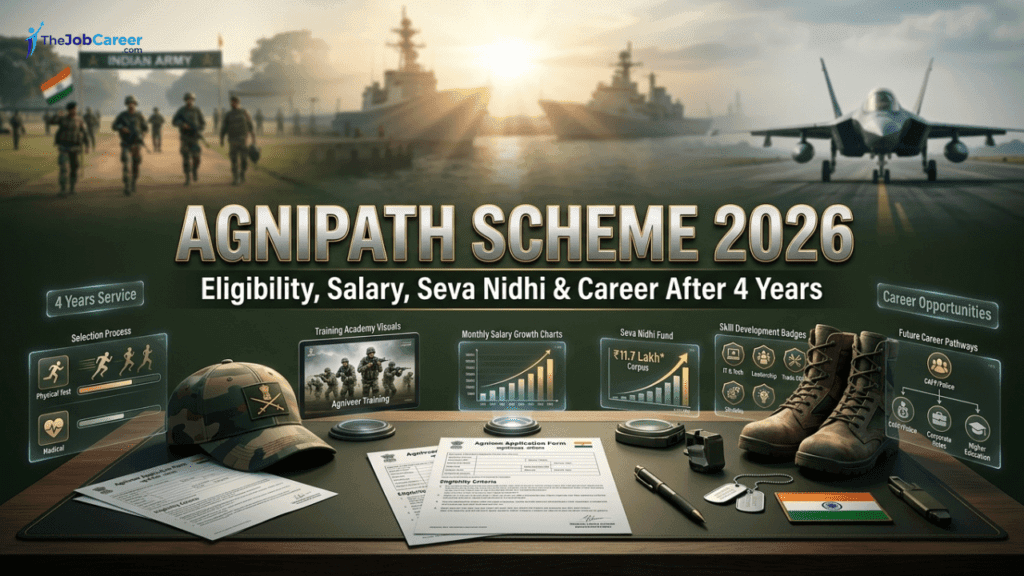

In June 2022, the Government of India launched one of the most debated and consequential defence policy reforms in recent Indian history — the Agnipath Scheme. Under this scheme, young Indians between the ages of 17.5 and 21 years are recruited into the Indian Army, Indian Navy, and Indian Air Force for a fixed 4-year service period as “Agniveers.” After four years, up to 25% are selected for permanent service in the armed forces, while the remaining 75% exit with a tax-free lump sum of Rs. 11.71 lakh called the Seva Nidhi, a skill certificate, and a growing list of government-backed career opportunities in police, paramilitary, and private sector employment.
Four years since its launch, the Agnipath Scheme has moved from controversy to reality. The first batch of Agniveers — recruited in 2022 — is completing its 4-year tenure in 2026, and the government machinery is actively preparing their rehabilitation through CAPF reservations, state police quotas, and corporate partnerships with companies like Tata, Mahindra, and Reliance. Meanwhile, new batches continue to be recruited every year across all three services. For lakhs of young Indians who dream of wearing the uniform, serving the nation, and building a strong career foundation — Agnipath is no longer a controversy. It is a live, operational recruitment programme with real outcomes and real career paths.
This complete guide explains the Agnipath Scheme from the ground up — what it is, how it works, exact eligibility criteria for Army/Navy/Air Force, the year-wise salary structure, the Seva Nidhi calculation, insurance coverage, physical standards, the selection process, and most importantly — what happens after 4 years. Whether you are considering applying, or you want to understand the scheme for someone at home, this is the only guide you need.
What Is the Agnipath Scheme? — The Core Idea
The Agnipath Scheme (also called Agnipath Yojana) is India’s short-service military recruitment programme launched on June 14, 2022 by the Ministry of Defence. It replaces the earlier system of permanent recruitment for soldier-level posts with a 4-year contract service model.
| Parameter | Details |
|---|---|
| Scheme Name | Agnipath Yojana (Agniveer Scheme) |
| Launched By | Ministry of Defence, Government of India |
| Launch Date | June 14, 2022 |
| Recruits Called | Agniveers (अग्निवीर) |
| Service Duration | 4 years (including training) |
| Forces Covered | Indian Army, Indian Navy, Indian Air Force |
| Recruitment Basis | All India, All Class (no caste/region restriction) |
| Permanent Retention | Up to 25% of each batch after 4 years |
| Exit Package | Rs. 11.71 lakh tax-free Seva Nidhi (for 75% who exit) |
| Official Portals | joinindianarmy.nic.in / joinindiannavy.gov.in / indianairforce.nic.in |
Why Was Agnipath Launched? — The Government’s Rationale
The Indian Armed Forces had three structural challenges the government aimed to address:
1. Ageing military profile: The average age of an Indian soldier was around 32 years — significantly higher than global standards. With fast-evolving warfare technology, a younger force is more adaptable and operationally agile.
2. Ballooning pension burden: India’s defence pension bill was consuming nearly Rs. 1.33 lakh crore of the annual defence budget — money that could otherwise fund equipment, technology, and infrastructure. A short-service model reduces long-term pension liability significantly.
3. Channelling youth energy: India has one of the world’s largest youth populations. A 4-year military service gives young people discipline, technical skills, physical fitness, and a sense of national purpose — skills that benefit both the individual and civil society post-service.
Agnipath Scheme: How It Works — The 4-Year Cycle
Understanding the lifecycle of an Agniveer is essential before evaluating whether the scheme is right for you.
| Phase | Duration | What Happens |
|---|---|---|
| Training Period | 6 months (included in 4 years) | Basic military training, physical conditioning, weapons familiarisation, technical skills |
| Active Service | 3.5 years | Deployed in units, formations, ships, or air bases — full active military duty |
| Performance Evaluation | Throughout 4 years | Performance records maintained — basis for 25% permanent retention |
| End of 4 Years — Decision Point | Month 48 | Up to 25% are offered permanent enrolment; 75% are released |
| For 25% Retained | 15+ years minimum service | Continue as regular soldiers with full salary, pension, promotion |
| For 75% Released | Exit with Seva Nidhi | Rs. 11.71 lakh tax-free + skill certificate + career support |
The 25% Permanent Retention — How Are They Selected?
Selection for permanent enrolment after the 4-year tenure is based on:
- Overall performance rating throughout service
- Medical fitness at end of tenure
- Disciplinary record — zero serious violations
- Organisational requirement — vacancies available in the respective regiment/unit
- Voluntary application — the Agniveer must apply for permanent service
Being selected in the 25% is not guaranteed — it is merit-based and competitive. However, serving well, maintaining physical fitness, demonstrating leadership, and building a clean record throughout the 4 years significantly improves retention chances.
Agnipath Eligibility 2026: Army, Navy, and Air Force
Eligibility criteria vary by force and by the specific role or category within each force. Here is the complete breakdown:
Age Limit
| Category | Age Limit |
|---|---|
| Standard (All Forces) | 17.5 years to 21 years |
| Extended (Early batches — 2022 batch) | Up to 23 years (one-time relaxation for first batches) |
| Age Calculation | As on date of enrolment (not application date) |
Important note for 2026: The standard age limit is 17.5 to 21 years for all new recruitment cycles. The extended age of 23 years was a one-time relaxation given only to the very first batches recruited in 2022–23. New applicants must be within 17.5–21 years.
Indian Army — Eligibility by Category
| Category | Education Required | Key Subjects | Other Requirements |
|---|---|---|---|
| Agniveer General Duty (GD) | Class 10 pass — minimum 45% overall and 33% per subject | Any | Most popular category — highest vacancies |
| Agniveer Technical | Class 12 pass — Physics, Chemistry, Maths, English — min 50% overall and 40% per subject | Science (PCM) | Technical trade roles |
| Agniveer Clerk / SKT | Class 12 pass — any stream — min 60% overall and 50% per subject; English and Maths mandatory | Any (12th must have English + Maths) | Office and administrative roles |
| Agniveer Tradesman (10th) | Class 10 pass — min 33% | Any | Trades: Cook, Washerman, Gardener, Safai Karamchari |
| Agniveer Tradesman (8th) | Class 8 pass | Any | Very limited trades |
Indian Navy — Eligibility by Category
| Category | Education Required | Subjects | Role |
|---|---|---|---|
| Agniveer SSR (Senior Secondary Recruit) | Class 12 pass with Physics and Maths — min 50% aggregate | Science (PCM) | Technical — engine room, electrical, weapons |
| Agniveer MR (Matric Recruit) | Class 10 pass — min 33% | Any | Service roles — cook, steward, hygienist |
Indian Air Force — Eligibility by Category
| Category | Education Required | Subjects | Marks Required |
|---|---|---|---|
| Agniveer Vayu — Science Subjects | Class 12 pass with Physics and Maths | PCM | Min 50% aggregate + 50% in English |
| Agniveer Vayu — Other Subjects | Class 12 pass without PCM | Any stream | Min 50% aggregate + 50% in English |
| Agniveer Vayu — Vocational | Class 12 with vocational trades approved by NSQF | Vocational | Min 50% aggregate + 50% in English |
Common Eligibility Across All Forces
| Requirement | Details |
|---|---|
| Nationality | Indian citizen (and eligible categories per GoI norms) |
| Gender | Male and Female both eligible (female vacancies are announced periodically by each service) |
| Marital Status | Must be unmarried at time of enrolment. Cannot marry during first year of service. |
| Medical Fitness | Must be medically fit as per Defence Services medical standards |
| Physical Standards | As per category and service (detailed below) |
Physical Standards: Army, Navy, Air Force
Indian Army Physical Standards
| Parameter | Standard (General Duty — Male) |
|---|---|
| Height | Minimum 170 cm (varies by region — e.g., Gorkha: 157 cm, NE candidates: lower) |
| Weight | Proportionate to height (BMI-based) |
| Chest | Minimum 77 cm (unexpanded) with 5 cm expansion |
| Running (1.6 km) | Under 5 minutes 30 seconds (Group I — full marks); Under 5 minutes 45 seconds (Group II — partial marks) |
| Pull-ups (Beam) | 10 pull-ups = full marks; minimum 6 pull-ups to qualify |
| Balance | 9-foot balance beam — qualifying |
| Zig-Zag Run | Qualifying |
Female candidates (Army): Height minimum 152 cm; 1.6 km run in under 7 minutes 30 seconds; push-ups replacing pull-ups.
Indian Navy Physical Standards (Male)
| Parameter | SSR | MR |
|---|---|---|
| Height | 157 cm minimum | 157 cm minimum |
| Weight | Proportionate (BMI within range) | Proportionate |
| Chest | 5 cm expansion required | 5 cm expansion required |
| Running (1.6 km) | 7 minutes | 7 minutes |
| Vision | 6/6 (correctable) for certain trades | Standard |
Indian Air Force Physical Standards (Male — Agniveer Vayu)
| Parameter | Standard |
|---|---|
| Height | Minimum 152.5 cm |
| Weight | Proportionate to height |
| Chest | Well-proportioned |
| Running (1.6 km) | Under 6 minutes 30 seconds |
| Vision | 6/6 in better eye, 6/9 in worse eye (correctable for some categories) |
| Additional | Cognitive ability test, adaptability test unique to Air Force |
Agnipath Scheme: Selection Process (Step by Step)
The selection process is different for each service but follows a common framework:
| Stage | Details | All Three Services |
|---|---|---|
| Stage 1: Online Registration | Apply on official portal — Army, Navy, or Air Force | Separately for each service |
| Stage 2: Written Exam (CEE) | Common Entrance Exam — objective type, category-specific syllabus | Yes |
| Stage 3: Physical Fitness Test (PFT) | Running, pull-ups/push-ups, balance, zig-zag run | Yes |
| Stage 4: Physical Measurement Test (PMT) | Height, weight, chest measurement verification | Yes |
| Stage 5: Medical Examination | Defence medical board — vision, hearing, general health, dental | Yes |
| Stage 6: Document Verification | Educational certificates, domicile, birth proof | Yes |
| Stage 7: Merit List and Enrolment | Final merit list based on CEE + PFT performance | Yes |
Air Force Additional Stages
The Indian Air Force has two additional stages not required by Army or Navy:
| Additional Stage | What It Tests |
|---|---|
| Cognitive Ability Test | Spatial reasoning, attention, memory, pattern recognition |
| Adaptability Test | Emotional stability, decision-making under pressure, stress tolerance |
These are unique to IAF and reflect the higher cognitive demands of aviation-related roles.
Written Exam (CEE) — Subject-wise Pattern
| Force | Subjects Tested | Total Marks |
|---|---|---|
| Army GD | General Knowledge, General Science, Maths, Reasoning | 100 marks |
| Army Technical | Physics, Chemistry, Maths, English | 100 marks |
| Army Clerk/SKT | General Knowledge, General English, Numerical Ability, Computer Knowledge | 100 marks |
| Navy SSR | English, Science (Physics, Chemistry), Maths, General Awareness | 100 marks |
| Navy MR | Science and Maths (Class 10 level), General Awareness | 50 marks |
| Air Force Vayu | English, Physics, Maths, Reasoning, General Awareness | 70 marks |
Agniveer Salary 2026: Complete Year-wise Breakdown
This is the section most aspirants search for — and also the most misunderstood. The “salary” of an Agniveer has two components: the monthly package (gross amount) and the in-hand amount (after Seva Nidhi deduction). Understanding both is important.
Year-wise Monthly Package and In-Hand Salary
| Year | Monthly Package (Gross) | Seva Nidhi Deduction (30%) | In-Hand Salary (70%) |
|---|---|---|---|
| Year 1 | Rs. 30,000 | Rs. 9,000 | Rs. 21,000 |
| Year 2 | Rs. 33,000 | Rs. 9,900 | Rs. 23,100 |
| Year 3 | Rs. 36,500 | Rs. 10,950 | Rs. 25,550 |
| Year 4 | Rs. 40,000 | Rs. 12,000 | Rs. 28,000 |
Understanding the deduction: The 30% deducted every month is not lost. It is saved in the Seva Nidhi fund on your behalf. The government adds an equal matching contribution every month. At the end of 4 years, the entire accumulated amount (your contributions + government’s equal contribution + interest on both) is paid to you as the Seva Nidhi lump sum — tax-free.
Annual Earnings Over 4 Years
| Year | Annual In-Hand | Annual Package (Gross) |
|---|---|---|
| Year 1 | Rs. 2,52,000 | Rs. 3,60,000 |
| Year 2 | Rs. 2,77,200 | Rs. 3,96,000 |
| Year 3 | Rs. 3,06,600 | Rs. 4,38,000 |
| Year 4 | Rs. 3,36,000 | Rs. 4,80,000 |
| Total (4 years) | Rs. 11,71,800 | Rs. 16,74,000 |
Total take-home money over 4 years: In-hand salary over 4 years (Rs. 11.71 lakh) + Seva Nidhi at exit (Rs. 11.71 lakh) = approximately Rs. 23.5 lakh over 4 years — with zero living expenses (food, accommodation, medical, clothing all provided free).
Compare this with a fresh graduate working a private security or entry-level job at Rs. 8,000–12,000 per month with full living expenses: net savings over 4 years would be negligible. An Agniveer with no living expenses and Rs. 21,000–28,000 in-hand monthly is in a significantly stronger financial position.
Additional Allowances
Beyond the monthly package, Agniveers receive:
| Allowance | Details |
|---|---|
| Risk and Hardship Allowance | For postings in field areas, high-altitude locations, counter-insurgency zones — Rs. 900 to Rs. 5,300 per month depending on area |
| Ration (Food) | Free — mess food provided at no cost |
| Accommodation | Free — barracks/quarters provided |
| Clothing and Uniform | Free — full uniform kit provided |
| Medical | Free — comprehensive medical care for self (not family during Agniveer tenure) |
| Travel Allowance | For authorised travel — home leave journeys |
Seva Nidhi: How Rs. 11.71 Lakh Is Calculated
The Seva Nidhi is the most important financial component of the Agnipath Scheme. Here is the exact calculation:
Seva Nidhi Corpus Buildup (Month by Month, Year by Year)
| Year | Agniveer Monthly Contribution | Govt. Matching Contribution | Cumulative Corpus (Before Interest) |
|---|---|---|---|
| Year 1 | Rs. 9,000 × 12 = Rs. 1,08,000 | Rs. 1,08,000 | Rs. 2,16,000 |
| Year 2 | Rs. 9,900 × 12 = Rs. 1,18,800 | Rs. 1,18,800 | Rs. 4,68,000 (approx. with interest) |
| Year 3 | Rs. 10,950 × 12 = Rs. 1,31,400 | Rs. 1,31,400 | Rs. 7,62,000 (approx. with interest) |
| Year 4 | Rs. 12,000 × 12 = Rs. 1,44,000 | Rs. 1,44,000 | Rs. 11,71,000 (with interest) |
| Total at Exit | ~Rs. 5.02 lakh (Agniveer’s share) | ~Rs. 5.02 lakh (Govt share) | Rs. 11.71 lakh (with interest) ✅ |
Key facts about Seva Nidhi:
- The full Rs. 11.71 lakh is completely tax-free under the Income Tax Act
- Paid as a lump sum on completion of 4 years
- If an Agniveer is dismissed from service or leaves before completing 4 years due to disciplinary reasons, they forfeit the government’s matching contribution and receive only their own contribution with interest
- If an Agniveer is medically discharged due to disability sustained in service, the government pays the full Seva Nidhi regardless of how many years were completed
- The 25% who are retained permanently do not receive the Seva Nidhi — they instead transition to the regular army pay scale, pension, and gratuity system
Seva Nidhi vs Regular Job Savings — A Real Comparison
| Scenario | 4-Year Total Savings |
|---|---|
| Agniveer (Rs. 21K–28K in-hand, zero living expenses) | Rs. 11.71 lakh (in-hand savings) + Rs. 11.71 lakh (Seva Nidhi) = ~Rs. 23.5 lakh |
| Private job (Rs. 15K salary, Rs. 8K expenses) | Rs. 7K × 48 months = Rs. 3.36 lakh savings |
| Fresh graduate (Rs. 20K salary, Rs. 12K expenses in city) | Rs. 8K × 48 months = Rs. 3.84 lakh savings |
The financial case for Agnipath is significantly stronger than most entry-level civilian jobs for candidates who qualify for the scheme.
Insurance and Compensation — What Happens in Case of Injury or Death
The government provides comprehensive insurance and compensation coverage for all Agniveers — a critically important aspect that is often overlooked in public discussions of the scheme.
| Situation | Compensation |
|---|---|
| Life insurance cover (in service) | Rs. 48 lakh (non-contributory — Agniveer pays nothing) |
| Death in service (non-battle) | Rs. 48 lakh insurance + remaining Seva Nidhi (Agniveer’s contribution + Govt. contribution) paid to family |
| Death in battle (killed in action) | Rs. 1 crore ex-gratia compensation to family + full Seva Nidhi to family + remaining service package to family |
| Disability due to battle injury (100%) | Rs. 44 lakh disability compensation + full Seva Nidhi |
| Disability due to battle injury (75–99%) | Rs. 25 lakh disability compensation + full Seva Nidhi |
| Disability due to non-battle injury | Medical discharge + proportionate compensation + Seva Nidhi |
| Disability that renders unfit for service | Full Seva Nidhi regardless of years completed |
Gallantry Awards: Agniveers are eligible for all gallantry awards — Param Vir Chakra, Vir Chakra, Shaurya Chakra — on the same basis as regular soldiers. Service to the nation is recognised equally regardless of permanent vs. short-service status.
After 4 Years: What Happens to the 75% Who Exit?
This is the question that defines whether Agnipath is genuinely beneficial — and the answer has become significantly stronger since the scheme’s 2022 launch.
Path 1: Government Employment Reservations
The most significant post-service benefit for ex-Agniveers is reservation across multiple government job categories:
| Organisation / Force | Reservation for Ex-Agniveers | Physical Test Exemption? | Age Relaxation |
|---|---|---|---|
| CAPFs (BSF, CRPF, CISF, ITBP, SSB) | 10% of Group C vacancies | ✅ Exempt from PET/PST | 3 years (5 years for first batch) |
| Assam Rifles | 10% vacancies | ✅ Exempt from PET/PST | 3 years |
| Delhi Police Constable | 20% vacancies | ✅ Exempt from PET | 3 years (5 years for first batch) |
| Uttar Pradesh Police | 20% vacancies (PAC, Constable) | ✅ Exempt from PET | As per state notification |
| Madhya Pradesh Police | Priority consideration | Subject to state rules | 3 years |
| Haryana Police | Priority consideration | Subject to state rules | 3 years |
| Rajasthan Police | Priority consideration | Subject to state rules | 3 years |
| Karnataka Police | Priority consideration | Subject to state rules | 3 years |
| Indian Coast Guard | Priority in recruitment | Expedited processing | 3 years |
| Railway Protection Force (RPF) | Reservation announced | Subject to notification | 3 years |
What “exempt from PET/PST” means: In most government paramilitary and police recruitment, the Physical Efficiency Test (running, pull-ups, long jump) eliminates 40–60% of candidates. Ex-Agniveers skip this stage entirely — already having proven military-grade physical fitness. This is one of the most valuable competitive advantages an ex-Agniveer has over civilian applicants.
Path 2: Higher Education
The government has facilitated multiple education pathways for ex-Agniveers:
| Education Opportunity | Details |
|---|---|
| Class 12 equivalency | Agniveer service counts as equivalent qualification for those who joined with Class 10 — enables higher education access |
| IGNOU dedicated programme | Indira Gandhi National Open University offers special degree programmes designed for ex-Agniveers |
| NCC Certificate equivalency | Agniveer service recognised equivalent to NCC ‘C’ Certificate for education and job purposes |
| Skill certificates | All Agniveers receive NSQF (National Skills Qualification Framework) recognised skill certificates for the technical training received during service |
| Priority in government skill institutes | ITI, polytechnics, and skill development centres give priority admission to ex-Agniveers |
Path 3: Private Sector Employment
Several major Indian corporations have announced preferential hiring policies for ex-Agniveers:
| Company / Sector | What Is Offered |
|---|---|
| Tata Group | Preferential hiring across manufacturing, logistics, security |
| Mahindra Group | Fast-track hiring in auto, farm equipment, logistics |
| Reliance Industries | Priority hiring in retail, security, logistics |
| Private Security Sector | Ex-Agniveers are highly valued — military training is a premium qualification; salaries 30–50% higher than non-military candidates |
| Banking Sector | Several banks have expressed interest in ex-Agniveer recruitment for security and operations roles |
| Corporate Security | Manufacturing plants, IT campuses, hospitality sector actively prefer ex-military for security supervisory roles |
An honest assessment: The private sector opportunities depend heavily on which industry and city you target. Ex-Agniveers with technical trades (Army Technical, Navy SSR, Air Force Vayu Science) have significantly stronger private sector prospects than those with non-technical backgrounds.
Path 4: Entrepreneurship
| Support Mechanism | Details |
|---|---|
| Priority in Mudra Yojana loans | Collateral-free business loans under PM Mudra Yojana — ex-Agniveers get priority processing |
| Startup India benefits | Ex-Agniveer entrepreneurs eligible for Startup India schemes |
| Bank loan priority | Many nationalised banks have been instructed to give priority to ex-Agniveer loan applications |
| Skill Development Courses | Government-funded skill development courses through PMKVY for post-service skilling |
Agnipath Scheme: Force-wise Comparison
| Factor | Indian Army | Indian Navy | Indian Air Force |
|---|---|---|---|
| Minimum Education | Class 10 (GD) / Class 12 (Technical/Clerk) | Class 10 (MR) / Class 12 PCM (SSR) | Class 12 with PCM |
| Monthly Package | Rs. 30,000 – 40,000 | Rs. 30,000 – 40,000 | Rs. 30,000 – 40,000 |
| In-Hand | Rs. 21,000 – 28,000 | Rs. 21,000 – 28,000 | Rs. 21,000 – 28,000 |
| Seva Nidhi | Rs. 11.71 lakh | Rs. 10.04 – 11.71 lakh | Rs. 11.71 lakh |
| Insurance | Rs. 48 lakh | Rs. 48 lakh | Rs. 48 lakh |
| Additional Tests | None beyond standard | None beyond standard | Cognitive + Adaptability Test |
| Service Nature | Ground operations, border duty | Sea-based, ship operations | Aviation support, air base operations |
| Training Period | 6 months (Kel Center) | 6 months (INS Chilika / INS Valsura) | 6 months (Bhopal AFTS) |
| Technical Opportunities | Moderate | High (SSR roles) | Highest — aviation, radar, electronics |
| Physical Demands | Very High | High | High |
| Best For | Ground combat + discipline | Technical + sea life | Technical + aviation + premium training |
Common Questions About Agnipath Scheme — Honest Answers
Is Agnipath a Good Career Decision?
Yes — with clear understanding of what it is and is not.
Agnipath is ideal for you if:
✅ You want to serve in the armed forces and gain the experience of military life ✅ You are between 17.5 and 21 years old and meet physical and educational requirements ✅ You want structured discipline, physical fitness, and life skills that no civilian job provides ✅ You want to build a strong foundation for government employment in CAPF or police after 4 years ✅ You want to save Rs. 11+ lakh in 4 years with zero living expenses, which is near impossible in civilian jobs at the same age ✅ You genuinely aspire to be in the 25% retained permanently in the armed forces
Agnipath may not be the right choice if:
❌ You want a permanent government job with pension from day one — in that case, SSC GD Constable, CRPF, or BSF direct recruitment may suit you better ❌ You are older than 21 and do not qualify for the age limit ❌ You have significant family financial obligations that require immediate stable income — in-hand Rs. 21,000 in Year 1 may not suffice
Previous Year Agniveer Recruitment — Vacancy Trends
| Year | Army Agniveer Vacancies | Navy Agniveer Vacancies | Air Force Agniveer Vacancies | Total |
|---|---|---|---|---|
| 2022 (First Batch) | ~25,000 | ~3,000 | ~3,500 | ~30,000 |
| 2023 | ~40,000 | ~2,800 | ~3,000 | ~45,000 |
| 2024 | ~25,000 | ~2,500 | ~2,500 | ~30,000 |
| 2025 | ~20,000+ | ~2,800 | ~3,000+ | ~25,000+ |
| 2026 (Expected) | ~20,000 – 30,000 | ~2,500 – 3,500 | ~2,500 – 3,500 | ~25,000 – 37,000 |
Recruitment notifications are released by each service separately throughout the year. Always monitor the official portals for the latest notification.
How to Apply for Agniveer — Step by Step
Application is done separately for each service. You cannot apply to all three with a single form. Choose your preferred service and apply accordingly.
Step 1: Choose Your Service and Category
Decide whether you want to apply for Army, Navy, or Air Force — and which category within that service (GD, Technical, SSR, MR, Vayu, etc.). This determines the education requirement, physical standards, and written exam syllabus.
Step 2: Register on Official Portal
| Service | Official Application Portal |
|---|---|
| Indian Army | joinindianarmy.nic.in |
| Indian Navy | joinindiannavy.gov.in |
| Indian Air Force | indianairforce.nic.in/agniveer |
Create a profile with your personal details, educational details, and upload photo + signature.
Step 3: Check Rally / Online Exam Schedule
Army Agniveer recruitment is conducted through Recruitment Rallies — physical events held city-wise where candidates appear for physical tests. Navy and Air Force use an online written exam first, followed by physical testing.
Check the official notification for rally schedules (Army) or exam dates (Navy/Air Force) near your district.
Step 4: Prepare for Written Exam and Physical Tests
Start physical preparation immediately — 1.6 km running, pull-ups, and physical fitness are assessed on the day of the rally or PFT stage. Many candidates who clear the written exam fail at the physical stage due to insufficient fitness preparation.
Step 5: Document Preparation
Keep these documents ready:
✅ Class 10 / Class 12 mark sheet and certificate (as applicable to your category) ✅ Date of birth certificate (Class 10 board certificate) ✅ Domicile/residence certificate ✅ Caste certificate (SC/ST/OBC — if applicable) ✅ Aadhaar Card ✅ PAN Card (for salary and Seva Nidhi records) ✅ Bank account details (for salary transfer) ✅ Recent passport-size photographs (white background) ✅ Medical fitness certificate (from authorised govt. hospital — if asked)
Agnipath Scheme 2026: Current Status
| Update | Status |
|---|---|
| First batch of Agniveers (2022 batch) | ✅ Completing 4-year tenure in 2026 — retention selection in progress |
| 25% permanent retention (2022 batch) | 🔄 Process underway — retained Agniveers transitioning to regular service |
| 75% exit (2022 batch) | 🔄 Seva Nidhi disbursement and career transition support being provided |
| CAPF reservation (10%) | ✅ Active — BSF, CRPF, CISF, ITBP, SSB all notified |
| Delhi Police 20% reservation | ✅ Notified — March 29, 2026 |
| UP Police 20% reservation | ✅ Announced — active |
| MHA portal for ex-Agniveer career | 🔄 Under development |
| New Agniveer recruitment (2026 batch) | 🔄 Notifications expected — check official portals |
| Scheme duration extension (4 to 6–8 yrs) | ⚠️ Discussed but not officially confirmed — verify on mod.gov.in |
Frequently Asked Questions
Q1. Can girls apply for Agnipath?
Yes. Female candidates are eligible to apply for Agniveer posts in all three services — Army, Navy, and Air Force. However, vacancies for female Agniveers are announced separately and are not available in every recruitment cycle. When announced, female candidates apply through the same portals with slightly different physical standards (height minimum 152 cm, different running time requirements).
Q2. What is the difference between Agnipath and NDA?
NDA (National Defence Academy) is an entry route to become an officer in the armed forces — you join as a commissioned officer after the NDA course and training. Agnipath recruits you as a soldier/sailor/airman (non-officer rank). NDA requires clearing the UPSC-conducted NDA exam and is open to Class 12 students. Agnipath is a separate recruitment process for soldier-level posts.
Q3. Does the Seva Nidhi count as income? Will I pay tax on it?
No. The Seva Nidhi package received on completion of 4 years is fully exempted from income tax under the Income Tax Act, 1961, as specifically notified by the government at the time of the scheme’s launch. You receive the full Rs. 11.71 lakh without any tax deduction.
Q4. If I am selected in the 25% permanent retention, do I also get the Seva Nidhi?
No. Agniveers selected for permanent enrolment do not receive the Seva Nidhi. Instead, they transition to the regular armed forces pay scale, receive the same salary, allowances, pension, and gratuity as any regular soldier who joined before the Agnipath Scheme. The Seva Nidhi is specifically the exit package for those completing 4 years and leaving service.
Q5. Can an Agniveer apply for UPSC/SSC exams while in service?
Applying for external government exams while serving as an Agniveer is generally subject to the service’s leave and administrative rules. In practice, Agniveers have limited time for external exam preparation given the nature of military service. Most planning to pursue government jobs after service prepare during their notice period or after exit.
Q6. What happens if an Agniveer is injured during training or active duty?
If an Agniveer is injured (non-battle injury during training) and declared unfit for service, they receive medical discharge with a disability compensation and the full Seva Nidhi regardless of how many years they served. If the injury is battle-related (killed or disabled in action), the compensation is significantly higher — up to Rs. 1 crore for killed in action and Rs. 44 lakh for 100% battle disability.
Q7. Is Agnipath permanent or will it be discontinued?
The Agnipath Scheme is a permanent policy of the Government of India and has been in operation since 2022. Multiple batches have been recruited. The first batch is completing its tenure in 2026. There is no indication of the scheme being discontinued. A proposal to extend service duration from 4 years to 6–8 years has been discussed but as of June 2026, no official announcement confirming this change has been made.
Q8. Can an ex-Agniveer apply for SSC GD Constable or other police exams?
Yes — and with significant advantages. Ex-Agniveers receive:
- 3-year age relaxation (5 years for the first batch) in CAPF and police recruitment
- 10–20% reserved vacancies in CAPF, Delhi Police, and several state police forces
- Exemption from Physical Efficiency Test (PET) in most forces — bypassing one of the most competitive elimination stages
This makes ex-Agniveers among the most advantaged candidates in CAPF and police recruitment after their 4-year service.
Your Agnipath Decision Framework
Agnipath is not for everyone — and that is perfectly fine. It is designed for a specific type of young Indian: one who wants to serve the nation, can meet high physical and mental standards, and is willing to give 4 years of their youth to military life in exchange for financial security, world-class training, lifelong discipline, and strong post-service career options.
If that sounds like you — here is what to do right now:
- Check your age immediately — you must be between 17.5 and 21 years old at the time of enrolment. If you are approaching 21, the current notification cycle may be your last opportunity. Do not wait.
- Choose your service based on your education — Class 10 pass → Army GD or Navy MR. Class 12 with PCM → Army Technical, Navy SSR, or Air Force Vayu. Class 12 any stream → Army Clerk or Air Force Vayu (other subjects).
- Start physical preparation today — 1.6 km running is the single most common failure point. If you cannot run 1.6 km in under 5.5 minutes (Army GD standard), you will not clear the physical test regardless of how well you do on the written exam. Start running daily from tomorrow.
- Monitor official portals weekly — joinindianarmy.nic.in, joinindiannavy.gov.in, and indianairforce.nic.in for the latest notification, rally schedules, and exam dates for your preferred service and category.
- Prepare for the CEE (written exam) — General Knowledge, Science, Maths, and Reasoning for most categories. Class 10 and 12 NCERT books are the primary resource.
- Plan your 4-year financial goal — understand that Rs. 21,000 in-hand in Year 1 is not a large number in isolation. But combined with zero expenses and a Rs. 11.71 lakh Seva Nidhi exit package, the total financial outcome over 4 years is substantially better than most civilian options available to candidates at this age and education level.
Wearing the uniform of the Indian Armed Forces — even for four years — is not just a job. It is a transformation. The discipline, the camaraderie, the physical conditioning, the sense of pride, and the skills you carry out of those four years will define the rest of your career and your life.
Agniveer बनो। देश की सेवा करो। आगे बढ़ो। 🇮🇳
Related Defence and Government Job Articles:
- NDA 2026: Eligibility, Exam Pattern and Complete Preparation Guide
- Defence Jobs 2026: Army, Navy, Air Force — Complete Entry Guide
- SSC MTS 2026: Complete Guide — Eligibility, Exam Pattern and Salary
- 12th Pass Government Jobs 2026: Latest Vacancies and How to Apply
- Government Jobs for Women 2026: Special Recruitment and Reservations
Related Career Articles:
- How to Apply for Government Jobs in India Step by Step
- Top 10 High-Paying Jobs in India in 2026 (With Salary Breakdown)
- How to Prepare for Interviews: Complete Step-by-Step Guide
- How to Build a Credit Score from Zero: Complete Guide for Freshers
- Free vs Paid Coaching for Government Exams: What Actually Works in 2026
Official Resources:
- Ministry of Defence — Agnipath Scheme: https://mod.gov.in
- Indian Army Agniveer Recruitment: https://joinindianarmy.nic.in
- Indian Navy Agniveer Recruitment: https://joinindiannavy.gov.in
- Indian Air Force Agniveer Recruitment: https://indianairforce.nic.in
- Employment News (Official): https://employmentnews.gov.in