
As of March 2026, Naukri lists over 16,475 active UI/UX job openings in India and LinkedIn shows 3,575+ live positions — and those numbers are not counting the hundreds of freelance and remote opportunities that never even make it to job boards. Ten years ago, “UX Designer” was a role that barely existed in Indian job descriptions. Today, it is one of the fastest-growing, highest-paying creative technology careers in the country — with fresher salaries starting at Rs. 3–8 LPA and senior designers at funded startups and product companies earning Rs. 25–40 LPA.
What makes UI/UX design genuinely different from most high-paying tech careers is who can enter it. You do not need a computer science degree. You do not need to know how to code. India’s top UI/UX designers include people who studied psychology, architecture, journalism, fine arts, and even history. What you need is the ability to understand how people think, solve problems visually and systematically, and communicate your design decisions clearly. Every sector — fintech, edtech, healthtech, e-commerce, SaaS, gaming, government — is hiring. The digital economy crossed $1 trillion in 2025, and every rupee of that economy runs through a screen that someone designed.
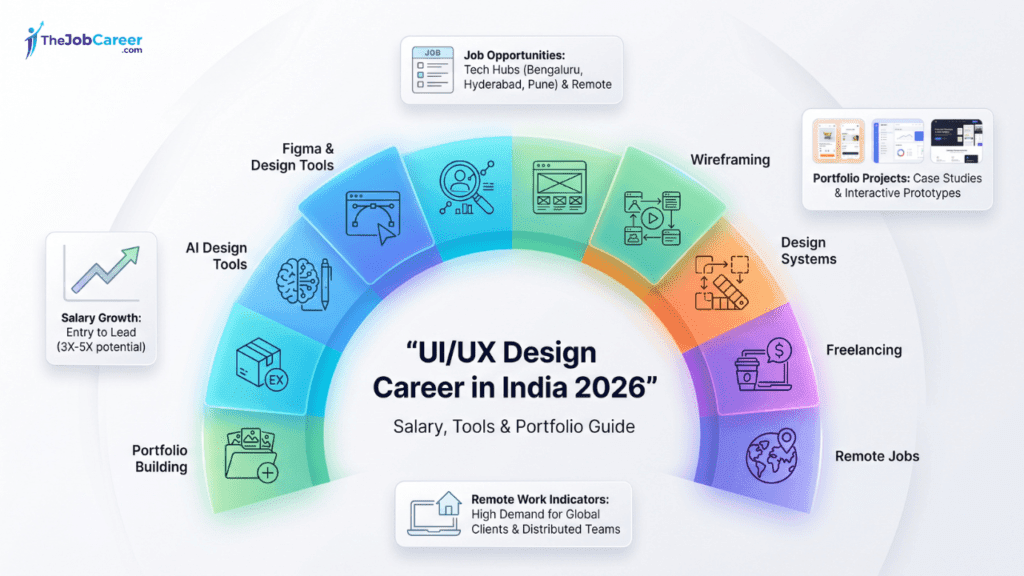
This complete guide covers everything you need to know about building a UI/UX design career in India in 2026 — what UI and UX actually mean and how they differ, the exact salary structure from fresher to senior level, every tool you need to learn (and which ones to skip), a city-wise salary comparison, a step-by-step portfolio building guide, the best free and paid learning resources, career paths and specialisations, and a 6-month roadmap to go from complete beginner to your first UI/UX job.
What Is UI/UX Design? — Understanding the Difference
Before building a career in this field, you need to clearly understand what UI and UX actually mean — because they are different skills, even though they are almost always mentioned together.
| Factor | UX Design (User Experience) | UI Design (User Interface) |
|---|---|---|
| Focus | The overall experience — how a product works and feels | The visual layer — how a product looks and is interacted with |
| Core Activities | User research, personas, user flows, wireframes, usability testing | Visual design, colour palette, typography, components, prototypes |
| Tools Used | Maze, Hotjar, Miro, FigJam, Optimal Workshop | Figma, Adobe Illustrator, Lottie, Principle |
| Skills Required | Empathy, research, problem-solving, systems thinking | Visual design, typography, colour theory, motion design |
| Output | Low-fidelity wireframes, user journey maps, research reports | High-fidelity mockups, design systems, interactive prototypes |
| Analogy | Architect who designs the floor plan and user flow of a building | Interior designer who makes it look and feel beautiful |
| Salary in India | Generally higher at senior level (UX Research roles) | Slightly lower except at brand-heavy consumer companies |
The reality in 2026: Most Indian companies hire for “UI/UX Designer” — a combined role requiring both skills. Pure UX Researcher roles exist mainly at large product companies (Flipkart, Swiggy, Razorpay, Google India). Pure UI Designer roles exist mainly at design agencies and brand-focused companies. As a beginner, learn both — and as you grow, specialise in whichever excites you more.
Why UI/UX Design Is One of India’s Best Careers in 2026
| Factor | Why It Matters |
|---|---|
| No degree required | Portfolio quality determines hiring — not college name or branch |
| Any stream can enter | Arts, Commerce, Science, Engineering, Psychology — all backgrounds welcome |
| High salary growth | Entry Rs. 3–8 LPA → Senior Rs. 20–40 LPA in 4–6 years |
| Remote work friendly | Most UI/UX roles can be done fully remote — work for Bangalore companies while living in Ahmedabad |
| Freelance potential | Strong freelance market — experienced designers earn Rs. 50,000–3,00,000 per project |
| Global opportunities | Indian designers work for US, UK, and European companies remotely at international pay rates |
| AI-resistant | AI generates layouts, not empathy, research insight, or strategic design thinking — UX is human-led |
| Creative + analytical | Combines creative satisfaction with data-driven problem-solving — rare mix |
| Low entry barrier | 6 months of focused learning + a strong portfolio is enough to get a first job |
| Growing market | India’s digital economy growth means every startup, bank, hospital, and retailer needs designers |
UI/UX Design Salary in India 2026 — Complete Breakdown
By Experience Level
The average UI/UX designer salary in India in 2026 ranges between Rs. 6 LPA to Rs. 12 LPA depending on skills, experience, company type, and location.
| Experience Level | Years | Salary Range (LPA) | Monthly In-Hand (Approx.) |
|---|---|---|---|
| Fresher / Entry Level | 0 – 1 year | Rs. 3 – 8 LPA | Rs. 22,000 – 58,000 |
| Junior Designer | 1 – 2 years | Rs. 6 – 12 LPA | Rs. 44,000 – 88,000 |
| Mid-Level Designer | 2 – 5 years | Rs. 10 – 20 LPA | Rs. 73,000 – 1,47,000 |
| Senior Designer | 5 – 8 years | Rs. 18 – 35 LPA | Rs. 1,32,000 – 2,57,000 |
| Lead / Principal Designer | 8 – 12 years | Rs. 30 – 50 LPA | Rs. 2,20,000 – 3,67,000 |
| Design Manager / Head of Design | 12+ years | Rs. 45 – 80 LPA | Rs. 3,30,000 – 5,87,000 |
The portfolio factor: Salary in UI/UX is almost entirely portfolio-driven, not experience-driven. A fresher with three strong, well-documented case studies routinely outearns a two-year professional with a weak portfolio. This is the most important salary truth in this entire guide.
By Company Type
| Company Type | Fresher Salary | Mid-Level | Senior | Notes |
|---|---|---|---|---|
| FAANG / Global MNC (Google, Microsoft, Adobe) | Rs. 15 – 25 LPA | Rs. 30 – 50 LPA | Rs. 50 – 80 LPA | Extremely competitive entry |
| Indian Unicorns (Flipkart, Swiggy, Razorpay, CRED) | Rs. 8 – 15 LPA | Rs. 18 – 30 LPA | Rs. 30 – 50 LPA | Best combination of pay + design quality |
| Funded Startups (Series A–C) | Rs. 6 – 12 LPA | Rs. 12 – 22 LPA | Rs. 20 – 35 LPA | High ownership, fast growth |
| IT Services (TCS, Infosys, Wipro design arms) | Rs. 3 – 6 LPA | Rs. 8 – 14 LPA | Rs. 14 – 22 LPA | Volume hiring, structured training |
| Design Agencies (Accenture Song, Publicis Sapient) | Rs. 4 – 8 LPA | Rs. 10 – 18 LPA | Rs. 18 – 30 LPA | Diverse projects, good portfolio building |
| Consulting (ThoughtWorks, Deloitte Digital) | Rs. 6 – 10 LPA | Rs. 12 – 20 LPA | Rs. 20 – 35 LPA | Strong UX culture, research-heavy |
| Freelance (Independent) | Rs. 2 – 6 LPA | Rs. 8 – 20 LPA | Rs. 20 – 60 LPA | Highly variable — depends on clients |
By City
| City | Average UI/UX Salary (All Levels) | Notes |
|---|---|---|
| Bengaluru | Rs. 10 – 18 LPA | Highest salaries in India — startup + product company hub |
| Mumbai | Rs. 9 – 16 LPA | Fintech, media, e-commerce — strong demand |
| Gurugram / Delhi NCR | Rs. 9 – 15 LPA | Consulting, fintech, large IT campuses |
| Hyderabad | Rs. 8 – 14 LPA | Growing startup scene, Microsoft/Google India offices |
| Pune | Rs. 7 – 13 LPA | Product companies + IT services + good quality of life |
| Chennai | Rs. 6 – 11 LPA | IT services heavy — slightly lower than Bengaluru |
| Ahmedabad | Rs. 5 – 10 LPA | Growing startup ecosystem — lower cost of living |
| Remote (anywhere in India) | Rs. 8 – 25 LPA | Work for Bengaluru/Mumbai companies remotely |
The remote advantage: Remote job opportunities are growing, allowing UI/UX designers to earn Bengaluru-level salaries while living in lower-cost cities. For someone in Ahmedabad or Jaipur, landing a remote role at a Bengaluru startup means Rs. 12–18 LPA salary with Rs. 15,000–20,000 monthly rent instead of Rs. 35,000–50,000 — significantly better quality of life.
By Specialisation
UX roles (UX Researcher, UX Designer, Product Designer) pay more than pure UI/visual design roles at product companies. A UX Researcher at Razorpay earns more than a UI Designer at a design agency.
| Specialisation | Average Salary Range | Demand Level |
|---|---|---|
| Product Designer | Rs. 12 – 35 LPA | 🔥 Extremely High |
| UX Researcher | Rs. 10 – 30 LPA | 🔥 Very High |
| Interaction Designer | Rs. 10 – 28 LPA | 🔥 Very High |
| UI Designer / Visual Designer | Rs. 6 – 22 LPA | High |
| Design Systems Designer | Rs. 14 – 35 LPA | High |
| Motion / Micro-interaction Designer | Rs. 10 – 28 LPA | Moderate–High |
| Accessibility Designer | Rs. 12 – 30 LPA | Growing Rapidly |
| AI Interface Designer | Rs. 15 – 40 LPA | 🔥 Extremely High (New) |
| AR/VR Experience Designer | Rs. 15 – 45 LPA | High — niche |
| Freelance UI/UX Designer | Rs. 50,000 – 3,00,000/project | Variable |
UI/UX Design Tools in 2026 — What to Learn and What to Skip
The tool landscape has consolidated dramatically. Figma has won — 90%+ of Indian product companies, startups, and agencies use Figma as their primary design tool. Here is the complete, prioritised tool guide for 2026:
Tier 1: Must-Learn (Non-Negotiable)
| Tool | What It Does | Why You Need It | Cost |
|---|---|---|---|
| Figma | UI design, prototyping, design systems, collaboration | Mentioned in 94% of Indian UI/UX job listings. If you know only one tool, this is it. | Free (starter) / Rs. 1,250/month (professional) |
| FigJam | Whiteboarding, brainstorming, user flow mapping, workshops | Built into Figma — used for collaborative UX workshops and research synthesis | Free with Figma |
Tier 2: Important (Learn After Figma)
| Tool | What It Does | When You Need It | Cost |
|---|---|---|---|
| Maze | Remote usability testing, prototype testing | UX research — test your designs with real users before building | Free (limited) / paid |
| Hotjar | Heatmaps, session recordings, user behaviour on live products | Understanding how real users interact with existing websites/apps | Free (limited) / paid |
| Miro | Digital whiteboard for user journey maps, affinity diagrams | UX research synthesis, stakeholder workshops | Free (limited) |
| Lottie / LottieFiles | Micro-animations and motion design for apps | Adding motion to UI — increasingly expected in product roles | Free |
| Principle / Protopie | Advanced interactive prototyping beyond Figma | For complex micro-interactions and gesture-based prototypes | Paid |
Tier 3: Situational (Learn Based on Role)
| Tool | Use Case | Who Needs It |
|---|---|---|
| Adobe Illustrator | Complex vector illustrations, icon creation | Designers at branding-heavy companies |
| Adobe Photoshop | Photo manipulation, marketing visuals | Agency designers and brand designers |
| Zeplin | Design-to-developer handoff | Older tech companies not fully on Figma |
| InVision | Legacy prototyping tool | Older companies — being phased out |
| Framer | Design-to-code websites, AI-assisted web building | Web designers and no-code specialists |
| Optimal Workshop | Card sorting, tree testing, information architecture | Specialised UX researchers |
| UserTesting | Remote user interviews | Large product companies with budget |
| Notion | Design documentation, design decisions log | All designers — organisation and communication |
Skip These in 2026
| Tool | Status | Reason to Skip |
|---|---|---|
| Adobe XD | Essentially obsolete in India | Adobe XD is essentially obsolete in India’s product design community in 2026. Adobe discontinued active development. |
| Sketch | Mac-only, declining adoption | Figma replaced it entirely — not worth learning |
| InVision | Legacy tool | Most companies have moved to Figma prototyping |
AI Tools Reshaping UI/UX in 2026
Figma AI has built-in capabilities to auto-generate UI components from text prompts. Knowing AI design tools adds a 20–30% salary premium at AI-forward companies.
| AI Tool | What It Does | Salary Impact |
|---|---|---|
| Figma AI (built-in) | Auto-generates UI components, suggests layouts, writes UX copy | Now standard — all Figma users get it |
| Midjourney | Concept exploration, mood boards, visual inspiration | +15–20% premium at creative companies |
| ChatGPT / Claude | UX copy writing, research synthesis, persona generation | Productivity booster — widely used |
| Framer AI | AI-assisted website building from designs | Web design specialists |
| Galileo AI | Generates full UI screens from text descriptions | Rapid prototyping — emerging tool |
Career Paths in UI/UX Design — Where Can You Go?
Track 1: Individual Contributor (IC) Path
| Stage | Role | Years | Salary |
|---|---|---|---|
| Entry | Junior UI/UX Designer | 0–2 years | Rs. 3–8 LPA |
| Mid | UI/UX Designer | 2–4 years | Rs. 8–16 LPA |
| Senior | Senior UX / Product Designer | 4–7 years | Rs. 16–30 LPA |
| Expert | Principal Designer / Design Architect | 7–12 years | Rs. 30–55 LPA |
| Peak | Distinguished Designer / Design Fellow | 12+ years | Rs. 50–80+ LPA |
Track 2: Management Path
| Stage | Role | Years | Salary |
|---|---|---|---|
| Senior IC | Senior Designer | 4–6 years | Rs. 16–28 LPA |
| First management | Design Lead / Manager | 6–9 years | Rs. 25–45 LPA |
| Mid management | Director of Design | 9–13 years | Rs. 40–70 LPA |
| Executive | VP of Design / Head of Design | 13+ years | Rs. 60–1.2 crore+ |
| C-suite | Chief Design Officer (CDO) | 15+ years | Rs. 1 crore+ |
Track 3: Specialisation Path
| Specialisation | Entry Point | Why Choose This |
|---|---|---|
| UX Researcher | 1–2 years as UX Designer | Highest pay at senior level at product companies; rare talent pool |
| Design Systems | 2–3 years as UI Designer | Building component libraries and design tokens; highly valued at scale-ups |
| Product Designer | 2+ years as UI/UX | Combines design + product thinking + data; highest-paying mainstream role |
| Motion Designer | UI background + After Effects/Lottie | Growing demand in consumer apps; Swiggy, CRED, Meesho pay premium |
| AI Interface Designer | UI/UX + AI product knowledge | Newest and highest-growth niche in 2026 — designing for AI-native products |
| Accessibility Designer | UX background + WCAG knowledge | Growing due to regulatory requirements and inclusive design mandates |
Track 4: Freelance / Independent
Freelancing in UI/UX is one of the most viable independent career tracks in India in 2026:
| Level | Projects per Month | Per-Project Rate | Monthly Earnings |
|---|---|---|---|
| Beginner freelancer (0–1 yr) | 1–2 projects | Rs. 15,000 – 50,000 | Rs. 15,000 – 1,00,000 |
| Established (2–4 yrs) | 2–3 projects | Rs. 50,000 – 2,00,000 | Rs. 1,00,000 – 4,00,000 |
| Expert / Niche specialist | 1–2 premium projects | Rs. 2,00,000 – 5,00,000 | Rs. 2,00,000 – 8,00,000 |
| International clients | 1 project | USD 3,000 – 10,000 | Rs. 2,50,000 – 8,30,000 |
Top Companies Hiring UI/UX Designers in India 2026
Product Companies (Best for Career Growth)
| Company | Design Team Size | Typical Salary (Mid-Level) | Known For |
|---|---|---|---|
| Flipkart | 200+ designers | Rs. 18 – 30 LPA | Design systems, large-scale e-commerce UX |
| Swiggy | 150+ designers | Rs. 16 – 28 LPA | Consumer product design, motion design |
| Razorpay | 80+ designers | Rs. 18 – 32 LPA | Fintech UX, developer-facing product design |
| PhonePe | 100+ designers | Rs. 16 – 28 LPA | Payment UX, accessibility-first design |
| CRED | 60+ designers | Rs. 20 – 35 LPA | Premium UI — best visual design culture in India |
| Zepto / Blinkit | Growing teams | Rs. 14 – 25 LPA | Rapid commerce UX |
| Zoho | Large team | Rs. 8 – 18 LPA | SaaS product design — 50+ products |
| Freshworks | 100+ designers | Rs. 12 – 22 LPA | B2B SaaS design, global products |
| Zomato | 100+ designers | Rs. 14 – 26 LPA | App UX, accessibility, consumer experience |
| Groww / Zerodha | 50+ designers | Rs. 14 – 25 LPA | Financial product design — high impact |
Consulting and Agency (Best for Portfolio Building)
| Company | Focus | Salary Range |
|---|---|---|
| Accenture Song (Interactive) | Digital experience design, large enterprise | Rs. 8 – 22 LPA |
| Publicis Sapient | Digital transformation, strong design culture | Rs. 8 – 20 LPA |
| ThoughtWorks | Excellent UX culture, research-heavy projects | Rs. 10 – 25 LPA |
| Deloitte Digital | Design consulting, government and enterprise | Rs. 8 – 20 LPA |
| Capgemini Invent | Innovation design, design sprints | Rs. 8 – 20 LPA |
IT Services (Best for Freshers Without Experience)
| Company | Notes | Fresher Salary |
|---|---|---|
| Infosys (UX practice) | Large volume hiring, good training | Rs. 4 – 6 LPA |
| Wipro (Design arm) | Structured onboarding, diverse clients | Rs. 3.5 – 6 LPA |
| TCS (Digital) | High volume, less creative ownership | Rs. 3.5 – 5.5 LPA |
| HCL Technologies | Growing design practice | Rs. 4 – 6 LPA |
How to Build a UI/UX Portfolio — The Complete Guide
Your portfolio is the single most important thing in your UI/UX job search. The most common reason Indian UI/UX freshers get rejected is that their portfolio shows only pretty screens with no explanation of the thinking. Employers hire people who can solve problems — not people who can make things look nice.
What a Winning Portfolio Looks Like
Wrong approach (what most beginners do): “Here are 10 screens I designed in Figma. They look nice.”
Right approach (what gets you hired): “Here is the problem I was solving → here is the user research I did → here are the insights I found → here are my early wireframes → here is what I tested → here is what changed after testing → here is the final design → here is the business or user impact.”
The portfolio tells a story of thinking, not a gallery of screens.
How Many Projects Do You Need?
| Stage | Number of Projects | Quality Bar |
|---|---|---|
| First job application | 3 strong case studies | Each showing full design process — research to final |
| Mid-level application | 4–5 case studies | Include 1–2 from real work, not just self-initiated |
| Senior level | 5–7 case studies | Include measurable impact metrics |
Quality over quantity always. Three deeply documented case studies with research, process, and outcome beat fifteen screens with no context.
Step-by-Step: Building Your First 3 Portfolio Projects
Project Type 1: Redesign an Existing App
Choose a popular app with obvious problems — a banking app, a government portal, a food delivery app — and redesign it with documented reasoning.
Process:
- Download the app and use it extensively — note every friction point
- Conduct at least 3 user interviews (friends and family count for your first project)
- Document the problems you found
- Create user personas from your research
- Sketch user flows
- Build low-fidelity wireframes
- Design high-fidelity screens in Figma
- Create a Figma prototype
- Test with 3–5 people and document changes made based on feedback
- Write a case study documenting all of the above
Project Type 2: Design from a Brief
Find a design challenge brief online — Designlab, Daily UI challenges, or create your own brief: “Design an app that helps college students track their assignments.” Build it from scratch with full process documentation.
Project Type 3: Real Client or Volunteer Project
The most powerful portfolio piece is a real project. Options:
- Design for an NGO or local business for free — they get a website/app design, you get a real project
- Contribute to an open-source project’s design — many open-source tools need UX help
- Take a freelance project at low cost just for the portfolio piece
- Participate in a hackathon with a design track
Portfolio Platforms — Where to Host
| Platform | Best For | Cost |
|---|---|---|
| Behance | Showcasing visual design work — standard platform | Free |
| Dribbble | Short visual shots — discovery by recruiters | Free (limited) / paid for pro |
| Personal website | Most professional — custom domain, full control | Rs. 500–2,000/year (hosting + domain) |
| Notion | Simple, text-heavy case studies — easy to update | Free |
| UXFolio | Specifically built for UX case studies | Free (limited) / paid |
Recommendation: Build a personal website (even a simple one on Framer, Webflow, or Carrd) and cross-post case studies to Behance. A personal website signals professionalism and effort — it is the first thing hiring managers check.
What to Include in Each Case Study
| Section | What to Write | Length |
|---|---|---|
| Project Overview | Problem, your role, team size, timeline, tools used | 100–150 words |
| Problem Statement | Specific user pain point or business challenge being solved | 100 words |
| Research | Methods used, key findings, user quotes, data | 200–300 words + visuals |
| User Personas | 1–2 personas with goals, frustrations, behaviours | Visual cards |
| User Journey Map | Steps the user takes — highlight pain points | Visual |
| Information Architecture | Site map or app structure (for complex products) | Visual |
| Wireframes | Low-fidelity sketches or digital wireframes showing layout | Images |
| Design Iterations | Show 2–3 versions and explain why you changed them | Images + text |
| Final Design | High-fidelity screens — annotated to explain decisions | Images |
| Prototype Link | Clickable Figma prototype link | Link |
| Testing and Results | What you tested, what users said, what you changed | 150 words |
| Reflection | What you would do differently — shows maturity | 100 words |
How to Learn UI/UX Design in 2026 — Free and Paid Resources
Free Learning Resources (Start Here)
| Resource | What You Learn | Time Required |
|---|---|---|
| Google UX Design Certificate (Coursera) | Full UX process — research, wireframes, prototyping, portfolio | 6 months (7 hrs/week) — financial aid available |
| Figma YouTube Channel (Official) | Figma from basics to advanced features | 20–30 hours |
| Nielsen Norman Group Articles (nngroup.com) | UX research best practices — the gold standard in UX knowledge | Ongoing reading |
| Interaction Design Foundation (IxDF) | Comprehensive UX courses — typography, colour, research | Free trial / Rs. 5,000/year |
| CareerFoundry Blog | Beginner UI/UX tutorials and guides | Free |
| UX Collective (Medium) | Case studies and design thinking articles from practitioners | Free |
| Daily UI (dailyui.co) | 100-day UI design challenge — one prompt per day | Free — 100 days |
Paid Courses Worth the Investment
| Course | Platform | Price | Best For |
|---|---|---|---|
| Google UX Design Professional Certificate | Coursera | Rs. 2,000/month (financial aid available) | Complete beginner — industry recognised |
| UI/UX Design Bootcamp | Designlab | Rs. 80,000 – 1,20,000 | Structured learning with mentor |
| Interaction Design Foundation | IxDF | Rs. 5,000/year | Deep UX research and theory |
| Figma UI UX Design Essentials | Udemy | Rs. 499 – 1,499 (on sale) | Figma-specific skill building |
| Zero to Mastery — UI/UX Bootcamp | ZTM | Rs. 4,000/month | Practical, project-based learning |
Indian-Specific Design Communities to Join
| Community | Platform | What You Get |
|---|---|---|
| Design India | Slack | Networking, job referrals, portfolio feedback |
| Designerrs | Instagram + Community | Indian design content, job postings |
| NID Alumni Network | Connections in India’s top design community | |
| ProductHunt India | Discord | Product + design community overlap |
| UX India Conference | Annual event | Best networking event for Indian designers |
Certifications That Actually Matter
Certifications have a measurable salary impact of 10–25% premium based on job listing analysis.
| Certification | Issuing Body | Salary Impact | Recognised By |
|---|---|---|---|
| Google UX Design Certificate | Google / Coursera | High — widely recognised | Most Indian companies |
| Nielsen Norman UX Certification | NN/g | Very High — premium signal | Senior roles at top companies |
| Interaction Design Foundation | IxDF | Moderate–High | Consulting and product companies |
| Certified Usability Analyst (CUA) | Human Factors International | High — UX research roles | UX Researcher positions |
| Adobe Certified Professional | Adobe | Low (in 2026 — Figma dominant) | Agency work mainly |
The 6-Month Roadmap: Zero to First UI/UX Job
This is a realistic, achievable plan for a complete beginner — any stream, any degree, any age — to go from knowing nothing about design to landing their first UI/UX role.
| Month | Focus | What to Do | Output |
|---|---|---|---|
| Month 1 | Foundations | Learn UX fundamentals (Google Certificate Week 1–4). Set up Figma. Complete 30 Daily UI challenges. | Figma basics + first UI screens |
| Month 2 | UX Process | Learn user research methods, create user personas, draw user journey maps. Watch NN/g YouTube videos. | First wireframe project |
| Month 3 | First Portfolio Project | Choose an app to redesign. Conduct 3 user interviews. Build wireframes and high-fidelity screens. Write case study. | Portfolio Project 1 complete |
| Month 4 | Tools Depth + Project 2 | Learn Maze for usability testing. Build Project 2 from a brief. Test your designs with real users. | Portfolio Project 2 complete |
| Month 5 | Real Project + Figma Advanced | Volunteer for a real client project. Learn Auto Layout, design systems, components in Figma. | Portfolio Project 3 (real client) |
| Month 6 | Job Prep | Build personal portfolio website. Optimise LinkedIn. Apply to 20+ roles/week. Do mock interviews. Target internships or junior roles at startups. | First job or internship offer |
UI/UX vs Related Careers — Which Should You Choose?
Many aspirants wonder whether UI/UX is right for them versus adjacent careers. Here is a clear comparison:
| Factor | UI/UX Design | Graphic Design | Front-End Development | Product Management |
|---|---|---|---|---|
| Coding Required | ❌ No | ❌ No | ✅ Yes (HTML/CSS/JS) | ❌ No |
| Primary Tool | Figma | Adobe Illustrator/Photoshop | VS Code | Notion / Jira |
| Entry Salary | Rs. 3 – 8 LPA | Rs. 2.5 – 5 LPA | Rs. 4 – 8 LPA | Rs. 8 – 15 LPA |
| Senior Salary | Rs. 20 – 40 LPA | Rs. 10 – 20 LPA | Rs. 20 – 40 LPA | Rs. 30 – 60 LPA |
| Job Market Size | Very Large | Moderate | Very Large | Moderate |
| Creative vs Analytical | Both | Highly Creative | Analytical | Highly Analytical |
| Learning Curve | Moderate | Moderate | Steep | Steep |
| Remote Opportunities | Very High | Moderate | Very High | High |
| AI Impact | Low (research-led) | Moderate | Moderate | Low |
Common Mistakes Beginners Make in UI/UX
❌ Mistake 1: Learning tools before understanding UX principles Many beginners dive straight into Figma and start making screens. Without understanding user research, personas, wireframing principles, and information architecture first, your Figma screens will look nice but solve no problems. Learn the process before the tool.
❌ Mistake 2: Copying existing designs without documenting your own thinking Recreating Swiggy’s UI in Figma for practice is fine. Putting it in your portfolio as a “project” is a mistake. Portfolio projects must show your original problem-solving — not your ability to replicate existing designs.
❌ Mistake 3: Ignoring UX writing The words in a UI — button labels, error messages, onboarding copy, empty states — are part of UX design. Designers who can write good UX copy are significantly more valuable than those who just push pixels. Learn the basics of UX writing as you learn design.
❌ Mistake 4: Skipping user research because “it’s just a portfolio project” Even 3 user interviews with friends or family is real research. It changes your design decisions in ways that looking at reference screens never will. Always do some form of user research, even for self-initiated portfolio projects.
❌ Mistake 5: Applying to every company with the same generic portfolio Tailor your portfolio to the company you are applying to. Applying to a fintech company? Put your financial product case study first. Applying to a health-tech startup? Lead with your healthcare UX project. Customisation signals genuine interest and pays off in interview rates.
❌ Mistake 6: Waiting until the portfolio is “perfect” to start applying Three solid projects are enough to apply. Many designers wait 12–18 months to get every detail right and miss multiple hiring cycles. A good portfolio that exists is worth infinitely more than a perfect portfolio that is still in progress.
Frequently Asked Questions
Q1. Can I become a UI/UX designer without a design degree?
Absolutely yes. The majority of working UI/UX designers in India today do not hold a formal design degree. What matters to employers is your portfolio — the quality of your case studies and the depth of your design thinking. Engineers, arts graduates, commerce students, and even doctors have successfully transitioned into UI/UX design careers. The Google UX Design Certificate is employer-recognised and does not require a design background.
Q2. How long does it take to become a UI/UX designer from scratch?
With focused, consistent effort of 2–4 hours daily, most people become job-ready in 5–8 months. The 6-month roadmap above is achievable. The timeline varies based on prior background — someone with a design or psychology background may move faster; someone with no visual or research background may need 8–10 months for a strong first application.
Q3. Do UI/UX designers need to know how to code?
No — coding is not required for UI/UX roles. However, a basic understanding of HTML/CSS (what is and is not possible to build) makes you a significantly better designer, because you design within real technical constraints. You do not need to write code, but you should understand why a developer says a design element is difficult to implement.
Q4. Is NID or NIFT necessary for a UI/UX career?
Not at all. NID (National Institute of Design) and NIFT produce excellent designers, but their degrees are not prerequisites for UI/UX employment. The portfolio is the great equaliser — a self-taught designer with three strong case studies will be hired over an NID graduate with a weak portfolio. NID/NIFT are excellent institutions but not the only or even the primary path into UI/UX design.
Q5. What is the difference between a UI/UX Designer and a Product Designer?
Product Designer is generally the more senior and more holistic role. A Product Designer is expected to understand not just visual design and UX but also product strategy, user metrics, business goals, and data analysis. The title commands higher salary and greater influence. Most UI/UX Designers evolve into Product Designer roles after 3–5 years. Target “Product Designer” title in job applications once you have 2+ years of experience and a research-strong portfolio — Product Designer roles at funded startups typically pay 20–30% more than equivalently experienced UI/UX Designer roles at IT services companies.
Q6. Which is more in demand — UI design or UX design?
Both are in demand, but the skill mix that commands the highest salary is UX Research + Product Thinking + Figma proficiency. Pure visual UI design (without research or strategy) is increasingly being assisted by AI tools, making the human value-add in research, empathy, and strategic thinking — the UX side — more important. Build strong UX foundations first, then develop your UI visual skills on top.
Q7. Is freelancing a viable full-time career in UI/UX design?
Yes — UI/UX is one of the most freelance-friendly careers in India. An established designer with 3–4 years of experience and a strong Behance/Dribbble presence can earn Rs. 1,00,000–4,00,000 per month from freelance projects. International clients via Toptal, Upwork, and direct LinkedIn outreach pay in USD — significantly higher rates. Most designers start freelancing part-time alongside a job and transition to full-time freelance once their client base is established.
Current Status: UI/UX Design Job Market in India (June 2026)
| Indicator | Status |
|---|---|
| Active UI/UX job openings on Naukri | 16,475+ (March 2026 data) |
| Active UI/UX positions on LinkedIn | 3,575+ |
| Average fresher salary | Rs. 3 – 8 LPA (portfolio-dependent) |
| Average senior salary | Rs. 18 – 35 LPA |
| Highest paying niche | AI Interface Design — Rs. 15–40 LPA for freshers in AI companies |
| Most in-demand tool | Figma (94% of job listings) |
| Fastest growing sector for UI/UX | Fintech + AI products + Healthtech |
| Remote opportunity level | Very High — most product companies offer remote or hybrid |
| Outlook (3–5 years) | Excellent — India’s digital economy expansion drives continued hiring |
Your UI/UX Career Action Plan — Start This Week
UI/UX design is one of the rare careers where your background does not matter, your degree does not matter, and your age does not matter — only your portfolio does. And a portfolio is built through practice, research, and documentation of your thinking. It cannot be bought or inherited. It is built by you, one project at a time.
Here is what to do starting today:
- Download Figma for free — go to figma.com and create an account. Spend the first week watching the official Figma YouTube channel tutorials. Get comfortable with the basic tools — frames, components, auto layout, and prototyping.
- Enroll in the Google UX Design Certificate — it is available on Coursera with a financial aid option that makes it essentially free. This gives you a structured learning path that covers the full UX process from research to prototype.
- Start your first redesign project this month — pick an app you use and dislike. Document its problems, talk to 3 people who use it, and start redesigning. This is your Portfolio Project 1.
- Join the Design India Slack community — get feedback on your work, find accountability partners, and start networking with working designers.
- Create a Behance profile — even an empty one. Start posting your Daily UI challenges as practice work while your case studies are in progress.
- Set a 6-month target — by December 2026, you will have 3 strong case studies, a personal portfolio website, and applications going out to junior roles and design internships across Bengaluru, Pune, and remote-friendly startups.
- Read one UX article daily — NN/g, UX Collective, and UX Matters are free. 15 minutes of daily reading compounds into deep knowledge over months.
The best UI/UX designers in India right now were not born designers. They were curious people who decided to understand how others think, learn a few tools, and document their thinking clearly. That is a learnable, practicable skill. And in 2026, the Indian market is paying very well for it.
Start designing. Start thinking. Start building. 🇮🇳
Related Tech Career Articles:
- Cybersecurity Career 2026: Roles, Salary, Certifications and How to Get Started
- Digital Marketing Career in India 2026: Salary, Skills and How to Start
- IT Jobs for Freshers 2026: Which Companies Hire Without Experience
- IT Jobs for Freshers 2026: Software Developer, Testing, and Support Roles
- AI Tools for Job Seekers 2026: How to Use ChatGPT and AI to Get Hired Faster
Related Career Skill Articles:
- LinkedIn Profile Guide 2026: How to Get Noticed by Recruiters
- How to Write a Cover Letter in 2026: Format, Examples and Templates
- Resume Tips for Freshers: How to Create a Job-Winning Resume
- Freelancing in India 2026: How to Start, Earn and Grow Your Income
- How to Switch Careers at 30/35/40: Complete Roadmap for 2026
- Work Abroad From India 2026: Best Countries, Visa and Salary Guide
Official and Useful Resources:
- Figma (Free account): https://www.figma.com
- Google UX Design Certificate: https://grow.google/certificates/ux-design/
- Interaction Design Foundation: https://www.interaction-design.org
- Nielsen Norman Group (Free articles): https://www.nngroup.com/articles/
- Behance (Portfolio hosting): https://www.behance.net
- Daily UI Challenges: https://www.dailyui.co