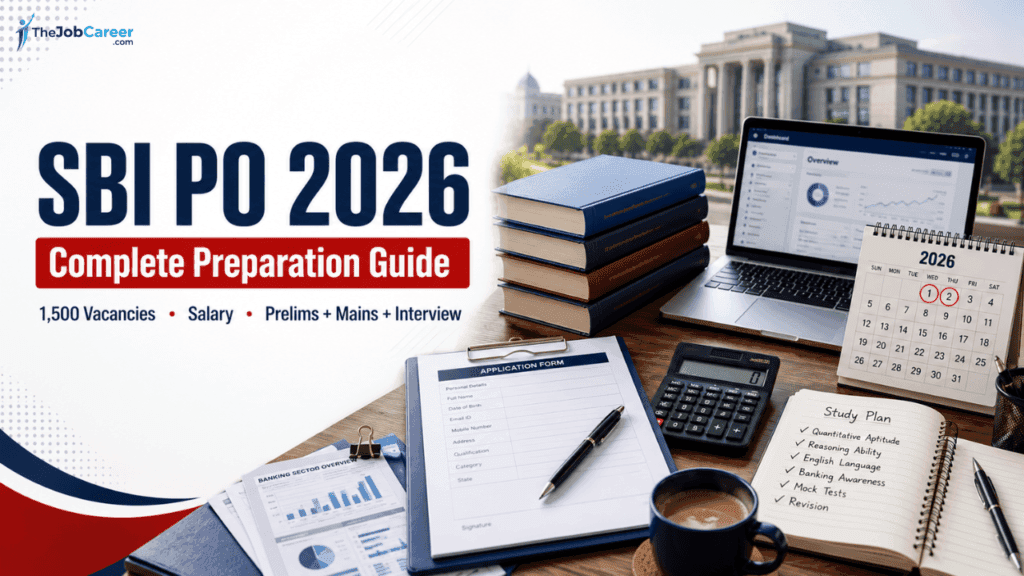

The State Bank of India has officially released the SBI PO 2026 Notification on June 18, 2026 (Advertisement No. CRPD/PO/2026-27/09), announcing 1,500 vacancies for Probationary Officers — the largest SBI PO recruitment drive in recent years, up from just 541 vacancies in 2025. The Prelims exam is confirmed for August 1 and 2, 2026, with over 12 lakh applications already received. If you are one of them, the exam is days away. If you are planning ahead for the next cycle — this guide is your complete preparation blueprint.
SBI PO is the most prestigious entry-level officer examination in Indian banking — period. Not IBPS PO, not any private bank. SBI is India’s largest bank, one of the Fortune 500 companies, and an SBI Probationary Officer is a manager from day one — supervising staff, sanctioning loans, managing branch operations, representing the bank with government authorities, and building a career that can culminate in becoming a General Manager or Chief General Manager of one of the world’s largest banking institutions. The 2026 notification brings a substantially revised salary package with an in-hand salary of Rs. 80,000 – 85,000 per month at entry level — making it one of the highest-paying entry-level government jobs in India for graduates of any stream.
This complete guide covers everything — the official 2026 notification details, category-wise vacancies, eligibility, the revised three-stage selection process, full exam pattern for Prelims and Mains (including the revised Descriptive Paper), complete syllabus subject by subject, salary breakdown, previous year cut-offs, Group Exercise and Interview preparation, and a month-by-month preparation strategy to crack SBI PO 2026 in your very first attempt.
What Is SBI PO? — Why It Is India’s Most Sought-After Banking Job
| Parameter | Details |
|---|---|
| Full Name | State Bank of India Probationary Officer |
| Advertisement No. | CRPD/PO/2026-27/09 |
| Post Name | Probationary Officer (PO) — Junior Management Grade Scale-I (JMGS-I) |
| Conducting Body | State Bank of India (SBI) — Central Recruitment & Promotion Department (CRPD), Mumbai |
| Total Vacancies (2026) | 1,500 (1,446 regular + 54 backlog) |
| Qualification | Any Graduation from a recognised university |
| Age Limit | 21 to 30 years |
| Attempts | General/EWS: 6 attempts (revised 2026); OBC: 9 attempts |
| Starting Basic Pay | Rs. 48,480 (+ 4 advance increments = effective Rs. 56,480) |
| Annual CTC (Mumbai) | Rs. 21.97 lakh |
| In-Hand Salary | Rs. 80,000 – 85,000/month |
| Bond Period | Rs. 2 lakh bond — must serve minimum 3 years |
| Official Website | sbi.bank.in/web/careers |
Why SBI PO is different from every other banking exam:
SBI is not just another public sector bank. It commands 25% of India’s total banking market. An SBI PO has access to international postings (SBI has offices in 30+ countries), the fastest promotion cycle among all PSBs, the highest entry-level in-hand salary in public sector banking, and the institutional brand that opens every professional door in finance, government, and policy circles. An SBI General Manager has more operational authority than the CFO of most mid-size Indian companies.
SBI PO 2026: Important Dates — Current Status
| Event | Date / Status |
|---|---|
| Official Notification Released | ✅ June 18, 2026 |
| Online Application Opens | ✅ June 18, 2026 |
| Last Date to Apply | ✅ July 8, 2026 (Closed) |
| Total Applications Received | ✅ Over 12,14,076 |
| Phase I Prelims Admit Card | ✅ Released — July 2026 |
| Phase I — Prelims Exam | ✅ August 1 and 2, 2026 (8 shifts — 4 per day) |
| Phase I Result | ⏳ August–September 2026 (Expected) |
| Phase II — Mains Exam | ⏳ September 2026 (Expected) |
| Phase III — Psychometric Test, GE & Interview | ⏳ October – November 2026 |
| Final Result and Joining | ⏳ December 2026 – January 2027 |
🚨 If you have already applied: Prelims is on August 1–2. Download your admit card immediately from sbi.bank.in if not already done. You have days — not weeks — to prepare.
SBI PO 2026: Vacancies (Category-wise)
| Category | Regular Vacancies | Backlog Vacancies | Total |
|---|---|---|---|
| UR (Unreserved / General) | 543 | 45 | 588 |
| OBC (Non-Creamy Layer) | 378 | 12 | 390 |
| SC | 234 | 0 | 234 |
| ST | 144 | 0 | 144 |
| EWS | 147 | 0 | 147 |
| Total | 1,446 | 54 | 1,500 |
PwBD Horizontal Vacancies: 61 posts across all categories for candidates with benchmark disabilities (VI, HI, LD, MD categories — check official notification for eligibility).
SBI PO Vacancy Trend — What Changed in 2026
| Year | Total Vacancies | Change |
|---|---|---|
| 2019 | 2,000 | — |
| 2020 | 2,000 | Stable |
| 2021 | 2,056 | +56 |
| 2022 | 1,673 | −383 |
| 2023 | 2,000 | +327 |
| 2024 | 600 | −1,400 (significant drop) |
| 2025 | 541 | −59 |
| 2026 | 1,500 | +959 (nearly 3x increase) |
The 2026 vacancy surge from 541 to 1,500 is the single biggest positive development for SBI PO aspirants in years. More vacancies means higher cut-offs are manageable and slightly more forgiving for borderline scorers — but the competition also intensifies with 12+ lakh applications.
SBI PO 2026: Eligibility Criteria
Educational Qualification
| Requirement | Details |
|---|---|
| Minimum Degree | Graduation in any discipline from a recognised university |
| Streams Accepted | Any — B.A., B.Sc., B.Com., B.Tech., BCA, BBA, B.Pharm., LLB, MBBS — all accepted |
| Minimum Percentage | No minimum percentage specified — pass is sufficient |
| Final Year Students | Eligible to apply — but must produce degree certificate at time of interview |
| Professional Degrees | CA, ICWA, CS — fully eligible |
Age Limit (As on April 1, 2026)
| Category | Minimum Age | Maximum Age |
|---|---|---|
| General / UR | 21 years | 30 years |
| OBC (Non-Creamy Layer) | 21 years | 33 years (+3 years) |
| SC / ST | 21 years | 35 years (+5 years) |
| PwBD (General) | 21 years | 40 years (+10 years) |
| PwBD (OBC) | 21 years | 43 years (+13 years) |
| PwBD (SC/ST) | 21 years | 45 years (+15 years) |
| J&K Domicile (1980–89) | 21 years | 35 years (+5 years) |
| Ex-Servicemen | — | Service rendered + 3 years deducted from age |
2026 Key Change: Revised Attempt Limits
This is a major positive change in the 2026 notification:
| Category | Old Attempt Limit | New Attempt Limit (2026) |
|---|---|---|
| General / EWS | 4 attempts | 6 attempts |
| OBC | 7 attempts | 9 attempts |
| SC / ST | No limit (within age) | No limit (within age) |
| PwBD (General/EWS) | 7 attempts | 9 attempts |
This is a significant relief for aspirants who have been preparing for 2–3 years — you now have more attempts available before exhausting your eligibility.
SBI PO 2026: Three-Stage Selection Process
SBI PO selection involves three distinct phases — each eliminates a large proportion of candidates. Understanding each stage deeply is essential to preparing strategically.
| Phase | Stage | Purpose | Marks Count in Final Merit? |
|---|---|---|---|
| Phase I | Preliminary Examination (CBT) | Screening only | ❌ No |
| Phase II | Main Examination (Objective + Descriptive) | Merit determination | ✅ Yes |
| Phase III | Psychometric Test + Group Exercise + Interview | Final selection | ✅ Yes (25 marks) |
Phase I: Prelims Exam Pattern (August 1–2, 2026)
Prelims is a screening test only — your Prelims marks do NOT count toward the final merit list. Approximately 10 times the number of vacancies are shortlisted for Mains from each category.
| Section | Questions | Marks | Time |
|---|---|---|---|
| English Language | 30 | 30 | 20 minutes |
| Quantitative Aptitude | 35 | 35 | 20 minutes |
| Reasoning Ability | 35 | 35 | 20 minutes |
| Total | 100 | 100 | 60 minutes |
Prelims Rules
| Rule | Details |
|---|---|
| Negative Marking | −0.25 marks per wrong answer |
| Sectional Time Limit | Each section has its own 20-minute window — cannot borrow time |
| Sectional Cut-off | Must clear minimum cut-off in each of the 3 sections independently |
| Language | Bilingual — English and Hindi |
| Mode | Computer Based Test |
The 20-minute sectional limit is the decisive tactical challenge of Prelims. The biggest differentiator between selected and rejected candidates at the same knowledge level is time management within sections. Practice every Prelims mock with a strict timer.
Phase II: Mains Exam Pattern (September 2026)
Mains is the merit-determining exam. Your Mains score forms the basis for Phase III shortlisting and ultimately the final selection.
Objective Test (200 marks — 3 hours)
| Section | Questions | Marks | Time |
|---|---|---|---|
| Reasoning and Computer Aptitude | 45 | 60 | 60 minutes |
| Data Analysis and Interpretation | 35 | 60 | 45 minutes |
| General/Economy/Banking Awareness | 40 | 40 | 35 minutes |
| English Language | 35 | 40 | 40 minutes |
| Total | 155 | 200 | 3 hours |
Descriptive Test — 2026 Revised Pattern
Important change in 2026: The Descriptive Paper marks have been reduced from 50 to 30 marks, and total Mains marks have been revised accordingly. This makes the Objective Test even more decisive.
| Component | Marks | Time | Conducted |
|---|---|---|---|
| Letter Writing | 10 marks | — | Immediately after Objective Test |
| Essay Writing | 20 marks | — | Same session |
| Total Descriptive | 30 marks | 30 minutes | Same day as Objective Test |
| Total Mains | 230 marks | — | Combined |
Mains Rules
| Rule | Details |
|---|---|
| Negative Marking | −0.25 marks per wrong answer (Objective only) |
| Descriptive Marking | Evaluated by SBI-appointed examiners — no negative marking |
| Sectional Cut-offs | Apply to Objective sections |
| Language for Descriptive | English only |
| Descriptive Paper evaluated | Only for candidates who qualify Objective cut-offs |
| Minimum qualifying marks | Separate for each category — announced with result |
2026 Key Change: Revised Mains Pattern Summary
| Factor | Old Pattern | New Pattern (2026) |
|---|---|---|
| Descriptive Paper Marks | 50 marks | 30 marks |
| Total Mains Marks | 250 marks | 230 marks |
| Attempt Limit (General) | 4 | 6 |
| Descriptive Time | 30 minutes | 30 minutes (unchanged) |
Phase III: Psychometric Test, Group Exercise and Interview
Phase III is the final and most differentiated stage of SBI PO — it is what separates SBI from all other banking exams. While IBPS PO only has an Interview, SBI PO has three sub-components in Phase III.
3A. Psychometric Test
| Parameter | Details |
|---|---|
| Purpose | Assess personality traits, decision-making style, emotional intelligence, stress response |
| Marks | No marks — qualifying/informational |
| Format | Online questionnaire — no right or wrong answers |
| How it is used | Panel uses your Psychometric profile during the interview |
| Preparation | Cannot be “prepared for” — answer honestly and consistently |
| Common mistake | Trying to game it by answering what you think they want — inconsistent answers are flagged |
3B. Group Exercise (GE)
| Parameter | Details |
|---|---|
| Duration | 20 minutes |
| Marks | Part of 25 marks combined with interview |
| Format | Group of 8–10 candidates discuss a given topic without a designated leader |
| Evaluators | Panel of 3–4 SBI officials observe the group |
| Topics typically given | Banking sector challenges, economic policy, current affairs, social issues, technology in banking |
| What is evaluated | Communication clarity, leadership initiative, listening skills, logical reasoning, team behaviour |
Group Exercise — What assessors actually watch for:
| Behaviour | What It Signals |
|---|---|
| Initiating the discussion | Leadership confidence |
| Summarising others’ points | Listening + synthesis skills |
| Bringing back off-track discussion | Structure and problem-solving |
| Agreeing substantively, not just nodding | Collaborative intelligence |
| Using data or facts in arguments | Preparation and analytical thinking |
| Interrupting repeatedly | Poor team fit — negative signal |
| Speaking the most without substance | Dominance without value — negative |
| Staying completely silent | Disengagement — serious negative signal |
3C. Personal Interview
| Parameter | Details |
|---|---|
| Duration | 20–30 minutes |
| Marks | Part of 25 marks combined with GE |
| Panel | 3–5 senior SBI officials, sometimes including a General Manager |
| Final merit | Phase II Mains (205 marks) + Phase III GE+Interview (25 marks) = 230 marks total |
Final Merit Distribution:
| Component | Marks |
|---|---|
| Phase II — Objective Test | 200 marks |
| Phase II — Descriptive Paper | 30 marks |
| Phase III — Group Exercise + Interview | 25 marks |
| Grand Total | 255 marks |
SBI PO 2026: Salary Structure (Fully Updated)
This is the most significantly updated section of the 2026 notification. The SBI PO salary has been substantially revised upward.
Pay Scale (Revised 2026)
Official Pay Scale: Rs. 48,480 — 2000/7 — 62,480 — 2340/2 — 67,160 — 2680/7 — 85,920
| Pay Point | Basic Pay (Rs.) | After How Many Years |
|---|---|---|
| Entry (with 4 advance increments) | 56,480 | On joining |
| After 3 years | 62,480 | Increment |
| After 5 years | 67,160 | Increment |
| After 7 years | 72,840 | Increment |
| After 10 years | 80,360 | Increment |
| Maximum | 85,920 | Full scale |
Monthly Salary Breakdown (Entry Level — Metro City like Mumbai)
| Component | Amount (Rs.) |
|---|---|
| Basic Pay | 56,480 |
| Dearness Allowance (DA) | ~11,297 |
| House Rent Allowance (HRA) / Lease Rent | ~13,555 (Metro) |
| City Compensatory Allowance (CCA) | ~540 |
| Special Allowance | ~10,166 |
| Other Allowances | ~5,550 |
| Gross Monthly Salary | ~Rs. 97,590 |
| NPS (10% of Basic) | −5,648 |
| Professional Tax | −200 |
| Income Tax / TDS | ~−7,260 |
| Net In-Hand Salary (Mumbai) | ~Rs. 84,882 |
| Annual CTC (Mumbai Centre) | Rs. 21.97 lakh |
In-Hand Salary by City Category
| City Category | Examples | Approx. In-Hand Salary |
|---|---|---|
| Metro (Area I) | Mumbai, Delhi, Chennai, Kolkata, Bengaluru, Hyderabad | Rs. 80,000 – 85,000 |
| Urban (Area II) | Ahmedabad, Pune, Jaipur, Lucknow, Patna, Chandigarh | Rs. 73,000 – 78,000 |
| Semi-Urban (Area III) | Medium towns, district HQs | Rs. 68,000 – 73,000 |
| Rural (Area IV) | Small towns, rural branches | Rs. 65,000 – 70,000 |
Additional Benefits and Perks
| Benefit | Details |
|---|---|
| Medical Aid | 100% for self, 75% for family — cashless treatment at empanelled hospitals |
| NPS (Pension) | Employer contributes 14% of basic — one of the best pension provisions in PSBs |
| Leave Fare Concession (LFC) | Rail/air travel for self and family — every 2 years |
| Housing Loan | Up to Rs. 1 crore at concessional rate (currently ~6.7% vs market 8.5%+) |
| Car Loan | At concessional interest rates |
| Personal Loan | At bank employee concessional rates |
| Staff Account Benefits | Zero-balance account, free locker, unlimited transactions |
| JAIIB/CAIIB Increments | Additional salary increments for passing banking certifications |
| Newspaper + Entertainment | Monthly allowance for both |
| International Posting | SBI has offices in 30+ countries — posting opportunities after 3–4 years |
| Uniform Allowance | For certain roles and postings |
| Bond | Rs. 2 lakh bond — must serve minimum 3 years after joining |
SBI PO vs IBPS PO — Salary Comparison (2026)
| Factor | SBI PO | IBPS PO |
|---|---|---|
| Starting Basic Pay | Rs. 56,480 (with 4 increments) | Rs. 48,480 (base) |
| In-Hand Salary (Metro) | Rs. 80,000 – 85,000 | Rs. 74,000 – 76,000 |
| Annual CTC | Rs. 21.97 lakh (Mumbai) | Rs. 18–20 lakh |
| Interview | ✅ Yes + Group Exercise | ✅ Yes (Interview only) |
| Vacancies (2026) | 1,500 | 4,455 (CRP PO/MT-XVI) |
| Brand Value | Highest | High |
| Promotion Speed | Fastest among PSBs | Good |
| International Posting | ✅ Available | Limited |
SBI PO 2026: Complete Syllabus
Prelims Syllabus
English Language (30 Questions)
| Topic | Expected Questions | Key Focus |
|---|---|---|
| Reading Comprehension | 7–10 | 1 passage — vocabulary-heavy, inference-based |
| Cloze Test | 5–7 | Word fit in context |
| Para Jumbles | 3–5 | Sentence rearrangement |
| Error Detection / Spotting | 4–5 | Grammar — tense, agreement, articles |
| Fill in the Blanks (Double Fillers) | 3–5 | Word pair selection |
| Sentence Improvement | 3–4 | Identify and correct incorrect part |
| Vocabulary — Synonyms / Antonyms | 2–3 | Word meaning in context |
Quantitative Aptitude (35 Questions)
| Topic | Expected Questions | Key Focus |
|---|---|---|
| Data Interpretation (2 sets) | 10–12 | Table, bar graph, line graph, pie chart — fast calculation |
| Number Series | 5 | Missing / wrong term |
| Quadratic Equations | 5 | Roots of two equations — compare x and y |
| Simplification / Approximation | 5–7 | BODMAS — quick mental math |
| Arithmetic — Percentage, Profit/Loss, SI/CI | 3–4 | Standard formula application |
| Arithmetic — Time/Work, Speed/Distance | 2–3 | Classic word problems |
| Arithmetic — Averages, Ratio, Mixture | 2–3 | Standard types |
Reasoning Ability (35 Questions)
| Topic | Expected Questions | Key Focus |
|---|---|---|
| Seating Arrangements (Linear + Circular) | 10–12 | 2 sets — most time-consuming, highest marks |
| Puzzles (Floor, Box, Month+Day) | 8–10 | 1–2 complex sets — critical |
| Syllogism | 3–5 | All/Some/No — reverse syllogism also appears |
| Inequalities | 3–5 | Coded + direct — fastest marks if practiced |
| Blood Relations | 2–3 | Family tree method |
| Direction Sense | 2–3 | Distance + final direction |
| Coding-Decoding | 2–3 | Letter/number shift |
| Input-Output | 3–5 | Machine input series — appears in Prelims sometimes |
Mains Syllabus
Reasoning and Computer Aptitude (45 Questions — 60 Marks)
Reasoning component (30–35 questions):
| Topic | Expected Questions |
|---|---|
| Complex Puzzles (4–5 variables) | 15–20 (3–4 sets) |
| Seating Arrangements (complex, mixed) | 8–10 |
| Syllogism + Reverse Syllogism | 4–5 |
| Inequalities | 3–5 |
| Blood Relations + Direction (combined) | 3–4 |
| Input-Output | 4–5 |
| Data Sufficiency | 3–5 |
| Logical Reasoning (Course of Action, Conclusion) | 3–5 |
| Critical Reasoning | 2–4 |
Computer Aptitude component (10–15 questions):
| Topic | Expected Questions |
|---|---|
| Computer Fundamentals — Hardware, Software | 2–3 |
| MS Office — Word, Excel, PowerPoint | 2–3 |
| Networking — Internet, LAN, WAN, protocols | 2–3 |
| Database — DBMS basics | 1–2 |
| Cybersecurity — Threats, Firewall, VPN | 2–3 |
| Number Systems — Binary, Decimal, Hex | 1–2 |
| Operating Systems | 1–2 |
Data Analysis and Interpretation (35 Questions — 60 Marks)
| Topic | Expected Questions |
|---|---|
| Data Interpretation — 4–5 sets (Table, Bar, Line, Pie, Mixed) | 20–25 |
| Data Sufficiency | 4–5 |
| Caselet DI (paragraph-based data) | 5–8 |
| Number Series (advanced) | 3–5 |
| Quadratic Equations | 3–5 |
| Arithmetic (advanced — Partnership, Boats, Pipes) | 3–5 |
DI dominates Mains QA entirely. 60–70% of the section is Data Interpretation. If you cannot read and process tables and charts under time pressure, Mains QA will be brutal. Practice 3 full DI sets daily without fail.
General / Economy / Banking Awareness (40 Questions — 40 Marks)
This section is the biggest differentiator between shortlisted and rejected candidates. 40 questions in 35 minutes — you need to be fast and accurate.
| Sub-section | Expected Questions | What to Study |
|---|---|---|
| Current Affairs — last 6 months | 12–15 | National, international events, appointments, awards, summits |
| Banking Awareness | 10–12 | RBI policy, repo rate, CRR, SLR, types of banks, NPA, SARFAESI, Basel norms |
| Financial / Economic Awareness | 8–10 | GDP, inflation, Union Budget, economic survey, Niti Aayog, trade data |
| Government Schemes | 4–5 | PM Kisan, PMAY, Mudra, Jan Dhan, Ayushman Bharat, PM Fasal Bima |
| Static GK | 3–5 | Capital cities, currencies, headquarters of banks/regulatory bodies |
| SBI-specific | 2–3 | SBI history, SBI subsidiaries (SBI Life, SBI General, SBI Cards), key appointments |
The SBI-specific questions are unique to SBI PO and do not appear in IBPS. Always include SBI’s subsidiaries, recent initiatives, SBI Foundation, and the current SBI Chairman in your preparation.
English Language — Mains Level (35 Questions — 40 Marks)
| Topic | Expected Questions |
|---|---|
| Reading Comprehension (2 passages — 800–1,000 words) | 15–18 |
| Error Detection | 5–7 |
| Sentence Improvement / Correction | 4–6 |
| Para Jumbles | 4–5 |
| Cloze Test | 5–7 |
| Fill in the Blanks (Double Fillers) | 3–4 |
| Connectors / Sentence Starters | 2–3 |
Mains English is significantly harder than Prelims. Passages are longer and more complex — editorial-level text from The Hindu or Economic Times. Vocabulary questions use words in context. Grammar questions test nuanced rules, not basic ones.
Descriptive Paper — Letter and Essay Writing (30 marks — 30 minutes)
2026 revised: 30 marks (down from 50). Two components:
Letter Writing (10 marks):
| Letter Type | Characteristics | Examples |
|---|---|---|
| Formal / Official Letter | Strict structure, formal language, clear purpose | Complaint letter to bank manager, application for loan, letter to RBI |
| Business Letter | Professional tone, precise content | Letter to company, letter to client |
| Letter to Editor | Opinion + evidence + call to action | Social/economic issue letter |
Essay Writing (20 marks):
| Essay Type | Characteristics | Common Topics |
|---|---|---|
| Analytical Essay | Problem → Analysis → Solutions | Digital lending risks, MSME credit gap, UPI adoption |
| Argumentative Essay | For/Against with balanced conclusion | Cryptocurrency regulation, work from home policy |
| Descriptive Essay | Explain a concept or issue | Economic inequality in India, impact of AI on banking |
2026 essay topics that commonly appear:
- Fintech and traditional banking — competition or collaboration?
- RBI’s role in controlling inflation in India
- Digital financial inclusion — challenges and solutions
- Green banking and sustainable finance
- Impact of artificial intelligence on the banking sector
- Cybersecurity challenges for Indian banks
- Role of SBI in financial inclusion
Scoring strategy for Descriptive: Write 200–250 words for the letter (do not exceed) and 350–450 words for the essay. Start the essay with a striking fact or quote. Use 3–4 structured paragraphs with a clear introduction, body (2 points), and conclusion. Proofread for grammar — examiners are banking officials who value clarity over literary flair.
Previous Year Cut-offs — SBI PO
Prelims Cut-off (Overall — Out of 100)
| Year | General | OBC | SC | ST | EWS |
|---|---|---|---|---|---|
| 2019 | 67.25 | 62.25 | 55.75 | 47.75 | — |
| 2021 | 72.25 | 67.50 | 61.75 | 53.75 | 68.75 |
| 2022 | 71.50 | 67.00 | 60.25 | 51.25 | 67.75 |
| 2023 | 74.75 | 69.25 | 63.50 | 56.00 | 71.00 |
| 2026 Expected | 68 – 74 | 63 – 69 | 57 – 63 | 49 – 56 | 65 – 71 |
Expected cut-off may be slightly lower in 2026 due to higher vacancy count (1,500 vs 541 in 2025 — nearly 3x more seats). But with 12+ lakh applicants, competition remains intense.
Target score for Prelims: Aim for 80+ out of 100 — gives a strong buffer and positions you well for Mains shortlisting.
Mains Cut-off (Out of 250 — Old Pattern; ~230 equivalent in 2026)
| Year | General | OBC | SC | ST |
|---|---|---|---|---|
| 2019 | 108.80 | 101.50 | 91.85 | 80.05 |
| 2021 | 122.50 | 115.00 | 100.50 | 91.00 |
| 2022 | 120.25 | 112.75 | 99.50 | 88.75 |
| 2023 | 126.75 | 119.25 | 106.00 | 93.50 |
2026 Mains target (adjusted for new 230-mark pattern): Aim for 115+ out of 230 for General category — equivalent to roughly 50% of total marks, which historically ensures Phase III shortlisting.
Preparation Strategy: How to Clear SBI PO 2026
If Prelims Is Days Away (August 1–2, 2026)
With the exam hours away, do not start new topics. Here is your last-minute strategy:
| Day | Action |
|---|---|
| Day 1–2 before exam | Revise notes — Inequalities shortcuts, DI table tricks, vocabulary lists, banking awareness key terms |
| Day before exam | 1 full Prelims mock test — timed. Analyse only wrong answers. Sleep by 10 PM |
| Exam morning | Light breakfast, reach venue 45 minutes early, attempt mock in your head with no stress |
| During exam | Attempt easiest section first within your section time — do not freeze on one question for more than 60 seconds |
Exam day time allocation guide:
| Section | Time Allowed | Ideal Attempt Target | Accuracy Target |
|---|---|---|---|
| Reasoning | 20 minutes | 22–27 questions | 85%+ |
| Quantitative Aptitude | 20 minutes | 20–25 questions | 80%+ |
| English | 20 minutes | 25–28 questions | 85%+ |
For Mains Preparation (September 2026 — 6 Weeks After Prelims)
The gap between Prelims result and Mains is typically 4–6 weeks. Candidates who start Mains preparation from the day after Prelims exam — not after Prelims result — gain a decisive 2–3 week advantage.
| Week | Focus | Daily Target |
|---|---|---|
| Week 1–2 | Complex Puzzles (3 sets daily), DI (3 sets daily), Banking Awareness catchup | 100 questions/day |
| Week 3–4 | Descriptive writing practice (2 letters + 2 essays per week), Mains mock analysis | 1 full mock + writing practice |
| Week 5 | Current Affairs — last 6 months intensive revision, Economy/Budget data | GK sprint — 50 facts/day |
| Week 6 | 3 full Mains mocks, Group Exercise mock sessions, Interview prep begins | 2 mocks + GE + interview |
For Phase III: Group Exercise and Interview Preparation
Group Exercise preparation:
The GE topic is given on the spot — you cannot prepare the specific topic. But you can prepare the format and thinking framework:
- Read The Hindu / Economic Times daily — 20 minutes minimum. Know 5–6 current banking/economy debates well enough to contribute to a group discussion.
- Practise speaking in English — record yourself discussing a topic for 2 minutes. Play it back. Identify filler words, hesitations, and clarity issues.
- Mock GE sessions — gather 5–8 fellow SBI PO aspirants and run a GD on a topic. Practice initiating, summarising, and bringing back off-track discussions.
Interview preparation:
| Category | Questions to Prepare | How to Prepare |
|---|---|---|
| About Yourself | Tell me about yourself, strengths, weaknesses, 5-year plan | Write and memorise a 90-second answer |
| Why SBI? | Why SBI over private banks, IBPS banks, your field | Research SBI’s recent initiatives, subsidiaries, CSR |
| Banking Knowledge | Repo rate, CRR, SLR, NPA definition, SARFAESI Act, RBI functions | Read Arihant Banking Awareness or Adda247 banking notes |
| Current Affairs | Last 3 months — national, international, banking sector specifically | Daily newspaper + monthly current affairs PDF |
| Your Graduation Subject | Questions from your degree — accounting, engineering, law, etc. | Review 5 key concepts from your graduation |
| SBI-specific | SBI’s current MD & CEO, SBI’s subsidiaries, recent SBI news, SBI Foundation | SBI annual report highlights + SBI website news |
| Situational | What would you do if a customer is angry, how would you handle a loan default | STAR method — Situation, Task, Action, Result |
Best Books for SBI PO 2026 Preparation
| Subject | Book | Author / Publisher |
|---|---|---|
| Quantitative Aptitude | Quantitative Aptitude for Competitive Examinations | R.S. Aggarwal |
| Quantitative Aptitude | Fast Track Objective Arithmetic | Rajesh Verma (Arihant) |
| Reasoning | A Modern Approach to Verbal and Non-Verbal Reasoning | R.S. Aggarwal |
| Reasoning | Analytical Reasoning | M.K. Pandey (BSC) |
| English | Objective General English | S.P. Bakshi (Arihant) |
| English | Word Power Made Easy | Norman Lewis |
| Banking Awareness | Banking Awareness Handbook | Adda247 |
| Banking Awareness | Banking Awareness | Arihant |
| Current Affairs | Monthly PDF | BankersAdda / GK Today (Free) |
| Descriptive Writing | Descriptive English | S.P. Bakshi + K. Kumar (Arihant) |
| Complete Guide | SBI PO Guide (Prelims + Mains) | Arihant / Disha |
| Previous Papers | SBI PO 10-Year Previous Year Papers | Kiran Publications |
| Mock Tests | Online full mocks | Oliveboard / Testbook / Adda247 |
SBI PO Job Profile — What You Actually Do After Joining
Understanding the job profile is essential — both for your personal decision and because interview panels test your knowledge of what an SBI PO does on the ground.
During Probation (2 Years)
| Phase | What Happens |
|---|---|
| Foundation Training (4 months) | At SBI’s banking training institutes — classroom training on banking operations, products, regulations |
| On-the-Job Training (8 months) | Posted to a branch — hands-on work across departments |
| Specialised Training (4 months) | Domain-specific training — credit, trade finance, digital banking |
| On-the-Job Training Round 2 (8 months) | Senior branch posting — greater responsibility |
| Probation Assessment | Performance evaluation — confirmation as Permanent Officer |
Day-to-Day Responsibilities (Post Confirmation)
| Area | Responsibilities |
|---|---|
| Customer Service | Handle HNI and priority customer queries, resolve escalations |
| Lending | Process and evaluate retail loan applications (home loan, auto loan, personal loan) |
| Branch Operations | Oversee teller operations, account opening, KYC compliance |
| Business Development | CASA (Current Account Savings Account) mobilisation, cross-sell insurance and investment products |
| Staff Supervision | Manage clerks and support staff in the branch |
| Compliance | Ensure adherence to RBI guidelines, SBI’s internal circulars, audit preparedness |
| Government Schemes | Implementation of PM Awas, Kisan Credit Card, Mudra loans, Jan Dhan |
SBI PO Career Progression — Fastest Among All PSBs
SBI offers the fastest promotion cycle among all public sector banks — an ambitious SBI PO can become Deputy General Manager in 10–15 years.
| Grade | Designation | Approx. Years from PO | Pay Scale (Basic) |
|---|---|---|---|
| JMGS-I | Probationary Officer → Junior Manager | Entry | Rs. 48,480 – 85,920 |
| MMGS-II | Manager | 4–5 years | Rs. 63,840 – 78,230 |
| MMGS-III | Senior Manager | 7–9 years | Rs. 76,010 – 89,890 |
| SMGS-IV | Chief Manager | 10–13 years | Rs. 89,890 – 1,05,280 |
| SMGS-V | Assistant General Manager (AGM) | 13–16 years | Rs. 1,05,280 – 1,20,940 |
| TEGS-VI | Deputy General Manager (DGM) | 16–20 years | Rs. 1,20,940 – 1,32,840 |
| TEGS-VII | General Manager (GM) | 20–25 years | Rs. 1,32,840 – 1,45,060 |
| TEGSS-I | Chief General Manager (CGM) | 25+ years | Special Pay |
| TEGSS-II | Deputy MD / MD / Chairman | Top of career | Government-appointed |
Common Mistakes SBI PO Aspirants Make
❌ Mistake 1: Treating Prelims as the real exam Prelims is screening only — its marks do not count. Many candidates give everything to Prelims, clear it narrowly, and then have 4–5 weeks to prepare Mains from scratch. Start Mains prep the day after writing Prelims, not after the result is declared.
❌ Mistake 2: Ignoring the Descriptive Paper The Descriptive Paper is 30 marks — roughly 13% of total Mains marks. Candidates who never practise descriptive writing often score 15–18 out of 30 while prepared candidates score 24–27. A 9-mark gap in the descriptive paper alone can make or break your Phase III shortlisting.
❌ Mistake 3: Skipping Banking/Economy Awareness for Mains Banking Awareness is 40 questions for 40 marks in 35 minutes — the fastest section and highest marks-per-minute potential. Candidates who study banking awareness seriously score 30–36 out of 40 while unprepared candidates score 18–22. An 18-mark gap in one section.
❌ Mistake 4: Underestimating the Group Exercise Many candidates who score well in Mains fail in Phase III because they have never practised speaking in a group, have no knowledge of banking current affairs, or are too dominant or too silent in the GE. The GE is not a casual conversation — it is observed and scored by SBI’s senior officials.
❌ Mistake 5: Not preparing SBI-specific content for interview “Why SBI and not a private bank?” is asked in almost every SBI PO interview. Candidates who cannot answer specifically — mentioning SBI’s recent initiatives, its international footprint, its subsidiaries, its role in India’s financial inclusion — come across as uninformed. Spend 2 hours researching SBI specifically before your interview.
❌ Mistake 6: Signing the bond without reading it The Rs. 2 lakh bond requires minimum 3 years of service. If you resign before 3 years, you pay Rs. 2 lakh to SBI. This is non-negotiable. Plan your career accordingly — do not join SBI PO if you are planning to resign within 1–2 years for higher studies or another job.
Frequently Asked Questions
Q1. Is SBI PO better than IBPS PO?
Yes — on almost every dimension. SBI PO offers a higher in-hand salary (Rs. 80,000–85,000 vs Rs. 74,000–76,000 for IBPS PO), faster promotions, international posting opportunities, more prestigious brand name, and better employee benefits including a higher concessional housing loan limit. The trade-off is that SBI PO is harder to crack — it has fewer vacancies (1,500 vs 4,455), an additional Group Exercise stage, and is generally more competitive. Prepare for both simultaneously — the syllabi overlap by 75%.
Q2. How many times can I attempt SBI PO in 2026?
The 2026 notification revised attempt limits significantly. General and EWS candidates can now attempt 6 times (up from 4). OBC candidates can attempt 9 times. SC/ST candidates have no attempt limit — only the age limit applies. Attempts are counted from the 2014 recruitment cycle onwards.
Q3. Is the SBI PO Descriptive Paper compulsory?
Yes — the Descriptive Paper is conducted immediately after the Objective Test as part of the same Phase II Mains session. Both are mandatory. However, descriptive papers are evaluated only for candidates who qualify the Objective Test’s sectional and overall cut-offs. If you fail the Objective cut-off, your descriptive paper is not evaluated.
Q4. What is the difference between the Psychometric Test and the Interview in SBI PO?
The Psychometric Test is a personality questionnaire — no marks, no right or wrong answers. It helps the interview panel understand your personality type, decision style, and emotional traits. The Interview is a 20–30 minute panel discussion where you are asked questions on your background, banking knowledge, current affairs, and situational behaviour. Both together (with the GE) form Phase III, which carries 25 marks in the final merit.
Q5. Can a B.Com or Arts graduate compete with engineers in SBI PO?
Absolutely yes — and often outperform them. SBI PO is not a technical exam. It tests aptitude, English, General Awareness, and interview personality — none of which advantages engineers over B.Com or Arts graduates. In fact, B.Com graduates have a subject advantage in Banking/Financial Awareness. Arts graduates with strong reading habits often outperform others in English and Descriptive Writing. The exam is genuinely stream-neutral.
Q6. What happens after the 2-year probation in SBI?
After successful completion of the 2-year probation (assessed through training performance, on-the-job evaluations, and a final examination), you are confirmed as a Permanent Officer in Junior Management Grade Scale-I (JMGS-I). Your salary is confirmed at the scale, you become eligible for the first promotion cycle, and you can apply for specialised postings (international, treasury, technology).
Q7. Can I study for SBI PO while working at another bank job?
Yes — many SBI POs today were previously IBPS Clerks or Assistants at other banks. Studying while working is difficult but manageable with 2–3 hours of focused daily preparation. The challenge is the Group Exercise and Interview preparation, which requires speaking practice that is harder to do while working full-time. Plan your leave carefully around Phase III dates.
Current Status: SBI PO 2026 At a Glance (July 2026)
| Event | Status |
|---|---|
| SBI PO 2026 Notification | ✅ Released — June 18, 2026 |
| Total Vacancies | ✅ 1,500 (highest since 2021) |
| Applications Received | ✅ 12,14,076+ |
| Application Window | ✅ Closed — July 8, 2026 |
| Phase I Prelims Admit Card | ✅ Released |
| Phase I Prelims Exam | ✅ August 1 and 2, 2026 |
| Phase II Mains | ⏳ September 2026 |
| Phase III GE + Interview | ⏳ October–November 2026 |
| Expected Final Result | ⏳ December 2026 – January 2027 |
Your SBI PO 2026 Action Plan
SBI PO is not just a government job. It is the beginning of a career that can put you in charge of a billion-rupee branch within 5 years, managing hundreds of employees within 10 years, and shaping the financial lives of millions of Indians across a 25-year career. The bank that gave India its first ATM, its first credit card, its first home loan for common people — that is the institution you are qualifying for.
Here is what to do right now:
- If your exam is August 1–2: Download your admit card today from sbi.bank.in. Take one full timed Prelims mock tonight. Go to bed early. Eat well. Show up 45 minutes before your slot. Attempt confidently — you have prepared for this.
- If you are planning for the next cycle: Bookmark sbi.bank.in/careers and check every June for the next notification. Begin Prelims preparation with Quantitative Aptitude and Reasoning — 60 questions daily, strictly timed by section.
- Start Mains prep immediately after writing Prelims — do not wait for the result. Begin DI practice sets, Banking Awareness reading, and Descriptive writing practice the same week.
- Read one banking/economy news daily — The Hindu Business Line, Economic Times, or BankersAdda daily GK. This is the single highest-return daily habit for SBI PO aspirants.
- Practice GE speaking out loud — pick a banking topic today and speak about it for 2 minutes. Record it. Play it back. Do this every 2–3 days. It feels awkward at first and becomes natural by Phase III.
- Aim for Mains 115+ and Interview 18+ — do not settle for just clearing cut-offs. A high aggregate score gives you posting preference in your preferred state and city — which matters for your daily life for years.
SBI PO is hard. Only 1,500 out of 12 lakh applicants will make it this year. But the 1,500 who do are not superhuman — they are the ones who prepared smarter, practiced daily, and showed up to the exam with confidence rather than anxiety.
Be one of the 1,500. Jai Hind! All the best! 🇮🇳
Related Banking Exam Articles:
- IBPS PO 2026: Prelims + Mains + Interview Complete Roadmap
- IBPS Clerk 2026: Complete Guide — Prelims, Mains, Salary
- RBI Grade B 2026: Phase 1 + Phase 2 + Interview Complete Guide
- SBI Clerk 2026 Preparation for Freshers — Crack in First Attempt
- Latest Banking Jobs 2026: Public and Private Sector Monthly Roundup
Related Exam Articles:
- SSC CGL 2026: Complete Preparation Guide (Tier 1 to Tier 4)
- UPSC CSE 2026: Beginner’s Complete Roadmap (Zero to Selection)
- Top 10 Free Apps for Government Exam Preparation in 2026
- Free vs Paid Coaching for Government Exams: What Actually Works
Related Career and Finance Articles:
- Government Jobs After B.Com 2026: Complete Career Guide
- How to Build a Credit Score from Zero: Complete Guide for Freshers
- How to Read Your Salary Slip: CTC vs In-Hand Explained for Freshers
- How to Write a Professional Email: Templates for Freshers
Official Resources:
- SBI Careers Portal: https://sbi.bank.in/web/careers/current-openings
- SBI PO 2026 Official Notification PDF: https://sbi.bank.in (Advertisement CRPD/PO/2026-27/09)
- SBI PO Admit Card Download: https://sbi.bank.in/web/careers/current-openings
- SBI CRPD Contact: https://sbi.bank.in/web/careers/contact-us
- Employment News (Official): https://employmentnews.gov.in