
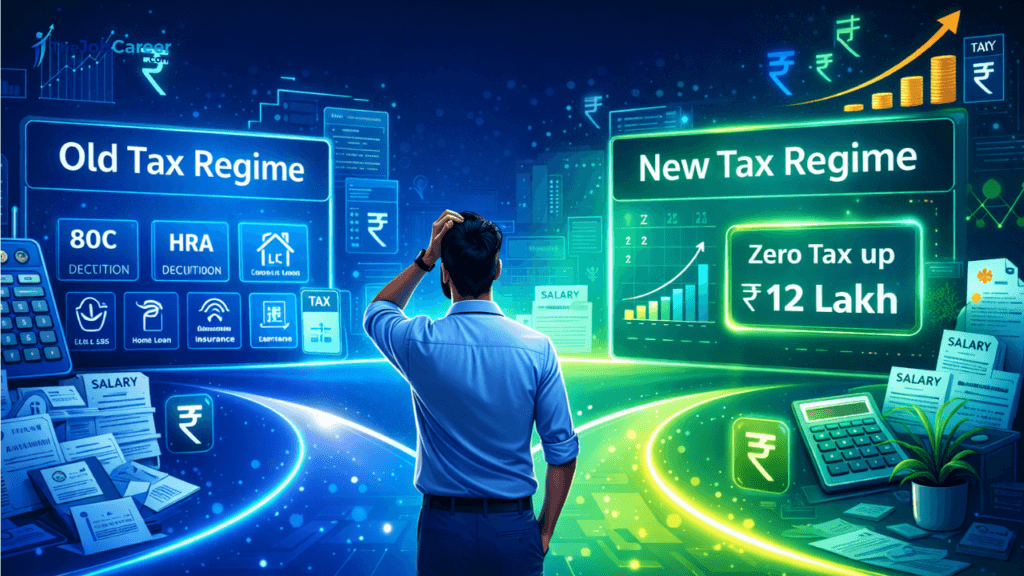

Every year between January and March, millions of salaried employees across India face the same deadline from their HR or payroll department — “Please submit your tax regime choice for the financial year.” And every year, millions of people make this choice without fully understanding what they are choosing between, why it matters, and how much money they could save or lose by choosing wrong.
In 2026, this decision is more important than ever before — because the tax slabs, exemption limits, and benefits under both regimes have changed significantly after the Union Budget 2025-26. The new tax regime has been made dramatically more attractive — with zero tax on income up to Rs. 12 lakh, a higher standard deduction of Rs. 75,000, and revised slabs that reduce tax at every income level. At the same time, the old tax regime still offers a wide range of deductions — home loan interest, HRA exemption, insurance premiums, PF investments — that can make it more beneficial for people who use them aggressively.
The right choice between old and new regime is not universal. It depends entirely on your income, your investments, your loans, and your personal financial situation. This complete guide breaks down both regimes clearly, compares them at every income level, shows you exactly which regime saves more money in specific scenarios, and gives you a clear decision framework so you can make the right choice for FY 2025-26 (AY 2026-27) — and every year after.
What Changed in Budget 2025-26: The Big Picture
The Union Budget 2025-26 made sweeping changes to both tax regimes — but especially to the new regime. Understanding these changes is critical because many people are still operating with outdated information from previous years.
New Tax Regime — Major Changes in Budget 2025-26
1. Zero Tax Up to Rs. 12 Lakh: The most headline-grabbing change — individuals with taxable income up to Rs. 12,00,000 pay zero tax under the new regime due to the enhanced rebate under Section 87A. Combined with the standard deduction of Rs. 75,000 for salaried employees, this effectively means zero tax on gross salary up to Rs. 12,75,000.
2. Standard Deduction Increased to Rs. 75,000: Previously Rs. 50,000, the standard deduction under the new regime was increased to Rs. 75,000 for salaried employees and pensioners. This is a flat deduction available to all salaried taxpayers without any investment or proof required.
3. Revised Tax Slabs: The income tax slabs under the new regime were restructured with lower rates and higher threshold limits — making more income taxable at lower rates.
4. New Regime Made Default: The new regime continues as the default regime in 2026. If you do not actively choose the old regime before the deadline set by your employer, you are automatically placed in the new regime.
Old Tax Regime — What Changed
The old tax regime slabs remain unchanged — the same 5%, 20%, and 30% rates with the same threshold limits as before. However, the basic exemption limit and Section 87A rebate under the old regime remain lower than the new regime, making it less attractive for those without significant deductions.
New Tax Regime: Complete Slab Structure for FY 2025-26
| Annual Income | Tax Rate |
|---|---|
| Up to Rs. 4,00,000 | Nil |
| Rs. 4,00,001 — Rs. 8,00,000 | 5% |
| Rs. 8,00,001 — Rs. 12,00,000 | 10% |
| Rs. 12,00,001 — Rs. 16,00,000 | 15% |
| Rs. 16,00,001 — Rs. 20,00,000 | 20% |
| Rs. 20,00,001 — Rs. 24,00,000 | 25% |
| Above Rs. 24,00,000 | 30% |
Key Rebates and Deductions Available:
- Standard Deduction: Rs. 75,000 (salaried and pensioners)
- Section 87A Rebate: Rs. 60,000 — applicable if taxable income is up to Rs. 12,00,000 (making tax nil)
- NPS Employer Contribution (Section 80CCD(2)): Up to 14% of basic + DA — still available in new regime
- Family Pension Standard Deduction: Rs. 25,000
- Surcharge and Cess: 4% Health and Education Cess on tax payable
What is NOT Available in New Regime:
- Section 80C (PF, LIC, ELSS, PPF, home loan principal, tuition fees)
- Section 80D (Health insurance premium)
- HRA Exemption
- Section 24b (Home loan interest up to Rs. 2 lakh)
- LTA (Leave Travel Allowance)
- Section 80E (Education loan interest)
- Section 80G (Donations)
- Section 80TTA/TTB (Savings account interest)
- Professional Tax deduction
Old Tax Regime: Complete Slab Structure for FY 2025-26
| Annual Income | Tax Rate |
|---|---|
| Up to Rs. 2,50,000 | Nil |
| Rs. 2,50,001 — Rs. 5,00,000 | 5% |
| Rs. 5,00,001 — Rs. 10,00,000 | 20% |
| Above Rs. 10,00,000 | 30% |
For Senior Citizens (60-80 years):
| Annual Income | Tax Rate |
|---|---|
| Up to Rs. 3,00,000 | Nil |
| Rs. 3,00,001 — Rs. 5,00,000 | 5% |
| Rs. 5,00,001 — Rs. 10,00,000 | 20% |
| Above Rs. 10,00,000 | 30% |
For Super Senior Citizens (80+ years):
| Annual Income | Tax Rate |
|---|---|
| Up to Rs. 5,00,000 | Nil |
| Rs. 5,00,001 — Rs. 10,00,000 | 20% |
| Above Rs. 10,00,000 | 30% |
Key Rebates and Deductions Available:
- Standard Deduction: Rs. 50,000 (salaried and pensioners)
- Section 87A Rebate: Rs. 12,500 — if taxable income is up to Rs. 5,00,000 (making tax nil)
- Section 80C: Up to Rs. 1,50,000 (PF, LIC, ELSS, PPF, NSC, home loan principal, tuition fees)
- Section 80D: Up to Rs. 25,000 (self/family health insurance) + Rs. 50,000 (senior citizen parents)
- HRA Exemption: Actual HRA received or 50%/40% of salary or rent paid minus 10% of salary (least of three)
- Section 24b: Up to Rs. 2,00,000 on home loan interest (self-occupied)
- LTA: Leave Travel Allowance exemption (twice in 4-year block)
- Section 80CCD(1B): Additional Rs. 50,000 for NPS over 80C limit
- Section 80E: Full education loan interest deduction (8 years)
- Section 80G: 50-100% of eligible donations
- Section 80TTA: Up to Rs. 10,000 savings account interest deduction
- Professional Tax: Deductible from gross salary
Side-by-Side Comparison: Old vs New Regime
| Feature | Old Tax Regime | New Tax Regime |
|---|---|---|
| Basic Exemption Limit | Rs. 2.5 lakh | Rs. 4 lakh |
| Zero Tax Up To (With Rebate) | Rs. 5 lakh | Rs. 12 lakh |
| Standard Deduction | Rs. 50,000 | Rs. 75,000 |
| Section 80C | ✅ Up to Rs. 1.5 lakh | ❌ Not available |
| Section 80D (Health Insurance) | ✅ Up to Rs. 75,000 | ❌ Not available |
| HRA Exemption | ✅ Available | ❌ Not available |
| Home Loan Interest (24b) | ✅ Up to Rs. 2 lakh | ❌ Not available |
| NPS Employer Contribution (80CCD2) | ✅ Available | ✅ Available (14% of basic) |
| LTA | ✅ Available | ❌ Not available |
| Education Loan Interest (80E) | ✅ Full deduction | ❌ Not available |
| Default Regime | ❌ Must opt-in | ✅ Auto-selected |
| Complexity | High — needs investment proofs | Low — no proofs required |
| Best For | High deduction users | Low deduction users |
Tax Calculation: Old vs New at Different Income Levels
Let us do the actual math — no estimates, no approximations. These calculations show exactly how much tax you pay under each regime at different income levels, helping you see which is better for your salary bracket.
Income Rs. 8 Lakh Per Year (Monthly Rs. 66,667)
New Regime:
- Gross Income: Rs. 8,00,000
- Less Standard Deduction: Rs. 75,000
- Taxable Income: Rs. 7,25,000
- Tax: (Rs. 4,00,000 × 0%) + (Rs. 3,25,000 × 5%) = Rs. 16,250
- Cess (4%): Rs. 650
- Total Tax: Rs. 16,900
Old Regime (with typical deductions — 80C Rs. 1.5L, 80D Rs. 25,000):
- Gross Income: Rs. 8,00,000
- Less Standard Deduction: Rs. 50,000
- Less 80C: Rs. 1,50,000
- Less 80D: Rs. 25,000
- Taxable Income: Rs. 5,75,000
- Tax: (Rs. 2,50,000 × 0%) + (Rs. 2,50,000 × 5%) + (Rs. 75,000 × 20%) = Rs. 12,500 + Rs. 15,000 = Rs. 27,500
- Cess (4%): Rs. 1,100
- Total Tax: Rs. 28,600
Winner at Rs. 8 Lakh: New Regime saves Rs. 11,700 ✅
Income Rs. 10 Lakh Per Year (Monthly Rs. 83,333)
New Regime:
- Taxable Income after standard deduction: Rs. 9,25,000
- Tax: (Rs. 4,00,000 × 0%) + (Rs. 4,00,000 × 5%) + (Rs. 1,25,000 × 10%) = Rs. 20,000 + Rs. 12,500 = Rs. 32,500
- Cess: Rs. 1,300
- Total Tax: Rs. 33,800
Old Regime (80C Rs. 1.5L, 80D Rs. 25,000, HRA Rs. 60,000):
- Taxable Income: Rs. 10,00,000 – Rs. 50,000 – Rs. 1,50,000 – Rs. 25,000 – Rs. 60,000 = Rs. 7,15,000
- Tax: (Rs. 2,50,000 × 0%) + (Rs. 2,50,000 × 5%) + (Rs. 2,15,000 × 20%) = Rs. 12,500 + Rs. 43,000 = Rs. 55,500
- Cess: Rs. 2,220
- Total Tax: Rs. 57,720
Winner at Rs. 10 Lakh: New Regime saves Rs. 23,920 ✅
Income Rs. 12 Lakh Per Year (Monthly Rs. 1,00,000)
New Regime:
- Taxable Income after standard deduction: Rs. 11,25,000
- Tax before rebate: (Rs. 4,00,000 × 0%) + (Rs. 4,00,000 × 5%) + (Rs. 3,25,000 × 10%) = Rs. 20,000 + Rs. 32,500 = Rs. 52,500
- Section 87A Rebate: Rs. 52,500 (full rebate since taxable income ≤ Rs. 12 lakh)
- Total Tax: Rs. 0 ✅ Zero tax!
Old Regime (80C Rs. 1.5L, 80D Rs. 25,000, HRA Rs. 80,000):
- Taxable Income: Rs. 12,00,000 – Rs. 50,000 – Rs. 1,50,000 – Rs. 25,000 – Rs. 80,000 = Rs. 8,95,000
- Tax: Rs. 12,500 + Rs. 79,000 = Rs. 91,500
- Cess: Rs. 3,660
- Total Tax: Rs. 95,160
Winner at Rs. 12 Lakh: New Regime saves Rs. 95,160 ✅ Massive saving!
Income Rs. 15 Lakh Per Year (Monthly Rs. 1,25,000)
New Regime:
- Taxable Income: Rs. 15,00,000 – Rs. 75,000 = Rs. 14,25,000
- Tax: Rs. 0 + Rs. 20,000 + Rs. 40,000 + (Rs. 2,25,000 × 15%) = Rs. 60,000 + Rs. 33,750 = Rs. 93,750
- Cess: Rs. 3,750
- Total Tax: Rs. 97,500
Old Regime (80C Rs. 1.5L, 80D Rs. 50,000, HRA Rs. 1.2L, Home Loan Interest Rs. 2L):
- Taxable Income: Rs. 15,00,000 – Rs. 50,000 – Rs. 1,50,000 – Rs. 50,000 – Rs. 1,20,000 – Rs. 2,00,000 = Rs. 9,30,000
- Tax: Rs. 12,500 + Rs. 86,000 = Rs. 98,500
- Cess: Rs. 3,940
- Total Tax: Rs. 1,02,440
Winner at Rs. 15 Lakh: New Regime saves Rs. 4,940 ✅ (But barely — depends on actual deductions)
Income Rs. 20 Lakh Per Year (Monthly Rs. 1,66,667)
New Regime:
- Taxable Income: Rs. 20,00,000 – Rs. 75,000 = Rs. 19,25,000
- Tax: Rs. 0 + Rs. 20,000 + Rs. 40,000 + Rs. 60,000 + Rs. 65,000 + (Rs. 3,25,000 × 25%) = Rs. 1,85,000 + Rs. 81,250 = Rs. 2,66,250
- Wait — let me recalculate correctly:
- Up to Rs. 4L: 0
- Rs. 4L-8L (Rs. 4L): 5% = Rs. 20,000
- Rs. 8L-12L (Rs. 4L): 10% = Rs. 40,000
- Rs. 12L-16L (Rs. 4L): 15% = Rs. 60,000
- Rs. 16L-19.25L (Rs. 3.25L): 20% = Rs. 65,000
- Total: Rs. 1,85,000
- Cess: Rs. 7,400
- Total Tax: Rs. 1,92,400
Old Regime (80C Rs. 1.5L, 80D Rs. 75,000, HRA Rs. 1.5L, Home Loan Interest Rs. 2L, NPS 80CCD(1B) Rs. 50,000):
- Taxable Income: Rs. 20,00,000 – Rs. 50,000 – Rs. 1,50,000 – Rs. 75,000 – Rs. 1,50,000 – Rs. 2,00,000 – Rs. 50,000 = Rs. 13,25,000
- Tax: Rs. 12,500 + Rs. 1,00,000 + (Rs. 3,25,000 × 30%) = Rs. 12,500 + Rs. 1,00,000 + Rs. 97,500 = Rs. 2,10,000
- Cess: Rs. 8,400
- Total Tax: Rs. 2,18,400
Winner at Rs. 20 Lakh: New Regime saves Rs. 25,000 — but ONLY if your actual deductions are similar to the example. If your deductions are higher (e.g., higher home loan in a metro city), old regime may win. ✅
Income Rs. 30 Lakh Per Year (Monthly Rs. 2,50,000)
New Regime:
- Taxable Income: Rs. 30,00,000 – Rs. 75,000 = Rs. 29,25,000
- Tax:
- Up to Rs. 4L: 0
- Rs. 4L-8L: Rs. 20,000
- Rs. 8L-12L: Rs. 40,000
- Rs. 12L-16L: Rs. 60,000
- Rs. 16L-20L: Rs. 80,000
- Rs. 20L-24L: Rs. 1,00,000
- Rs. 24L-29.25L (Rs. 5.25L): 30% = Rs. 1,57,500
- Total Tax: Rs. 4,57,500
- Cess: Rs. 18,300
- Total Tax: Rs. 4,75,800
Old Regime (Maximum deductions — 80C Rs. 1.5L, 80D Rs. 75,000, HRA Rs. 2L, Home Loan Rs. 2L, NPS Rs. 50,000):
- Taxable Income: Rs. 30,00,000 – Rs. 50,000 – Rs. 1,50,000 – Rs. 75,000 – Rs. 2,00,000 – Rs. 2,00,000 – Rs. 50,000 = Rs. 22,75,000
- Tax: Rs. 12,500 + Rs. 1,00,000 + (Rs. 12,75,000 × 30%) = Rs. 12,500 + Rs. 1,00,000 + Rs. 3,82,500 = Rs. 4,95,000
- Cess: Rs. 19,800
- Total Tax: Rs. 5,14,800
Winner at Rs. 30 Lakh: New Regime saves Rs. 39,000 even with maximum deductions in old regime ✅
The Break-Even Analysis: Where Old Regime Wins
After running all these calculations, the pattern becomes clear. There is a specific income range and deduction threshold where the old regime can outperform the new regime. Here is the honest break-even analysis:
Income Range Where Old Regime MIGHT Win (FY 2025-26)
| Income Bracket | Old Regime Wins If Deductions Exceed |
|---|---|
| Rs. 8 — Rs. 10 lakh | Practically never — new regime almost always better |
| Rs. 10 — Rs. 12 lakh | Practically never — new regime gives zero tax |
| Rs. 12 — Rs. 15 lakh | Deductions above Rs. 3.75 lakh needed |
| Rs. 15 — Rs. 20 lakh | Deductions above Rs. 4.5 lakh needed |
| Rs. 20 — Rs. 30 lakh | Deductions above Rs. 5.5 lakh needed |
| Above Rs. 30 lakh | Deductions above Rs. 6 lakh+ needed |
What deductions of Rs. 3.75 lakh+ look like:
- Standard Deduction: Rs. 50,000
- 80C investments: Rs. 1,50,000 (full limit)
- HRA exemption: Rs. 80,000-1,20,000 (requires renting in a city)
- Home loan interest (Section 24b): Rs. 1,50,000-2,00,000
- 80D health insurance: Rs. 50,000-75,000
- NPS 80CCD(1B): Rs. 50,000
If you have ALL of these — a home loan, you pay rent, you maximise 80C and 80D, and you invest in NPS — then for income above Rs. 15 lakh, the old regime may save you more tax. Below Rs. 15 lakh, the new regime is almost universally better in 2026.
The Special Case: Income Up to Rs. 12.75 Lakh
This is the most powerful feature of the new regime in 2026 and deserves special emphasis. If your gross salary is up to Rs. 12,75,000 per year, you pay absolutely zero income tax under the new regime.
Here is how:
- Gross Salary: Rs. 12,75,000
- Less Standard Deduction: Rs. 75,000
- Taxable Income: Rs. 12,00,000
- Tax on Rs. 12,00,000 (computed as per slabs): Rs. 60,000
- Section 87A Rebate (income ≤ Rs. 12,00,000): Rs. 60,000
- Net Tax Payable: Rs. 0
This zero-tax benefit for income up to Rs. 12.75 lakh is the single most compelling reason why the new regime has become default and why millions of salaried employees in the Rs. 8-13 lakh income bracket are switching to the new regime in 2026.
Important Note on the Rs. 12 Lakh Limit: The rebate under Section 87A applies when taxable income (after standard deduction) is up to Rs. 12,00,000. If your taxable income is Rs. 12,00,001 — even Rs. 1 above the limit — the full tax on Rs. 12,00,001 becomes payable (no marginal relief in new regime). This is called the marginal income trap. If your income is close to Rs. 12,75,000, be very careful — a small bonus or incentive could push you above the threshold and make you suddenly liable for Rs. 60,000+ in tax.
NPS Employer Contribution: The Hidden Advantage of New Regime
One deduction that IS available in the new regime and is often overlooked is the employer’s NPS contribution under Section 80CCD(2).
If your employer contributes to NPS on your behalf — up to 14% of your basic salary + DA under the central government / 10% for private sector — this entire amount is deductible even in the new regime.
Example: If your basic salary is Rs. 6 lakh per year and your employer contributes 10% (Rs. 60,000) to NPS, this Rs. 60,000 is deductible from your taxable income under the new regime.
For central government employees, the government contributes 14% of basic + DA to NPS — making this a significant deduction available in the new regime that many employees are not claiming correctly.
How to Choose: A Simple Decision Framework
Use these questions to make your decision quickly and confidently:
Step 1: Calculate Your Gross Annual Income
Include all components — basic salary, HRA, special allowance, bonus, variable pay. Do not include employer’s NPS contribution (it is not your income).
Step 2: Check if Your Income is Below Rs. 12.75 Lakh
If YES → Choose New Regime immediately. Zero tax. No investment required. No proof submission required. Simple.
If NO → Move to Step 3.
Step 3: List Your Actual Deductions Under Old Regime
Be honest — only include deductions you actually use or plan to use:
| Deduction | Amount You Claim |
|---|---|
| Standard Deduction | Rs. 50,000 (automatic) |
| Section 80C (PF + LIC + ELSS etc.) | Rs. _____ |
| HRA Exemption (if you pay rent) | Rs. _____ |
| Section 24b (Home Loan Interest) | Rs. _____ |
| Section 80D (Health Insurance) | Rs. _____ |
| NPS 80CCD(1B) | Rs. _____ |
| Other (80E, 80G, 80TTA etc.) | Rs. _____ |
| Total Deductions | Rs. _____ |
Step 4: Calculate Tax Under Both Regimes
Use the income tax portal calculator at incometax.gov.in — it has a free built-in comparison tool that calculates your tax under both regimes simultaneously when you enter your income and deductions.
Step 5: Choose the Regime with Lower Tax
It really is that simple. The regime that gives you the lower tax number is your answer.
Choose New Regime If:
✅ Your income is Rs. 12.75 lakh or below — zero tax is unbeatable ✅ You do not pay rent or your HRA exemption is small ✅ You do not have a home loan ✅ Your 80C investments are mainly PF (already deducted by employer) and you do not actively invest in LIC/ELSS/PPF ✅ You value simplicity — no investment proofs, no declarations ✅ You are a freelancer or self-employed with no salary-based deductions ✅ You are young (under 30) without major financial commitments like home loans
Choose Old Regime If:
✅ You pay significant rent in a metro city (HRA exemption is Rs. 1.5-2 lakh+) ✅ You have an active home loan with interest payments above Rs. 1.5 lakh per year ✅ You maximise all deductions — 80C, 80D, NPS, education loan, etc. ✅ Your total eligible deductions under old regime exceed Rs. 4.5-5 lakh ✅ Your income is above Rs. 20 lakh and you have substantial investments ✅ You are a senior citizen with high medical expenses and health insurance premiums
Switching Between Regimes: What Are the Rules
A common question is whether you can switch regimes every year. The rules are different for salaried employees and those with business income.
For Salaried Employees (No Business Income)
You can switch between old and new regime every financial year. If you chose the old regime last year and want to switch to new this year, simply inform your employer at the beginning of the financial year. You can switch back next year if you want.
Important: Your employer applies TDS based on your declared choice. If you choose new regime with your employer but want to claim old regime benefits at ITR filing time, you can do so — but you will need to pay any additional tax plus interest if there is a shortfall in TDS.
For Those With Business Income
If you have any business or professional income (freelancing, consulting, trading), the rules are stricter. Once you opt out of the new regime (to go to old regime), you can only switch back to new regime once in your lifetime. After that switch back, you cannot return to old regime again if you have business income.
Common Mistakes People Make
Choosing without calculating: The most common mistake. Many people choose new regime because “it seems simpler” or choose old regime because “my parents always invested in LIC.” Neither is a valid reason. Run the actual numbers for your specific income and deductions.
Forgetting that employer PF is already in 80C: Your Employee Provident Fund contribution is automatically part of Section 80C. Many employees forget this when calculating old regime deductions — their 80C is already partially or fully utilised without any additional investment.
Ignoring HRA correctly: HRA exemption is calculated as the MINIMUM of three amounts: actual HRA received, 50% of salary (metro)/40% of salary (non-metro), and actual rent paid minus 10% of salary. Many people claim the wrong amount. Use the HRA calculator on the income tax portal.
Not updating choice with employer at the start of year: If you want old regime benefits, you must inform your employer in April. If you inform them in December, only 4 months of revised TDS is possible — you may face tax shortfall and interest.
Assuming new regime is always better: Post-Budget 2025-26, new regime is better for most people — but not all. High-income individuals with large home loans in metro cities and aggressive investment habits can still save more in old regime.
Frequently Asked Questions
Q1: I earn Rs. 10 lakh per year. Which regime should I choose?
New regime — almost certainly. At Rs. 10 lakh, the new regime will result in significantly lower tax compared to old regime unless you have very high deductions (typically Rs. 3.5 lakh+). Use the income tax portal calculator to confirm with your specific numbers, but new regime is the right choice for most people at this income level in 2026.
Q2: I have a home loan. Should I always choose old regime?
Not necessarily. A home loan interest deduction of Rs. 1-1.5 lakh may not be enough to make old regime better, especially if your income is below Rs. 15 lakh. Run the actual calculation. If your home loan interest plus other deductions collectively exceed Rs. 3.75 lakh (the approximate break-even), old regime might save more.
Q3: My employer is deducting TDS under the new regime but I want old regime. What can I do?
Inform your employer in writing that you want to switch to old regime. Employers are required to honour your regime choice. If you missed informing them at the start of the year, request a switch for the remaining months. If TDS has already been deducted under new regime, you can claim old regime benefits when filing your ITR and receive the difference as a refund.
Q4: Can I claim 80C investments if I am in the new regime?
No. Section 80C deductions — including LIC premiums, PPF contributions, ELSS investments, and home loan principal repayment — are NOT available in the new regime. This is one of the key differences. If you have made these investments specifically for tax saving, the old regime is the only way to benefit from them.
Q5: The new regime says zero tax up to Rs. 12 lakh. But my CTC is Rs. 12 lakh. Will I pay zero tax?
Your CTC (Cost to Company) is not the same as your taxable income. CTC includes employer’s PF contribution, gratuity component, and other employer costs that are not your income. Your actual gross salary (in-hand components) is typically 85-90% of CTC. If your CTC is Rs. 12 lakh, your taxable gross salary might be around Rs. 10-10.5 lakh — well within zero tax territory under new regime.
Q6: Is the old regime being abolished?
No. The old regime remains available as an option. The government made the new regime the default — meaning you are auto-enrolled in new regime unless you actively opt for old regime. Both regimes continue to coexist and you can choose either based on what suits you better.
Q7: I am a senior citizen. Which regime is better?
Senior citizens (60-80 years) get a higher basic exemption of Rs. 3 lakh under the old regime, compared to Rs. 4 lakh under new regime. However, senior citizens with significant health insurance premiums (Section 80D allows up to Rs. 50,000 for self plus Rs. 50,000 for dependent parents — Rs. 1 lakh total), no HRA or home loan interest, and basic deductions typically find the new regime better in 2026 given the zero tax up to Rs. 12 lakh benefit. Super senior citizens (80+) with their Rs. 5 lakh old regime exemption need to calculate carefully.
Quick Reference: Old vs New Regime at a Glance
| Annual Income | Better Regime | Tax Saved |
|---|---|---|
| Up to Rs. 7 lakh | New Regime | Zero tax vs some tax in old |
| Rs. 7 — Rs. 12.75 lakh | New Regime (almost always) | Rs. 15,000 — Rs. 95,000+ |
| Rs. 12.75 — Rs. 15 lakh | New Regime (usually) | Rs. 5,000 — Rs. 25,000 |
| Rs. 15 — Rs. 20 lakh | Depends on deductions | Calculate both |
| Rs. 20 — Rs. 30 lakh | New Regime (usually) | Rs. 25,000 — Rs. 40,000 |
| Above Rs. 30 lakh | New Regime (usually) | Rs. 30,000 — Rs. 60,000+ |
| Above Rs. 30 lakh with large home loan + HRA + all deductions | Old Regime possible | Calculate both |
Conclusion: Your Tax Regime Action Plan for FY 2025-26
The tax regime decision is not complicated — it just requires you to spend 20-30 minutes running the actual numbers for your specific situation rather than guessing or following generic advice.
Here is exactly what to do:
- Go to incometax.gov.in → Tax Calculator → select AY 2026-27 → enter your income and deductions → it automatically shows tax under both regimes side by side
- If your gross annual income is below Rs. 12.75 lakh — choose new regime today, you pay zero tax
- If your income is above Rs. 12.75 lakh — list your actual deductions honestly and use the calculator
- Inform your employer of your chosen regime in writing before the April deadline
- File your ITR before July 31, 2026 under the regime that saves you more tax
The money you save by choosing the right regime is money that stays in your pocket — without any additional effort, investment, or sacrifice. A 20-minute calculation today could save you Rs. 50,000 to Rs. 1,50,000 in taxes over the year.
Make the right choice. Pay less tax. Keep more of what you earn.
All the best! 💰
Related Learn & Growth Articles:
- Income Tax Filing Guide 2026: ITR-1 Step by Step for Salaried Employees
- 8th Pay Commission 2026: Salary Hike, Fitment Factor, New Pay Matrix
- How to Open a Demat Account in India 2026: Step-by-Step Guide
- Global Investing: A Complete Guide for Indian Investors in 2026
- What Are Sovereign Gold Bonds? Meaning, Interest Rate, Tax Benefit
- How to Apply for PAN Card Online in India: Step-by-Step Guide
- 7 Common Job Frauds in India: Complete Awareness Guide
- Digital Arrests: Inside India’s Scariest Scam and How to Stop It
Related Career Articles:
- Fresher Jobs Rs. 20,000 Salary — No Experience Required
- Top 10 High Paying Jobs in India 2026
- Freelancing in India 2026: How to Start, Earn and Grow Your Income
- SSC CGL 2026: Complete Preparation Guide
- IBPS PO 2026: Prelims + Mains + Interview Complete Roadmap
Official Resources:
- Income Tax Calculator: https://www.incometax.gov.in/iec/foportal/tax-calculator
- Income Tax Portal: https://www.incometax.gov.in
- Budget 2025-26 Official: https://www.indiabudget.gov.in
- CBDT Circular: https://www.incometaxindia.gov.in