
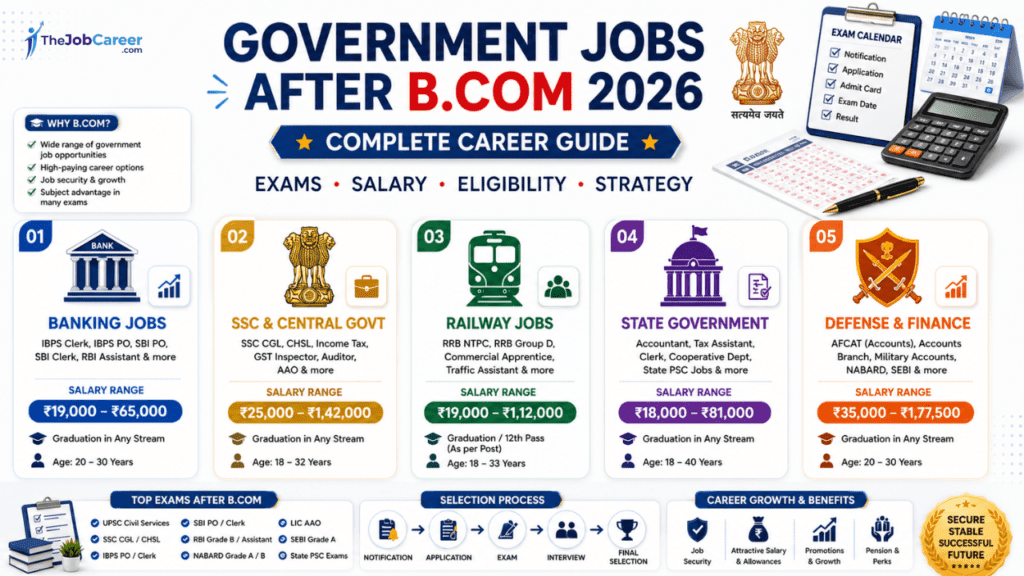

Commerce is the single largest stream at the graduate level in India — roughly 40% of all undergraduates hold a B.Com degree. Every year, lakhs of B.Com graduates walk out of colleges across the country wondering: what is the best government job I can get with this degree, how much will it pay, which exam do I need to clear, and what is the realistic path to getting there?
The honest answer is that B.Com graduates have one of the most powerful combinations of eligibility and subject advantage in Indian government recruitment. You can apply for every major central government exam — UPSC Civil Services, SSC CGL, IBPS PO, IBPS Clerk, SBI PO, RBI Grade B, LIC AAO, NABARD Grade A, SEBI Grade A, and dozens of state-level PSC positions. And unlike B.Tech graduates who are often funnelled toward technical roles, B.Com graduates have direct subject advantage in the highest-value posts — SSC CGL Auditor and Assistant Accounts Officer, RBI Grade B DEPR stream, NABARD Grade A Finance, LIC AAO — posts where your commerce background gives you a measurable edge over general stream candidates.
This complete guide covers every major government job option available to B.Com graduates in 2026 — ranked from highest to lowest salary, with exact eligibility criteria, exam pattern overview, salary structure, career growth timeline, and a strategic roadmap to decide which path is right for you. Whether you are a final-year B.Com student, a recent graduate, or someone who has been preparing for competitive exams for 1–2 years, this guide gives you the complete picture.
Why B.Com Graduates Have an Advantage in Government Recruitment
Before diving into individual exams, understand why B.Com specifically is a strong foundation for government job preparation:
| B.Com Subject | Directly Relevant To | Exam / Post |
|---|---|---|
| Financial Accounting | Auditor, AAO, RBI Finance, CAG | SSC CGL (AAO/Auditor), RBI Grade B DEPR, NABARD |
| Cost Accounting | Cost & Works Accountant, Finance roles | SSC CGL, UPSC IES, CAG |
| Economics | UPSC CSE, RBI Grade B, SEBI Grade A | All major competitive exams |
| Business Mathematics / Statistics | Quantitative Aptitude in all exams | SSC, Banking, Insurance exams |
| Income Tax and Law | Inspector Income Tax, Tax Assistant | SSC CGL, Income Tax Department |
| Banking and Finance | Banking PO/Clerk, IBPS/SBI exams | IBPS PO, SBI PO, RBI, NABARD |
| Business Communication | English in all exams, Interview rounds | All exams |
The subject advantage is real. A B.Com graduate preparing for SSC CGL’s AAO/Auditor posts brings 3 years of relevant academic background. A B.Com graduate preparing for IBPS PO already understands banking, accounting, and financial concepts that others must learn from scratch. This advantage, properly leveraged, translates directly into better scores and shorter preparation timelines.
Complete List: Government Jobs After B.Com 2026
Here is the master overview of every major government job a B.Com graduate can target in 2026, ranked by starting in-hand salary:
| # | Job / Post | Exam | Starting In-Hand Salary | Difficulty |
|---|---|---|---|---|
| 1 | RBI Grade B Officer | RBI Grade B | Rs. 1,20,000 – 1,60,000/month | Very High |
| 2 | SEBI Grade A Officer | SEBI Grade A | Rs. 90,000 – 1,10,000/month | Very High |
| 3 | NABARD Grade A Officer | NABARD Grade A | Rs. 80,000 – 95,000/month | High |
| 4 | IAS / IPS / IFS | UPSC CSE | Rs. 56,100 basic + perks | Extremely High |
| 5 | SBI Probationary Officer | SBI PO | Rs. 65,000 – 75,000/month | High |
| 6 | IBPS Probationary Officer | IBPS PO | Rs. 55,000 – 65,000/month | High |
| 7 | LIC Assistant Administrative Officer | LIC AAO | Rs. 58,000 – 68,000/month | High |
| 8 | SSC CGL — AAO / Auditor / Inspector | SSC CGL | Rs. 45,000 – 78,000/month (post-wise) | Moderate–High |
| 9 | UPSC EPFO (EO/AO) | UPSC EPFO | Rs. 55,000 – 65,000/month | High |
| 10 | RBI Assistant | RBI Assistant | Rs. 38,000 – 45,000/month | Moderate |
| 11 | IBPS Clerk / CSA | IBPS Clerk | Rs. 37,000 – 45,000/month | Moderate |
| 12 | SBI Clerk / Junior Associate | SBI Clerk | Rs. 38,000 – 46,000/month | Moderate |
| 13 | SSC CHSL — LDC / JSA / DEO | SSC CHSL | Rs. 30,000 – 40,000/month | Moderate |
| 14 | RRB NTPC — Graduate Posts | RRB NTPC | Rs. 35,000 – 50,000/month | Moderate |
| 15 | State PSC — Various Posts | State PSC | Rs. 35,000 – 70,000/month | Moderate–High |
1. RBI Grade B Officer — Highest Paying Entry-Level Government Job for B.Com
The Reserve Bank of India Grade B Direct Recruit is currently the highest-paying entry-level government job available to B.Com graduates.
| Parameter | Details |
|---|---|
| Post | Officer — Grade B (Manager) |
| Streams | General, DEPR (Economic Policy and Research), DSIM (Statistics) |
| Minimum Qualification | Graduation in any stream — 60% marks (55% for SC/ST/PwBD) |
| Age Limit | 21 to 30 years (33 for OBC, 35 for SC/ST) |
| Vacancies (2026) | 60 posts (General + DEPR + DSIM) |
| Selection Process | Phase 1 (Objective) → Phase 2 (Descriptive + Domain Paper) → Interview |
| Phase 1 Exam Date 2026 | June 13 – 14, 2026 |
| Phase 2 Exam Date 2026 | July 25 – 26, 2026 |
RBI Grade B Salary 2026
The RBI Grade B Salary for 2026 has been updated with a starting basic pay of Rs. 78,450 and a revised monthly gross pay of Rs. 1,54,936 (excluding HRA).
| Component | Amount (Rs.) |
|---|---|
| Basic Pay | 78,450 |
| Grade Allowance | 11,500 |
| Dearness Allowance (DA) | 15,669 |
| Special Allowance | 20,175 |
| HRA (15% if accommodation not provided) | 11,768 |
| Other Allowances | ~17,000 |
| Gross Monthly Salary (with HRA) | ~Rs. 1,54,936 – 1,62,000 |
| In-Hand (after NPS + tax deductions) | ~Rs. 1,20,000 – 1,32,000 |
| Annual CTC | Rs. 34 – 42 lakh |
RBI Grade B Pay Scale Progression
| Years of Service | Basic Pay | Approximate Gross |
|---|---|---|
| Entry | Rs. 78,450 | Rs. 1,55,000 |
| After 9 years | Rs. 1,14,900 | Rs. 2,00,000+ |
| After 11 years | Rs. 1,23,000 | Rs. 2,15,000+ |
| After 15 years | Rs. 1,41,600 | Rs. 2,40,000+ |
B.Com advantage: The DEPR (Economic Policy and Research) stream specifically tests economics, finance, and economic statistics — exactly what B.Com Honours in Economics covers. DEPR stream candidates write an additional paper in Economics/Finance in Phase 2, where B.Com and Economics graduates have significant advantage over general stream candidates.
Why it is the best job: RBI Grade B offers a high salary (Rs. 1.6 lakh/month in hand) for a moderate and structured workload — mostly policy-making, analysis, and desk-based tasks with generally fixed working hours around 9:30 AM to 5:30 PM. That combination of the highest entry-level government salary, excellent work-life balance, and the prestige of working at India’s central bank makes RBI Grade B the single best target for an ambitious B.Com graduate.
2. SEBI Grade A Officer — Financial Markets Regulator
| Parameter | Details |
|---|---|
| Post | Officer Grade A (Assistant Manager) |
| Streams | General, Legal, Information Technology, Research, Official Language |
| Minimum Qualification | Graduation in any stream — 60% marks |
| Age Limit | Up to 30 years (relaxations for reserved categories) |
| Selection Process | Phase 1 (Objective) → Phase 2 (Objective + Descriptive) → Interview |
| Starting Basic Pay | Rs. 44,500 per month |
| In-Hand Salary | Rs. 90,000 – 1,10,000/month |
| Annual CTC | Rs. 17 – 22 lakh (plus allowances) |
SEBI Grade A is the regulator of India’s capital markets — securities, stock exchanges, mutual funds, and derivatives. For B.Com graduates with strong interest in financial markets, capital markets law, and investment products, this is the premium regulatory job.
B.Com advantage: The Research stream specifically tests financial markets, investment analysis, economics, and statistical methods — B.Com Finance and Economics graduates are particularly well-suited. General stream candidates also benefit from B.Com’s quantitative and financial knowledge base.
3. NABARD Grade A — Development Banking and Rural Finance
| Parameter | Details |
|---|---|
| Post | Assistant Manager — Grade A |
| Streams | General, Agriculture, Finance, IT, Legal, HR, Rajbhasha |
| Minimum Qualification | Graduation — 50% (60% preferred) for Finance stream: B.Com / MBA Finance |
| Age Limit | 21 to 30 years |
| Selection Process | Phase 1 (Objective) → Phase 2 (Descriptive) → Interview |
| Starting Basic Pay | Rs. 44,500 per month |
| Gross Monthly Salary | Rs. 80,000 – 95,000 |
| In-Hand Salary | Rs. 68,000 – 80,000/month |
NABARD stands for National Bank for Agriculture and Rural Development. It finances and regulates agricultural credit, rural infrastructure, and microfinance across India. The Finance stream is directly suited to B.Com graduates — questions on financial accounting, cost accounting, management accounting, auditing, and financial management align directly with the B.Com syllabus.
Unique benefit: NABARD Grade A officers are eligible for subsidised housing loans, education loans, and foreign study tours. The work involves policy-level decisions on rural credit and agricultural financing — intellectually challenging and socially impactful.
4. IAS / IPS / IFS through UPSC Civil Services — The Most Prestigious Path
| Parameter | Details |
|---|---|
| Posts | IAS, IPS, IFS, IRS, and 20+ other All India Services |
| Exam | UPSC Civil Services Examination (CSE) |
| Minimum Qualification | Any graduation from a recognised university |
| Age Limit | 21 to 32 years (General); 35 (OBC); 37 (SC/ST) |
| Attempts | 6 (General); 9 (OBC); Unlimited (SC/ST until age limit) |
| Selection Process | Prelims (GS Paper 1 + CSAT) → Mains (9 papers) → Interview |
| Total Posts (2026) | ~1,056 posts (varies by cycle) |
| Entry Basic Pay (IAS) | Rs. 56,100 (Pay Level 10) |
| In-Hand Salary | Rs. 60,000 – 80,000 + perks worth Rs. 40,000 – 60,000 |
The full value of an IAS posting goes far beyond the salary: government accommodation (saves Rs. 30,000–80,000/month in metro cities), official vehicle and driver, household staff, medical facilities for the entire family, security cover, pension, and unmatched career authority. An IAS officer at District Collector level effectively commands a monthly lifestyle equivalent of Rs. 2–3 lakh even on a Rs. 80,000 salary.
B.Com Optional Subject Advantage in UPSC Mains
UPSC Mains allows candidates to choose one optional subject (two papers of 250 marks each). B.Com graduates have strong options:
| Optional Subject | B.Com Relevance | Typical Score Range |
|---|---|---|
| Commerce and Accountancy | Direct — all B.Com subjects covered | 250 – 320 out of 500 |
| Economics | B.Com Economics background | 280 – 340 out of 500 |
| Management | B.Com Management background | 260 – 320 out of 500 |
| Public Administration | Moderate relevance | 260 – 330 out of 500 |
Commerce and Accountancy optional is one of the highest-scoring optionals in UPSC — B.Com graduates who choose this stream consistently rank among the top performers in optional paper scores.
UPSC Mains — Commerce and Accountancy Optional Syllabus Overview
| Paper | Key Topics |
|---|---|
| Paper 1 | Accounting standards, financial statements, auditing, cost accounting, management accounting, financial management |
| Paper 2 | Business laws, company law, tax laws, economic environment, capital markets, international business |
For a sincere B.Com graduate, this optional reduces preparation time significantly compared to non-commerce candidates — these are subjects studied across 3 years of graduation.
5. SBI Probationary Officer — Premium Banking Career
| Parameter | Details |
|---|---|
| Post | Probationary Officer (PO) — Junior Management Grade Scale I |
| Exam | SBI PO |
| Minimum Qualification | Any graduation |
| Age Limit | 21 to 30 years |
| Selection Process | Prelims → Mains → Group Exercise + Interview |
| Starting Basic Pay | Rs. 41,960 (4 advance increments on joining) |
| Gross Monthly Salary | Rs. 80,000 – 90,000 |
| In-Hand Salary | Rs. 65,000 – 75,000/month |
| Annual CTC | Rs. 14 – 17 lakh |
SBI PO is the most prestigious banking PO exam in India — SBI is the country’s largest bank and an SBI PO carries significant institutional prestige. The exam is conducted in three stages including a Group Exercise and Personal Interview, making it slightly harder than IBPS PO.
Promotion path: SBI PO → Scale II Officer (3–4 years) → Scale III (5–7 years) → Branch Manager → AGM → DGM → GM → CGM — a 25-year path from PO to General Manager with salary crossing Rs. 2 lakh/month at senior levels.
6. IBPS Probationary Officer — 11 Banks, High Vacancies
| Parameter | Details |
|---|---|
| Post | Probationary Officer across 11 Public Sector Banks |
| Exam | IBPS PO (CRP PO/MT) |
| Minimum Qualification | Any graduation |
| Age Limit | 20 to 30 years |
| Selection Process | Prelims → Mains → Interview |
| Starting Basic Pay | Rs. 36,000 (Rs. 48,480 after 4 advance increments — 12th Bipartite) |
| Gross Monthly Salary | Rs. 73,000 – 82,000 |
| In-Hand Salary | Rs. 55,000 – 65,000/month |
| Annual CTC | Rs. 12 – 15 lakh |
IBPS PO covers 11 participating public sector banks and typically announces 4,000–6,000+ vacancies per cycle. The exam has three stages including an interview, and the in-hand salary after the 12th Bipartite Settlement makes it one of the most attractive banking entry points.
B.Com advantage: Banking Awareness, Financial Awareness, and Quantitative Aptitude — three major sections across IBPS PO Mains — align directly with B.Com curriculum. B.Com graduates who have studied banking, financial accounting, and business mathematics have a genuine preparation advantage.
7. LIC Assistant Administrative Officer (AAO) — Insurance Sector
| Parameter | Details |
|---|---|
| Post | Assistant Administrative Officer |
| Conducting Body | Life Insurance Corporation of India (LIC) |
| Minimum Qualification | Graduation in any stream |
| Age Limit | 21 to 30 years |
| Selection Process | Prelims → Mains → Interview |
| Starting Basic Pay | Rs. 32,795 per month |
| Gross Monthly Salary | Rs. 58,000 – 70,000 |
| In-Hand Salary | Rs. 52,000 – 62,000/month |
| Annual CTC | Rs. 12 – 14 lakh |
LIC is India’s largest insurance company and a central government enterprise. LIC AAO is a Grade B officer-level post — you join as a generalist manager with postings across LIC’s 2,048 branches nationwide.
Special note for B.Com graduates: LIC AAO has a Finance and Accounts specialist stream in addition to the general stream. The Finance stream requires B.Com / CA / MBA Finance qualification and tests subjects including financial accounting, taxation, audit, and corporate finance — directly from the B.Com syllabus. Finance stream AAOs receive the same pay scale as general AAOs but work exclusively in financial management, audit, and compliance divisions — more suited to commerce graduates.
8. SSC CGL — Multiple Commerce-Specific Posts
SSC CGL is the most versatile government exam for B.Com graduates because it recruits for over 60 different central government posts — and several of the highest-value posts are specifically designed for commerce graduates.
SSC CGL Posts Most Relevant for B.Com Graduates
| Post | Pay Level | Basic Pay | In-Hand | Department | Commerce Advantage |
|---|---|---|---|---|---|
| Assistant Audit Officer (AAO) | Level 8 | Rs. 47,600 | Rs. 70,000 – 78,000 | CAG of India | ✅✅✅ Direct — audit, accounting |
| Auditor | Level 5 | Rs. 29,200 | Rs. 46,000 – 54,000 | CAG / CGDA offices | ✅✅✅ Direct — auditing |
| Accountant / Junior Accountant | Level 5 | Rs. 29,200 | Rs. 46,000 – 54,000 | CAG, Railways, others | ✅✅✅ Direct — accounting |
| Tax Assistant | Level 4 | Rs. 25,500 | Rs. 41,000 – 48,000 | CBDT, CBIC | ✅✅ Strong — income tax knowledge |
| Inspector Income Tax | Level 7 | Rs. 44,900 | Rs. 68,000 – 76,000 | Income Tax Department | ✅✅ Strong |
| Inspector (Central Excise / Customs) | Level 7 | Rs. 44,900 | Rs. 68,000 – 76,000 | CBIC | ✅✅ Strong |
| Assistant Section Officer (ASS) | Level 6 | Rs. 35,400 | Rs. 54,000 – 63,000 | CSS, MEA, Railway Board | ✅ Moderate |
| Sub-Inspector (CBI) | Level 6 | Rs. 35,400 | Rs. 54,000 – 63,000 | Central Bureau of Investigation | ✅ Moderate |
The AAO post deserves special attention. AAO is the only Group B Gazetted post in SSC CGL, which means you start at Pay Level 8 (basic Rs. 47,600) instead of Level 7. The first promotion to Audit Officer (Level 10) happens in just 4–5 years, and the work is purely audit and accounting related — exactly what commerce graduates have studied. AAO is the single best CGL post for B.Com graduates and has the fastest promotion timeline.
SSC CGL Exam Pattern Overview
| Stage | Description | Marks |
|---|---|---|
| Tier 1 | Objective — GK, Reasoning, English, Maths | 200 marks (60 min) |
| Tier 2 | Objective — Maths/Reasoning + English/GK + Domain Specific | 390 marks |
| Tier 2 — Module III | Computer Proficiency Test (CPT) or Skill Test | Qualifying |
For AAO posts specifically, Tier 2 includes a Finance and Accounts domain paper — directly from the B.Com syllabus, covering financial accounting, auditing, cost accounting, and management accounting.
9. UPSC EPFO (Enforcement Officer / Accounts Officer)
| Parameter | Details |
|---|---|
| Post | Enforcement Officer / Accounts Officer (EO/AO) |
| Conducting Body | UPSC for EPFO (Employees’ Provident Fund Organisation) |
| Minimum Qualification | Any graduation |
| Age Limit | 21 to 30 years |
| Selection Process | Written Exam (Recruitment Test) → Interview |
| Pay Level | Level 8 — Basic Rs. 47,600 |
| In-Hand Salary | Rs. 55,000 – 65,000/month |
EPFO manages the Provident Fund accounts of over 70 million employees across India. The EO/AO post is a Group B Gazetted position under the Ministry of Labour and Employment. Work involves enforcing PF compliance by employers, handling employee grievances, conducting audits, and managing fund administration.
Why B.Com graduates should target this: The Accounts Officer stream directly uses accounting, auditing, and financial management knowledge. The exam tests General English, General Studies, and Industrial Relations and Labour Laws — all manageable for a B.Com graduate with focused preparation.
10. RBI Assistant — Entry-Level Central Banking
| Parameter | Details |
|---|---|
| Post | Assistant (Clerical Cadre) at Reserve Bank of India |
| Minimum Qualification | Graduation — 50% marks |
| Age Limit | 20 to 28 years |
| Selection Process | Prelims → Mains → Language Proficiency Test |
| Pay Scale | Rs. 20,700 – 53,735 |
| In-Hand Salary | Rs. 38,000 – 45,000/month |
| Annual CTC | Rs. 10 – 12 lakh |
While lower in salary than RBI Grade B, the RBI Assistant post carries the prestige of working in the Reserve Bank of India — one of India’s most respected institutions. Promotion from RBI Assistant to Grade B officer is possible through an internal exam after completing required years of service, making it a valuable stepping stone for those who want to work their way up within RBI.
11. IBPS Clerk / CSA — 15,736 Vacancies, Fastest Entry into Banking
| Parameter | Details |
|---|---|
| Post | Customer Service Associate (CSA) — formerly Clerk |
| Banks | 11 Public Sector Banks |
| Minimum Qualification | Any graduation |
| Age Limit | 20 to 28 years |
| Selection Process | Prelims → Mains (No Interview) |
| Starting Basic Pay | Rs. 24,050 (Rs. 26,730 for graduates — 2 advance increments) |
| In-Hand Salary | Rs. 37,000 – 45,000/month |
| Vacancies (CRP CSA-XV) | 15,736 — highest in recent years |
IBPS Clerk is the highest-vacancy banking exam in India — and the most accessible for fresh graduates. No interview means your Mains exam score alone determines selection. For B.Com graduates who want to enter banking quickly while continuing to prepare for PO/Grade B level exams, IBPS Clerk is the ideal entry point.
12. State PSC Exams — Overlooked Goldmine for B.Com Graduates
Every state has its own Public Service Commission conducting examinations for State Civil Services, Finance Services, Cooperative Banking, and Treasury posts. B.Com graduates are eligible for all of these.
Key State PSC Options for B.Com Graduates
| State | Exam | B.Com-Relevant Posts | Salary Range |
|---|---|---|---|
| Gujarat | GPSC | Gujarat Administrative Service, Finance Officer, Accounts Officer | Rs. 40,000 – 70,000/month |
| Maharashtra | MPSC | Maharashtra Finance Service, State Tax Inspector | Rs. 38,000 – 65,000/month |
| Rajasthan | RPSC | Rajasthan State and Subordinate Services — Finance cadre | Rs. 35,000 – 60,000/month |
| Uttar Pradesh | UPPSC / UPPCS | PCS, Finance Accounts Service | Rs. 38,000 – 68,000/month |
| Karnataka | KPSC | KAS, Commercial Tax Inspector | Rs. 38,000 – 65,000/month |
| Tamil Nadu | TNPSC | Group I, Group II — Finance and Accounts Service | Rs. 35,000 – 65,000/month |
| Madhya Pradesh | MPPSC | State Service — Finance cadre | Rs. 35,000 – 60,000/month |
Why state PSC is underrated: The competition for state PSC Finance posts is significantly lower than central government exams because fewer candidates specifically target Finance and Accounts cadre positions. B.Com graduates who prepare state-level Finance Service exams often face a candidate pool that is 50–70% smaller than the same exam’s general posts.
Salary Comparison: All Major Government Jobs for B.Com 2026
| Post | Starting Basic Pay | In-Hand Salary | 5-Year Projection | 10-Year Projection |
|---|---|---|---|---|
| RBI Grade B | Rs. 78,450 | Rs. 1,20,000 – 1,32,000 | Rs. 1,40,000+ | Rs. 1,80,000+ |
| SEBI Grade A | Rs. 44,500 | Rs. 90,000 – 1,10,000 | Rs. 1,15,000+ | Rs. 1,50,000+ |
| IAS (UPSC CSE) | Rs. 56,100 | Rs. 60,000 – 80,000 + perks | Rs. 80,000 + perks | Rs. 1,00,000 + perks |
| NABARD Grade A | Rs. 44,500 | Rs. 68,000 – 80,000 | Rs. 85,000+ | Rs. 1,10,000+ |
| SBI PO | Rs. 41,960 | Rs. 65,000 – 75,000 | Rs. 85,000+ | Rs. 1,10,000+ |
| LIC AAO | Rs. 32,795 | Rs. 52,000 – 62,000 | Rs. 70,000+ | Rs. 90,000+ |
| IBPS PO | Rs. 36,000 | Rs. 55,000 – 65,000 | Rs. 75,000+ | Rs. 95,000+ |
| SSC CGL AAO | Rs. 47,600 | Rs. 70,000 – 78,000 | Rs. 85,000+ | Rs. 1,05,000+ |
| SSC CGL Inspector IT | Rs. 44,900 | Rs. 68,000 – 76,000 | Rs. 82,000+ | Rs. 1,00,000+ |
| SSC CGL Auditor | Rs. 29,200 | Rs. 46,000 – 54,000 | Rs. 60,000+ | Rs. 78,000+ |
| UPSC EPFO EO/AO | Rs. 47,600 | Rs. 55,000 – 65,000 | Rs. 70,000+ | Rs. 88,000+ |
| RBI Assistant | Rs. 20,700 | Rs. 38,000 – 45,000 | Rs. 50,000+ | Rs. 65,000+ |
| IBPS Clerk | Rs. 24,050 | Rs. 37,000 – 45,000 | Rs. 50,000+ | Rs. 65,000+ |
Exam Difficulty and Preparation Timeline — Honest Assessment
Understanding how long it realistically takes to prepare for each exam helps you plan your career trajectory intelligently:
| Exam | Preparation Time (Dedicated) | Difficulty | Key Challenge |
|---|---|---|---|
| RBI Grade B | 12 – 18 months | Very High | Economics/Finance depth + Descriptive writing + low vacancy count (60 posts) |
| UPSC CSE | 18 – 36 months | Extremely High | Breadth of Mains syllabus, essay writing, interview preparation |
| SEBI Grade A | 12 – 18 months | Very High | Financial markets knowledge + low vacancy count |
| NABARD Grade A | 10 – 15 months | High | Agriculture + finance knowledge + interview |
| SBI PO | 6 – 10 months | High | Group Exercise + Interview stage |
| IBPS PO | 5 – 8 months | High | Data Interpretation depth in Mains |
| LIC AAO | 6 – 10 months | High | Insurance awareness + Interview |
| SSC CGL | 8 – 12 months | Moderate–High | Tier 2 Maths and English at competitive level |
| UPSC EPFO | 8 – 12 months | High | Labour laws + Industrial relations knowledge |
| IBPS Clerk | 3 – 5 months | Moderate | Consistent sectional accuracy in Mains |
| RBI Assistant | 4 – 6 months | Moderate | State-level competition varies |
| SSC CHSL | 4 – 6 months | Moderate | Typing test qualifying stage |
Which Path Is Right for You? — Decision Framework
Choose RBI Grade B / SEBI / NABARD if:
✅ You have a strong academic record (60%+ in graduation) ✅ You are genuinely interested in economics, monetary policy, financial markets, or agricultural finance ✅ You can invest 12–18 months in focused, structured preparation ✅ You want the highest salary and prestige combination in entry-level government jobs ✅ You are in the age range of 21–28 with enough attempts remaining
Choose IBPS PO / SBI PO if:
✅ You want a permanent, well-paying government bank job within 6–10 months of preparation ✅ You are comfortable with a three-stage exam including Interview ✅ You want a clear promotion path to Branch Manager and beyond ✅ You want the best combination of speed of entry and quality of career
Choose SSC CGL (AAO / Inspector) if:
✅ You want a central government job with strong subject alignment to your B.Com degree ✅ You are interested in income tax, auditing, or customs and excise work ✅ You want a gazetted government post (AAO is Group B Gazetted) with good promotion prospects ✅ You want to combine preparation with IBPS/Banking exams simultaneously (overlapping syllabi)
Choose UPSC CSE if:
✅ You have genuine intellectual passion for governance, public policy, and civil services ✅ You have the discipline and resources to prepare for 2–3 years ✅ You have a strong optional subject aligned with your B.Com background ✅ You are comfortable with the uncertainty of a low selection rate — only ~1,056 seats for 10+ lakh applicants
Choose IBPS Clerk / RBI Assistant if:
✅ You want the fastest entry into a government bank job while continuing to prepare for higher posts ✅ You are a fresher with 3–5 months available before the exam ✅ You want the security of a government job without a long preparation runway
How B.Com Graduates Should Structure Their Preparation
Subject Overlap Strategy — Prepare for Multiple Exams Together
The most efficient approach for B.Com graduates is to prepare for 2–3 exams simultaneously because the core syllabi overlap significantly:
| Common Subjects | Exams It Covers |
|---|---|
| Quantitative Aptitude | IBPS PO/Clerk, SBI PO, SSC CGL, RBI Grade B Phase 1, NABARD Phase 1 |
| Reasoning | All banking exams + SSC CGL |
| English | All banking exams + SSC CGL |
| General/Financial Awareness | IBPS PO Mains, SBI PO Mains, RBI Grade B, LIC AAO, NABARD |
| Banking Awareness | IBPS PO, SBI PO, RBI Grade B, NABARD, LIC AAO |
| Finance and Accounts (B.Com specific) | SSC CGL AAO/Auditor, RBI Grade B DEPR, NABARD Finance, LIC AAO Finance |
| Economics | UPSC CSE, RBI Grade B DEPR, NABARD, SEBI Grade A Research |
Recommended combinations:
| Combination | Effort Level | Covers |
|---|---|---|
| IBPS PO + IBPS Clerk + SBI PO | Moderate | 3 high-probability banking exams with 80% syllabus overlap |
| SSC CGL + IBPS PO | Moderate–High | Central govt + Banking — different exam formats but overlapping core subjects |
| RBI Grade B + NABARD Grade A + SEBI Grade A | High | Premium regulatory exams — overlap in economics and finance |
| UPSC CSE + Commerce Optional | Very High | Highest prestige — requires dedicated full-time preparation |
Best Books for B.Com Government Job Preparation
| Subject | Book | Author |
|---|---|---|
| Quantitative Aptitude | Quantitative Aptitude for Competitive Exams | R.S. Aggarwal |
| Reasoning | A Modern Approach to Verbal and Non-Verbal Reasoning | R.S. Aggarwal |
| English | Objective General English | S.P. Bakshi (Arihant) |
| Banking/Financial Awareness | Banking Awareness | Arihant |
| Current Affairs | Monthly PDF | Adda247 / GK Today (Free) |
| Economics (for RBI/SEBI/UPSC) | Indian Economy | Ramesh Singh |
| Economics (Macro) | Macroeconomics | N. Gregory Mankiw |
| Finance and Accounts (SSC CGL) | SSC CGL Tier 2 Finance and Economics | Disha Publication |
| Commerce Optional (UPSC) | Commerce and Accountancy Optional | IGNOU + Standard CA Notes |
| RBI Grade B Specific | RBI Grade B Phase 2 Guide | Anuj Jindal / EduTap |
| Previous Papers | 10-Year Previous Year Papers (exam-specific) | Kiran Publications |
Common Mistakes B.Com Graduates Make in Government Exam Preparation
❌ Mistake 1: Targeting only banking exams and missing SSC CGL AAO/Auditor Many B.Com graduates default to banking exams without realising that SSC CGL AAO is a Group B Gazetted post with a higher pay level (Level 8) than most Banking PO posts, and directly uses their B.Com finance and accounting knowledge. This is the single most overlooked high-value post for B.Com graduates.
❌ Mistake 2: Not using Commerce and Accountancy optional in UPSC B.Com graduates who attempt UPSC but choose Geography or History as their optional (because “everyone does it”) are ignoring a massive advantage. Commerce and Accountancy optional is one of the highest-scoring optionals in UPSC. Use the qualification you have.
❌ Mistake 3: Skipping Financial Awareness in banking exam Mains Financial Awareness and Banking Awareness together account for 50 marks in IBPS PO Mains and similar sections in SBI PO and RBI exams. B.Com graduates who study this section seriously gain 15–20 marks over non-commerce competitors.
❌ Mistake 4: Preparing for too many exams superficially Appearing for 8 different exams with surface-level preparation beats none of them. Focus on 2–3 exams with strategic syllabus overlap and prepare each one thoroughly. Quality of preparation matters more than quantity of attempts.
❌ Mistake 5: Ignoring the UPSC EPFO exam The UPSC EPFO EO/AO exam is one of the best-kept secrets for B.Com graduates — Group B Gazetted post, Pay Level 8, work-life balance, government job security, and a syllabus heavily weighted toward General Studies and Labour Law that is very manageable for a B.Com graduate. Very few candidates specifically prepare for EPFO, making it one of the lower-competition high-value exams on this list.
Frequently Asked Questions
Q1. Which is the best government job after B.Com in 2026?
The single best combination of salary, work-life balance, job profile, and prestige for a B.Com graduate is RBI Grade B Officer — starting in-hand salary of Rs. 1.2 lakh, fixed working hours, India’s premier financial institution. If RBI Grade B feels out of reach initially, IBPS PO or SSC CGL AAO are the next best options — both within reach with 6–10 months of focused preparation.
Q2. Is B.Com enough to clear UPSC Civil Services?
Yes. B.Com graduates are fully eligible for UPSC Civil Services and several have cleared it with top ranks. The degree stream matters less than preparation quality. However, B.Com graduates have a specific advantage in choosing Commerce and Accountancy as their optional subject in Mains — one of the highest-scoring optionals available.
Q3. Can a B.Com graduate apply for RBI Grade B without Economics knowledge?
Yes — the General stream of RBI Grade B does not require Economics specialisation. However, the General stream Phase 2 tests English Writing, Economic and Social Issues, and Finance and Management. B.Com graduates who know basic economics and financial management have a natural advantage. For the DEPR stream, Economics Honours or B.Com with strong Economics background is recommended.
Q4. Is it possible to prepare for IBPS PO and SSC CGL simultaneously?
Yes — and it is strategically recommended. Both exams test Quantitative Aptitude, Reasoning, and English. The main difference is that IBPS PO Mains requires Banking/Financial Awareness while SSC CGL requires General Awareness and a domain-specific paper. Preparing the common subjects together (saving 60% of the effort) and then splitting specialisation saves significant time.
Q5. What is the age limit for most government jobs after B.Com?
Most central government exams have an upper age limit of 28–32 years for General category candidates, with relaxations of 3 years for OBC and 5 years for SC/ST. This means most B.Com graduates (graduating at age 21–22) have 6–10 years of eligibility window — more than enough time to attempt multiple cycles of multiple exams.
Q6. Which state PSC exam is best for B.Com graduates in Gujarat?
For Gujarat, the GPSC Class I & II exam is the primary state PSC target. B.Com graduates can also target the Gujarat Finance Service — a cadre of finance and accounts officers in the Gujarat state government, with postings in treasury, audit, and accounts departments. Salary ranges from Rs. 40,000 to Rs. 70,000 per month depending on seniority.
Q7. Should I do CA or pursue government jobs after B.Com?
Both are excellent paths, but they are very different careers. CA offers higher peak private sector earnings (CA partner in a Big 4 can earn Rs. 50–80 lakh) but requires 3–5 years of articleship with low compensation and has a high failure rate at each level. Government jobs offer stability, pension, work-life balance, and social respect but lower peak salaries. A strategic option: appear for CA Foundation/Inter while simultaneously preparing for IBPS Clerk or SSC CHSL — having a stable government job while completing CA is one of the smartest B.Com career paths.
Your B.Com Government Job Action Plan
Commerce is India’s most popular graduation stream — and for good reason. It produces graduates who understand money, markets, organisations, and systems at a level that directly applies to the work of government institutions. Every major government job category — banking, regulatory, civil services, insurance, audit — is accessible to a B.Com graduate. The only question is which path you choose and how seriously you pursue it.
Here is what to do right now:
- Identify your primary target — use the decision framework above. If you are unsure, start with IBPS PO + SSC CGL as the default combination — both high-value, high-vacancy, and overlapping syllabi.
- Begin with Quantitative Aptitude and Reasoning — these are the foundation of every exam on this list. Start with 60 questions daily from today.
- Open a banking current affairs notebook — Banking Awareness is a B.Com graduate’s biggest competitive advantage in banking exams. Build this section every day.
- Buy Lucent’s GK + Arihant Banking Awareness — two books that together cover 80% of the GK and Banking Awareness content across all exams on this list.
- Explore the Commerce Optional for UPSC — even if you are not targeting UPSC right now, understanding the optional subject syllabus will help you decide whether UPSC deserves a serious preparation investment.
- Register for SSC OTR and IBPS OTR — both are free and ensure you are application-ready the moment notifications are released. Missing an application deadline because registration was not done is one of the most avoidable mistakes.
- Take one mock test this week — a diagnostic test on Testbook or Adda247 for IBPS PO or SSC CGL. It costs nothing and tells you exactly where you stand across all four subjects.
B.Com is not a limitation — it is a foundation. The government of India needs people who understand finance, commerce, economics, and administration. You have spent three years studying exactly those subjects. Now use that foundation to build the career it was always capable of supporting.
Jai Hind! Best of luck for your government exam journey! 🇮🇳
Related Banking Exam Articles:
- IBPS Clerk 2026 (CRP CSA-XVI): Complete Guide — Prelims, Mains, Salary
- IBPS PO 2026: Prelims + Mains + Interview Complete Roadmap
- RBI Grade B 2026: Phase 1 + Phase 2 + Interview Complete Guide
- SBI Clerk 2026 Preparation for Freshers — Crack in First Attempt
- Latest Banking Jobs 2026: Public and Private Sector Monthly Roundup
Related Exam Articles:
- SSC CGL 2026: Complete Preparation Guide (Tier 1 to Tier 4)
- UPSC CSE 2026: Beginner’s Complete Roadmap (Zero to Selection)
- SSC CHSL 2026: How to Prepare in 3 Months and Score 160+
- Top 10 Free Apps for Government Exam Preparation in 2026
Related Career Articles:
- How to Build a Credit Score from Zero: Complete Guide for Freshers
- Top 10 High-Paying Jobs in India in 2026 (With Salary Breakdown)
- How to Apply for Government Jobs in India Step by Step
- Highest Paying Private Sector Jobs Without Engineering Degree 2026
Official Resources:
- RBI Grade B Official: https://www.rbi.org.in/Scripts/BS_ViewBulletin.aspx
- IBPS Official: https://www.ibps.in
- SSC Official: https://ssc.gov.in
- UPSC Official: https://upsc.gov.in
- LIC Career Page: https://www.licindia.in/Bottom-Links/Careers
- NABARD: https://www.nabard.org
- SEBI: https://www.sebi.gov.in