
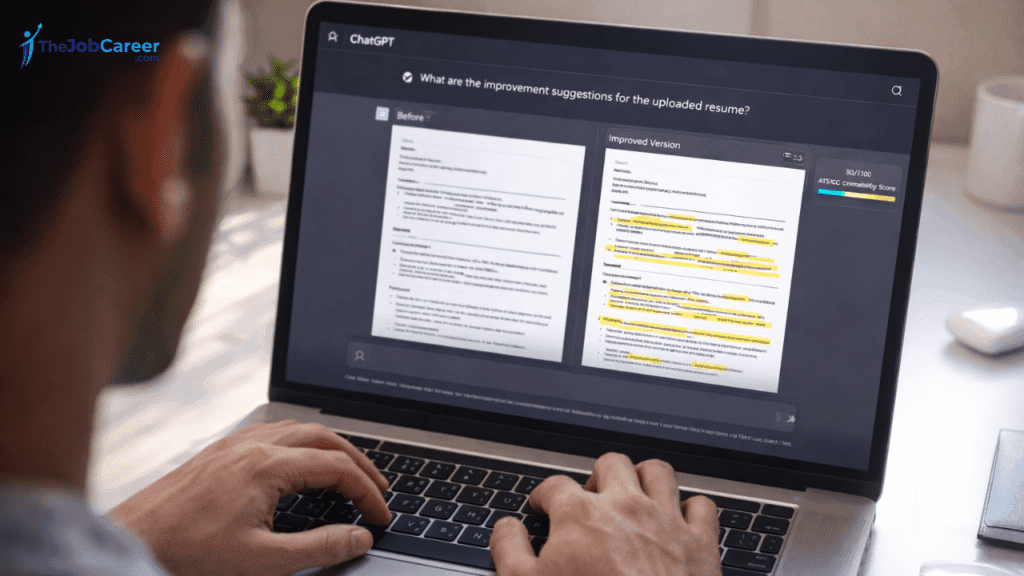

Two years ago, using AI to help with your job search felt like cheating. Today, not using AI in your job search feels like showing up to a race without shoes. The candidates who are getting hired faster, landing more interviews, and negotiating better salaries in 2026 are not necessarily the most qualified — they are the ones who have figured out how to use artificial intelligence as a force multiplier for every part of their job search.
Here is the reality of the job market in 2026: a recruiter at a mid-sized company receives 300-500 applications for a single opening. They spend an average of 7 seconds on the initial resume scan. Most applications are filtered by Applicant Tracking Systems (ATS) before a human ever sees them. The interview preparation process that used to require expensive coaching or lucky networking can now be done at midnight on your phone. Salary negotiation scripts that used to require a mentor can be generated in 30 seconds.
AI tools have not replaced the job search — they have dramatically compressed the time and effort required to do it well. This guide is a complete, practical roadmap to using AI tools — particularly ChatGPT, but also a dozen other specialised tools — to write better resumes, craft sharper cover letters, prepare for interviews, research companies, negotiate salaries, and ultimately get hired faster in 2026. Every technique in this guide is something you can implement today, most of them for free.
How AI Has Changed the Job Search in 2026
Before getting into specific tools and techniques, it is worth understanding how the job search landscape has changed — because using AI effectively requires understanding what problems it solves.
The Applicant Tracking System Problem
Most companies with more than 50 employees use Applicant Tracking Systems — software that automatically scans resumes for keywords before a human sees them. An ATS typically rejects 75% of resumes before any recruiter review. The criteria? Keyword matching against the job description.
This means a highly qualified candidate whose resume uses different terminology than the job description uses gets filtered out automatically. AI tools can analyse a job description and tell you exactly which keywords your resume is missing — something that used to require insider knowledge or expensive resume services.
The Research Problem
Preparing well for an interview used to require hours of research — reading company annual reports, understanding industry trends, finding information about the interviewer, researching salary benchmarks. AI compresses this from hours to minutes, allowing candidates to show up to every interview better prepared than they ever could have been before.
The Personalization Problem
The conventional wisdom has always been that you should customise your resume and cover letter for every application. In practice, almost nobody does it because it takes too long. AI makes personalisation fast — you can customise a cover letter for a specific company and role in 5-10 minutes instead of 45-60 minutes.
The Practice Problem
Interview practice used to require another person — a friend, a mentor, a career coach. AI tools now provide unlimited, on-demand mock interview practice with instant feedback. A candidate who practises 20 mock interviews with an AI will interview significantly better than one who practised twice with a busy friend.
The AI Job Search Toolkit: What You Need in 2026
You do not need to pay for expensive tools. Here is a complete toolkit covering every stage of the job search, including free options.
Primary AI Tool — ChatGPT
Access: chat.openai.com Free version: GPT-4o mini (sufficient for most job search tasks) Paid version: ChatGPT Plus at $20/month (GPT-4o — better for complex tasks)
ChatGPT is the most versatile AI tool for job seekers because it handles writing, analysis, research, and conversation practice all in one place. Most of the techniques in this guide use ChatGPT as the primary tool.
Other Strong Alternatives:
- Claude (claude.ai) — Excellent for long-form writing, nuanced cover letters, detailed interview prep
- Gemini (gemini.google.com) — Good for research, integrates with Google search
- Copilot (Microsoft) — Integrated into Windows and Office, good for document editing
Specialised Job Search AI Tools
| Tool | Purpose | Cost |
|---|---|---|
| Jobscan (jobscan.co) | ATS optimisation — matches your resume against job descriptions | Free (limited) / Rs. 1,500/month |
| Teal (tealhq.com) | Job application tracker + AI resume builder | Free / Premium Rs. 2,000/month |
| Rezi (rezi.ai) | AI-powered ATS-optimised resume builder | Free / Premium Rs. 1,200/month |
| Interview Warmup (Google) | AI mock interview practice with feedback | Free |
| Pramp (pramp.com) | AI + peer mock interviews for tech roles | Free |
| Levels.fyi | Salary data for tech companies | Free |
| Glassdoor | Company reviews + salary data | Free |
| LinkedIn AI features | Resume suggestions, job match scoring | Free (Premium enhances) |
| Grammarly | AI writing correction for all job documents | Free / Rs. 800/month |
| Canva AI | Resume and cover letter templates + AI design | Free / Rs. 600/month |
Using AI to Build an ATS-Optimised Resume
Your resume is the most important document in your job search — and in 2026, it needs to be optimised for both ATS software and human readers simultaneously. AI makes this dramatically easier.
Step 1: Analyse the Job Description with ChatGPT
Before touching your resume, paste the job description into ChatGPT and use this prompt:
Prompt: “I am applying for this job. Please analyse the job description and give me: (1) the top 10 keywords and phrases I must include in my resume, (2) the key skills and qualifications they are prioritising, (3) any specific experience or achievements they seem to value most, and (4) the overall tone and culture the company seems to have.”
[Paste the full job description]
ChatGPT will give you a detailed breakdown that serves as a targeting guide for your entire application. This single step — which takes 2 minutes — dramatically improves how relevant your resume appears to both ATS systems and human recruiters.
Step 2: Generate Achievement Statements
Most resumes are full of job duties — “Managed social media accounts,” “Assisted in project coordination,” “Handled customer queries.” These are boring and forgettable. Recruiters want achievement statements — what you did, how much impact it had, and what skills you demonstrated.
AI is exceptionally good at transforming duty statements into achievement statements. Use this prompt:
Prompt: “I am a [job title] with [X years] experience. Here are my job duties from my current/previous role. Please rewrite each one as a strong achievement statement using the format: Action Verb + Task + Result/Impact. Add specific numbers or percentages where reasonable for my industry.”
[List your duties]
Example Transformation:
Before (Duty): “Managed social media accounts for the company”
After (Achievement): “Grew company Instagram following from 3,200 to 11,500 in 8 months by implementing a data-driven content strategy, increasing average post engagement by 340%”
The after version tells a story. The before version says nothing memorable.
Step 3: Tailor Your Resume for Each Application
Once you have a strong base resume, use ChatGPT to quickly customise it for each specific application.
Prompt: “Here is my current resume: [paste resume]. Here is the job description I am applying for: [paste job description]. Please: (1) identify which parts of my resume are most relevant to this role, (2) suggest 3-5 specific changes I should make to better align my resume with this job, and (3) rewrite my career summary/objective specifically for this role.”
This customisation process — which used to take 45 minutes of careful reading and rewriting — now takes 5-10 minutes with AI assistance.
Step 4: ATS Score Check with Jobscan
After updating your resume, paste both your resume and the job description into Jobscan (jobscan.co). The free version gives you a match score and identifies which important keywords you are missing. Aim for a match score above 75% before submitting.
Resume Writing Prompts That Work
Here are specific ChatGPT prompts for different resume challenges:
For freshers with no experience: “I am a [degree] graduate with no work experience. I have done [list projects, internships, certifications, extracurriculars]. Please help me write a strong 1-page resume that presents these experiences effectively for a [target role] position. Focus on transferable skills and achievements.”
For career changers: “I am switching careers from [Current Field] to [Target Field]. My current resume focuses on [current skills]. Please help me reframe my experience to highlight transferable skills that are relevant to [target role]. Identify which of my existing experiences are most valuable for this transition.”
For gap in employment: “I have a [X month/year] gap in my employment history from [date] to [date] due to [brief reason]. Please help me address this gap professionally on my resume and suggest how to frame it positively in interviews without drawing unnecessary attention to it.”
Using AI to Write Compelling Cover Letters
A great cover letter is specific, human, and persuasive — qualities that require effort to achieve manually. AI makes the process much faster while still allowing you to maintain your authentic voice.
The Right Way to Use AI for Cover Letters
The wrong approach is to ask ChatGPT “write me a cover letter for this job” and submit what comes out. Recruiters in 2026 are very good at identifying generic AI-generated content — it is over-formal, lacks specific details, and reads as hollow.
The right approach is to use AI as a writing assistant — you provide the specific details, experiences, and voice, and AI helps you structure and refine them.
Best Prompt for Cover Letters:
“I am writing a cover letter for [Company Name] for the [Job Title] position. Here are the key details: (1) My most relevant experience: [describe specifically], (2) One specific achievement I want to highlight: [describe with numbers], (3) Something specific about this company that genuinely interests me: [describe], (4) My career goal that aligns with this role: [describe]. Please write a compelling, specific 3-paragraph cover letter that does NOT sound like a generic template. Use an engaging opening that references something specific about the company.”
The output will be far more personalised and effective than a generic “write me a cover letter” prompt.
Customising Company Research for Cover Letters
Prompt: “I am applying to [Company Name] for a [Role] position. Please tell me: (1) what this company is known for, (2) recent news or developments about this company, (3) what kind of culture and values they emphasise in their employer brand, and (4) what specific aspect of their work I could genuinely reference in a cover letter to show I have researched them.”
Use the output to add one genuinely specific, researched reference to your cover letter that makes it clear you are not using a template.
Using AI for Interview Preparation
This is where AI provides the most dramatic advantage over candidates who do not use it. Thorough interview preparation used to require hours of research and access to someone who could run mock interviews. AI provides both instantly.
Step 1: Generate Role-Specific Interview Questions
Prompt: “I have an interview for a [Job Title] position at [Company Name]. The job description mentions [key responsibilities]. Please generate: (1) 15 most likely technical/role-specific questions for this position, (2) 10 behavioural questions I should prepare for, (3) 5 questions specific to [Company Name]’s industry and business, and (4) 3 tricky questions that might catch me off guard.”
This gives you a comprehensive preparation list in 60 seconds. No career counsellor required.
Step 2: Prepare STAR Format Answers
The STAR method (Situation, Task, Action, Result) is the gold standard for answering behavioural interview questions. AI helps you structure your experiences into strong STAR answers.
Prompt: “I need to answer the interview question: ‘[Tell me about a time when you handled a difficult customer complaint].’ Here is the experience I want to use: [describe your experience briefly]. Please help me structure this into a strong STAR format answer — Situation (2-3 sentences), Task (1-2 sentences), Action (3-4 sentences detailing what I specifically did), Result (2-3 sentences with measurable outcome). Keep the total answer under 2 minutes when spoken.”
Prepare 8-10 STAR stories before any important interview. Most behavioural questions can be answered with a good library of STAR stories.
Step 3: Mock Interview Practice with AI
This is one of the most powerful uses of AI for job seekers. You can simulate a full interview with ChatGPT.
Prompt to start a mock interview: “I want to practise for a job interview. Please act as an interviewer for a [Job Title] position at a [type of company — e.g., mid-size IT company / large bank / startup]. Start with the first interview question and wait for my answer before asking the next one. After I give each answer, give me brief feedback on: (1) what was strong in my answer, (2) what could be improved, (3) how to make it more compelling. Begin the mock interview now.”
Run this mock interview for 30-45 minutes. The AI will challenge you, give you feedback, and help you refine your answers in real time. 10 sessions of this kind of practice will make you dramatically more confident and articulate in real interviews.
Step 4: Research the Company Thoroughly
Prompt: “I have an interview at [Company Name] tomorrow. Please give me: (1) A brief overview of what the company does and their key products/services, (2) Recent news or developments about this company in the last 6 months, (3) Who their main competitors are, (4) What challenges their industry is currently facing, (5) 3 intelligent questions I could ask the interviewer that would show I have done my research, (6) Any specific things I should know about [Company Name]’s culture or values based on publicly available information.”
This research brief — which would take 2-3 hours manually — is ready in 2 minutes.
Step 5: Prepare for “Tell Me About Yourself”
“Tell me about yourself” is asked in virtually every interview and is consistently the most poorly answered question. AI helps you craft a polished, memorable response.
Prompt: “Please help me craft a compelling 90-second ‘Tell me about yourself’ answer for a [Job Title] interview. Here are my key details: Education: [your degree and college], Relevant experience: [brief description], Key skills: [list 3-4], Career highlight: [one specific achievement], Why I want this role: [genuine reason]. Make it conversational, confident, and end with a natural bridge to why I am excited about this specific opportunity.”
Practice this answer until it sounds natural and not memorised. It is the foundation of every interview.
Using AI for Salary Research and Negotiation
Many job seekers accept the first offer they receive because they do not know what fair market compensation looks like, or they are uncomfortable negotiating. AI helps you research salary data and practice negotiation conversations.
Step 1: Research Your Market Value
Prompt: “What is the typical salary range for a [Job Title] with [X years] of experience in [City/Region], India, in 2026? Please give me: (1) Entry-level range, (2) Mid-level range, (3) Senior-level range, (4) What factors typically push salaries higher in this role — skills, certifications, company size, industry, (5) How this role’s compensation compares in different sectors — startup vs MNC vs government.”
Also use Glassdoor, LinkedIn Salary Insights, Levels.fyi (for tech), and AmbitionBox for data-backed salary research for your specific role.
Step 2: Generate a Negotiation Script
Prompt: “I have received a job offer for [Job Title] at [Company] with a salary of Rs. [X]. Based on my research, the market rate for this role in [City] is Rs. [Y range]. I have [X years] of experience and [specific skills/achievements]. Please write me a professional, confident salary negotiation script that: (1) Expresses genuine enthusiasm for the offer, (2) Makes a specific counter-offer with justification, (3) Handles the response if they say the salary is fixed, (4) Closes positively regardless of outcome. Keep it respectful and non-confrontational.”
Having a prepared script removes the anxiety from salary negotiation and dramatically increases the likelihood of a positive outcome.
Step 3: Negotiate Benefits Beyond Salary
Prompt: “The company cannot increase my base salary offer. What other compensation elements can I negotiate, and how should I approach negotiating each one? Give me specific scripts for negotiating: joining bonus, additional annual leave, work from home days, professional development budget, performance review timeline, and role title.”
Many candidates leave significant value on the table by only negotiating base salary. Total compensation includes much more.
Using AI to Optimise Your LinkedIn Profile
LinkedIn is where recruiters find you. AI can help you write every section more effectively.
LinkedIn Headline
Prompt: “I am a [Job Title] with [X years] experience in [key skills]. I am looking for [target roles]. Please write 5 different LinkedIn headline options that are keyword-rich, specific, and compelling. Each should be under 220 characters.”
LinkedIn About Section
Prompt: “Please write a compelling LinkedIn About section for me. Here are my details: [background], [key achievements with numbers], [skills], [what I am looking for]. Make it conversational, in first person, approximately 250 words, include relevant keywords naturally, and end with a clear call to action.”
LinkedIn Connection Requests
Prompt: “I want to connect with a [Job Title] at [Company Name] on LinkedIn. I found their profile while researching [reason]. Please write a personalised connection request message under 300 characters that explains why I want to connect without being too salesy or generic.”
For detailed LinkedIn guidance: LinkedIn Profile Guide 2026: How to Get Noticed by Recruiters
Using AI for Job Search Strategy and Organisation
Beyond writing and practice, AI can help you think more strategically about your entire job search.
Building a Target Company List
Prompt: “I am a [background] looking for [type of role] in [city/industry]. Please give me a list of 20 companies I should target for job applications, ranging from aspirational top choices to realistic options. For each company, briefly explain why they are a good fit for my background and what makes them a good employer in [field].”
Writing Cold Outreach Emails
Many of the best jobs are never publicly advertised. Direct outreach to hiring managers and senior professionals can open doors that job portals cannot.
Prompt: “I want to send a cold email to [Name], [Job Title] at [Company], expressing interest in [type of role]. I do not know if they are hiring. Please write a compelling, concise cold outreach email that: (1) Opens with a specific reason why I am reaching out to them personally, (2) Briefly establishes my relevant background in 2-3 sentences, (3) Makes a specific, low-friction ask (e.g., a 15-minute call), (4) Is under 150 words and does not sound like a template.”
Tracking Your Job Search
While AI cannot do this for you, use ChatGPT to create a personalised job search tracking system.
Prompt: “Please create a job search tracking spreadsheet structure for me with columns that help me track: companies applied to, role title, application date, application status, follow-up date, contact person, interview rounds, feedback received, and next steps. Also suggest a daily routine and weekly review process to keep my job search organised and momentum high.”
AI Tools Specifically for Indian Job Seekers
Beyond the global tools, here are AI-powered platforms particularly useful for the Indian job market:
| Platform | AI Feature | Best For |
|---|---|---|
| Naukri.com AI | Resume Score, AI job matching, skill gap analysis | All sectors |
| LinkedIn AI (India) | AI-generated profile summaries, job recommendations | IT, management, finance |
| Internshala AI | Resume builder, cover letter generator | Freshers, students |
| AmbitionBox | Salary insights, company reviews, interview questions | Salary research |
| Unstop (formerly Dare2Compete) | AI-matched opportunities, skill assessments | Campus hiring, competitions |
| HackerRank AI | AI skill assessment, company-specific practice | IT and tech roles |
| iimjobs.com | AI-matched senior roles | Management, MBA hiring |
Important Limits: What AI Cannot Do for You
AI is a powerful tool but it has real limits in the job search context. Understanding these limits prevents you from relying on AI in ways that will actually hurt you.
AI cannot replace genuine skill: If you use AI to write an impressive resume and cover letter but do not actually have the skills described, you will be exposed in the interview. AI helps you present your real skills better — it cannot manufacture skills you do not have.
AI-generated content is recognisable: Recruiters in 2026 are increasingly good at spotting purely AI-generated cover letters and emails. Generic phrasing, over-formal tone, and suspiciously perfect structure are giveaways. Always personalise and rewrite AI output in your own voice before submitting.
AI interview preparation does not replace real practice: Practising with AI is excellent preparation, but it is not the same as practising with a real person. The social pressure, non-verbal cues, and unpredictability of a real interview cannot be fully replicated by AI. Use AI to build your foundation and supplement with real mock interviews when possible.
AI research can be outdated: ChatGPT’s training data has a knowledge cutoff. For the most current company news, recent salary data, and live job postings, always verify AI-provided information with real-time sources like LinkedIn, Glassdoor, and company websites.
AI cannot network for you: Building genuine professional relationships — which remain the most effective way to get referred for jobs — requires human effort. AI can help you write networking messages, but the relationship itself requires you to show up.
A Complete AI-Powered Job Search Daily Routine
Here is a practical daily routine that incorporates AI tools effectively:
Morning (30 minutes):
- Check LinkedIn and Naukri for new job postings matching your target roles
- Apply to 3-5 jobs using AI-customised resumes and cover letters
- Use Jobscan to verify ATS compatibility before each submission
Afternoon (30 minutes):
- Use ChatGPT for interview preparation — run a 20-minute mock interview or prepare 5 STAR stories
- Research companies you have applied to and prepare intelligent interview questions
Evening (20 minutes):
- Engage on LinkedIn — comment on 2-3 posts in your target industry
- Send 1-2 personalised connection requests to recruiters or professionals at target companies
- Update your job search tracker
Weekly (1-2 hours):
- Review all applications sent that week — which got responses, which did not
- Analyse patterns — are certain types of roles or companies responding more?
- Use AI to refresh your resume or cover letter template based on feedback received
- Run one full AI mock interview session
Common Mistakes Job Seekers Make With AI
Submitting raw AI output without personalisation: The fastest way to get your application ignored is to submit a cover letter that reads like every other AI-generated letter recruiters receive. Always add specific personal details, rewrite in your own voice, and remove the tell-tale generic phrases.
Using AI as a substitute for self-knowledge: AI can help you articulate your strengths but it cannot know your genuine career goals, your authentic personality, or what truly motivates you. Before using AI for any job search material, spend time thinking clearly about what you actually want and what genuinely makes you good at your work. AI communicates your story — you need to know the story first.
Over-relying on one tool: ChatGPT is excellent but combining it with Jobscan for ATS optimisation, Glassdoor for salary research, LinkedIn for networking, and Google Interview Warmup for practice creates a far more complete advantage than using any single tool alone.
Not iterating based on results: If you have sent 50 applications with no responses, something in your resume or targeting is wrong. Use AI to analyse your resume and job description matches, ask for brutal honest feedback on your application materials, and adjust your approach based on what is actually working.
Frequently Asked Questions
Q1: Is using AI for job applications ethical?
Yes — using AI as a writing and research assistant is completely ethical and is now standard practice. The key ethical line is accuracy — using AI to present your genuine skills and experience more effectively is fine. Using AI to fabricate experience or skills you do not have is dishonest and will be exposed in interviews. Think of AI the way you think of using spell-check or a professional resume writer — it is a tool that helps you communicate better, not a substitute for genuine qualification.
Q2: Will recruiters know if I used AI to write my resume or cover letter?
They may suspect it if the writing is generic and impersonal — the hallmarks of unedited AI output. They are unlikely to know if you have used AI as a starting point and then personalised, rewritten, and added specific details in your own voice. The best approach is always to use AI to draft, then heavily edit for authenticity and specificity.
Q3: Which AI tool is best for freshers in India?
For freshers, the most practical combination is: ChatGPT (free version) for resume writing, cover letters, and interview prep + Internshala’s AI resume builder for formatting + Google Interview Warmup for free mock interview practice + AmbitionBox for salary research + LinkedIn for networking and job applications.
Q4: Can AI help me prepare for technical interviews in IT?
Yes, significantly. ChatGPT can explain technical concepts, generate practice coding problems, run mock technical interviews, review your code explanations, and help you understand common data structures and algorithm questions. For coding-specific practice, LeetCode’s AI features and HackerRank are more effective than general ChatGPT for pure coding practice.
Q5: How much does it cost to use AI tools for job searching?
Most essential AI job search tools are free or have generous free tiers. ChatGPT free version, Google Interview Warmup, Internshala, AmbitionBox, and LinkedIn’s basic features are all free. Jobscan offers limited free use. ChatGPT Plus ($20/month) is worth it if you are doing intensive job searching. Total cost for a full AI-powered job search toolkit is Rs. 0 to Rs. 1,500 per month depending on which paid tools you choose.
Q6: I have been applying to many jobs with no response. How can AI help diagnose the problem?
Use this prompt: “I have sent 40 job applications in the last 3 weeks with very few responses. Here is my resume: [paste resume]. Here is one of the job descriptions I applied for: [paste JD]. Please diagnose: (1) Why my resume might not be passing ATS screening, (2) What keywords or skills are missing, (3) Whether I am targeting the right roles for my background, (4) Specific changes that would most improve my response rate.” This kind of honest diagnostic analysis is something AI does exceptionally well.
Conclusion: Your AI-Powered Job Search Action Plan
The job market in 2026 rewards candidates who are prepared, specific, and strategic. AI tools do not give you an unfair advantage — they give you access to the kind of preparation and polish that used to require expensive career coaches, professional resume writers, and experienced mentors. Every job seeker now has access to the same tools. The ones who use them well will consistently outperform those who do not.
Here is exactly what to do this week:
- Open ChatGPT (free at chat.openai.com) and run your current resume through the ATS keyword analysis prompt for one target job posting — today
- Rewrite at least 3 of your resume bullet points from duties to achievement statements using AI — today
- Run a 20-minute mock interview using the AI interviewer prompt above — this week
- Use AI to write a customised cover letter for your single most important target application — this week
- Create a Jobscan account and check your resume’s ATS match score against your top 3 target job descriptions — this week
- Set up a daily 30-minute AI job search routine using the schedule above — starting tomorrow
The tools are free, the techniques work, and the results are measurable. Every hour you invest in AI-powered job search preparation directly improves your chances of landing interviews and offers faster.
Start today. Your next job is closer than you think.
All the best! 🚀
Related Career Articles:
- LinkedIn Profile Guide 2026: How to Get Noticed by Recruiters
- How to Write a Cover Letter in 2026: Format, Examples and Templates
- Resume Tips for Freshers: How to Create a Job-Winning Resume
- How to Prepare for Interviews: Complete Step-by-Step Guide
- Digital Marketing Career in India 2026: Salary, Skills and How to Start
- IT Jobs for Freshers 2026: Which Companies Hire Without Experience
- Freelancing in India 2026: How to Start, Earn and Grow Your Income
- How to Switch Careers at 30-35-40: Complete Roadmap
- How to Use Job Portals Effectively: Naukri, LinkedIn, Indeed
- Fresher Jobs Rs. 20,000 Salary — No Experience Required
- Highest Paying Private Sector Jobs Without Engineering Degree
- Top 10 High Paying Jobs in India 2026
- Work From Home Jobs 2025: Best Online Opportunities
- 7 Common Job Frauds in India: Awareness Guide
- Career Planning for Women After Marriage
Job Search Resources:
- Latest Jobs February 2026
- April 2026 Job Calendar: Government & Private Openings
- March 2026 Job Calendar
- Part Time Jobs for Students and Freshers
Free AI Tools to Start Today:
- ChatGPT: https://chat.openai.com
- Claude AI: https://claude.ai
- Google Interview Warmup: https://grow.google/certificates/interview-warmup/
- Jobscan: https://www.jobscan.co
- Teal HQ: https://www.tealhq.com
- AmbitionBox: https://www.ambitionbox.com
- Glassdoor India: https://www.glassdoor.co.in