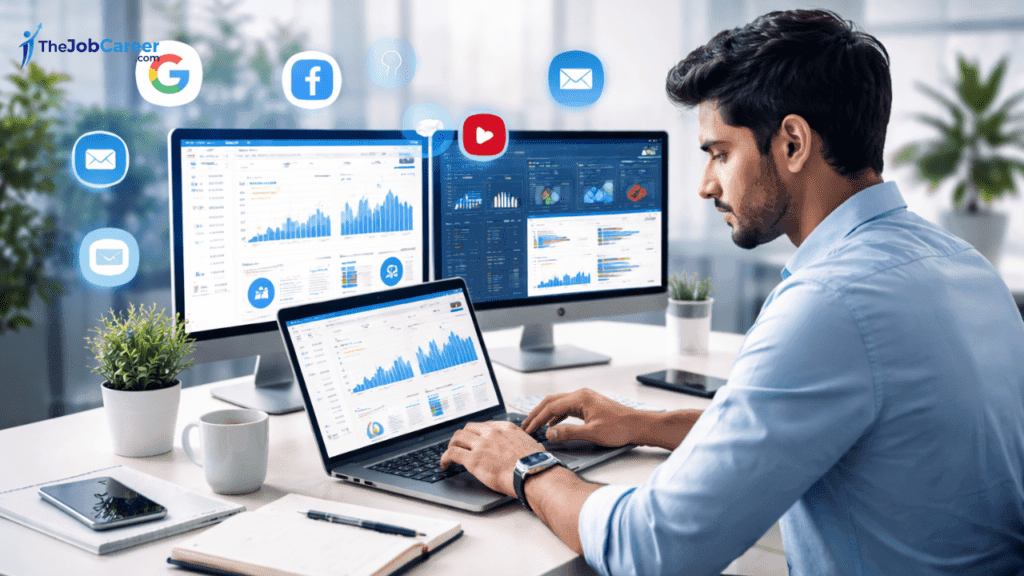

Ten years ago, “digital marketing” was a niche term used mostly by tech-savvy professionals in big cities. Today, it is one of the fastest-growing career fields in India, with demand far outpacing the supply of skilled professionals. Every business — from a local restaurant in Surat to a billion-dollar e-commerce company in Bengaluru — needs someone who understands how to reach customers online. And in 2026, that need has never been more urgent or more rewarding for people who build the right skills.
Here is what makes digital marketing genuinely exciting as a career choice: you do not need a specific degree. You do not need to be from a premier institution. You do not need years of experience before you can start earning. A motivated 22-year-old who spends six months learning SEO, Google Ads, and content strategy can land a job paying Rs. 25,000-35,000 per month and double that salary within two years. A freelance digital marketer with strong skills can earn Rs. 50,000-1,00,000 per month working from home, choosing their own clients and projects.
This guide is a complete, honest roadmap to building a digital marketing career in India in 2026. It covers every major specialization, realistic salary expectations at different experience levels, the skills that actually matter, how to get started with zero experience, the best free and paid learning resources, and how the field is being shaped by artificial intelligence. Whether you are a fresh graduate exploring options, a working professional considering a switch, or someone who wants to freelance — this guide has exactly what you need.
Why Digital Marketing is One of the Best Career Choices in India Right Now
India had 900+ million internet users in 2025, making it the second largest internet market in the world. Indian businesses spent over Rs. 35,000 crore on digital advertising in FY2025-26, a figure that has grown at 25-30% annually for the past five years. This spending needs skilled professionals to manage it — people who know how to run campaigns, analyze data, create content, and convert online audiences into paying customers.
The demand-supply gap in digital marketing is real and significant. According to industry reports, India needs approximately 20 lakh digital marketing professionals by 2027, but the current skilled workforce is far short of that number. This gap means that skilled digital marketers are in a genuinely strong position when it comes to job offers, salary negotiations, and freelance rates.
Beyond job availability, digital marketing has several qualities that make it particularly attractive:
- Low barrier to entry — No specific degree required, skills matter more than credentials
- Fast skill acquisition — Core skills can be learned in 3-6 months with focused effort
- Multiple earning models — Salaried jobs, freelancing, agency work, and even building your own business
- Remote work friendly — Most digital marketing work can be done from anywhere
- Creative and analytical — Appeals to both creative thinkers and data-driven professionals
- Constantly evolving — Always something new to learn, which keeps the work interesting
Digital Marketing Specializations: What Are Your Options?
Digital marketing is not one single skill — it is an umbrella term covering multiple distinct specializations. Understanding the different tracks helps you choose where to focus your energy based on your strengths and interests.
Search Engine Optimization (SEO)
SEO is the practice of optimizing websites and content so they appear higher in Google search results without paying for ads. It is one of the most in-demand and highest-paying digital marketing skills because organic search traffic is sustainable, scalable, and delivers results long after the initial work is done.
Good SEO professionals understand how search engines work, how to research keywords, how to structure website content, how to build backlinks, and how to analyze performance data. In 2026, SEO also increasingly involves understanding how AI-powered search features like Google’s SGE (Search Generative Experience) are changing how results appear.
Who it suits: Analytical thinkers who enjoy research, writing, and working with data over a long time horizon.
Search Engine Marketing / Pay Per Click (SEM/PPC)
SEM involves running paid advertisements on search engines — primarily Google Ads and Microsoft Ads. When you search for something on Google and see results labeled “Sponsored” at the top, those are SEM campaigns. PPC professionals manage ad budgets, write ad copy, optimize bidding strategies, and analyze campaign performance to maximize return on ad spend.
This specialization is particularly well-paid because professionals who can demonstrably improve the ROI of advertising budgets are directly linked to business revenue.
Who it suits: Analytical, numbers-oriented people who enjoy working with budgets, data, and measurable outcomes.
Social Media Marketing (SMM)
Social media marketing involves building and managing a brand’s presence on platforms like Instagram, Facebook, LinkedIn, YouTube, and emerging platforms. It includes content planning, community management, paid social advertising, influencer coordination, and performance analysis.
In India, social media marketing is one of the most in-demand skills because virtually every business — from D2C brands to local service providers — wants a strong social media presence. The work is creative, fast-paced, and highly visible.
Who it suits: Creative individuals with strong visual sense, writing ability, and genuine familiarity with social platforms.
Content Marketing
Content marketing is the strategy of creating valuable, relevant content — blog posts, videos, podcasts, infographics, case studies, e-books — to attract and retain customers. It is closely linked to SEO (which content ranks on Google) and social media (which content performs on platforms).
Good content marketers are strong writers or video creators who understand both the creative side (making engaging content) and the strategic side (making content that serves business goals).
Who it suits: Strong writers, communicators, and creative thinkers who enjoy research and storytelling.
Email Marketing
Email marketing involves building subscriber lists and sending targeted email campaigns to nurture leads and retain customers. Despite being one of the oldest digital marketing channels, email continues to deliver the highest ROI of any marketing channel — an average of Rs. 3,600 return for every Rs. 100 spent, according to industry benchmarks.
Email marketers work with tools like Mailchimp, HubSpot, and Klaviyo, and focus on list segmentation, automation workflows, A/B testing, and campaign analytics.
Who it suits: Detail-oriented professionals who enjoy writing, automation, and data analysis.
Performance Marketing / Growth Marketing
Performance marketing is an umbrella term for data-driven marketing where every rupee spent is tracked and optimized for specific outcomes — leads, purchases, app installs, sign-ups. It combines paid advertising across multiple channels (Google, Meta, YouTube, programmatic) with conversion rate optimization and analytics.
This is one of the highest-paying digital marketing specializations in India in 2026, particularly in e-commerce, fintech, and D2C brands where marketing budgets are large and every percentage improvement in conversion directly impacts revenue.
Who it suits: Highly analytical people who are comfortable with data, spreadsheets, and making decisions based on numbers.
Marketing Analytics
Marketing analytics involves collecting, analyzing, and interpreting data from all marketing channels to help businesses make better decisions. Professionals in this area work with tools like Google Analytics 4, Meta Business Suite, Power BI, and increasingly AI-powered analytics platforms.
As marketing budgets grow, businesses need professionals who can tell them what is working, what is not, and why — based on data rather than instinct.
Who it suits: Data-oriented professionals with strong Excel, SQL, or Python skills who want to work at the intersection of marketing and data science.
Digital Marketing Salary in India 2026: Complete Breakdown
Salaries in digital marketing vary significantly based on specialization, city, company type, and years of experience. Here is a realistic picture of what you can expect.
By Experience Level
| Experience Level | Role | Monthly Salary | Annual CTC |
|---|---|---|---|
| Fresher (0-1 year) | Digital Marketing Executive / Trainee | Rs. 15,000 — Rs. 25,000 | Rs. 1.8 — 3 LPA |
| Junior (1-2 years) | SEO Executive / Social Media Executive | Rs. 25,000 — Rs. 40,000 | Rs. 3 — 4.8 LPA |
| Mid-Level (2-4 years) | Senior Executive / Specialist | Rs. 40,000 — Rs. 70,000 | Rs. 4.8 — 8.4 LPA |
| Senior (4-7 years) | Manager / Team Lead | Rs. 70,000 — Rs. 1,20,000 | Rs. 8.4 — 14.4 LPA |
| Leadership (7+ years) | Head of Marketing / Director | Rs. 1,20,000 — Rs. 3,00,000+ | Rs. 14.4 — 36 LPA+ |
By Specialization (Mid-Level, 3-4 Years Experience)
| Specialization | Average Monthly Salary | Demand Level |
|---|---|---|
| Performance Marketing | Rs. 70,000 — Rs. 1,20,000 | 🔥 Very High |
| Marketing Analytics | Rs. 65,000 — Rs. 1,10,000 | 🔥 Very High |
| SEO Specialist | Rs. 50,000 — Rs. 80,000 | 🔥 High |
| SEM / Google Ads | Rs. 55,000 — Rs. 90,000 | 🔥 High |
| Content Marketing | Rs. 45,000 — Rs. 75,000 | ⚡ Medium-High |
| Social Media Marketing | Rs. 40,000 — Rs. 65,000 | ⚡ Medium-High |
| Email Marketing | Rs. 45,000 — Rs. 70,000 | ⚡ Medium |
By City
| City | Entry-Level Salary | Mid-Level Salary |
|---|---|---|
| Bengaluru | Rs. 20,000 — Rs. 30,000 | Rs. 55,000 — Rs. 90,000 |
| Mumbai | Rs. 20,000 — Rs. 28,000 | Rs. 50,000 — Rs. 85,000 |
| Delhi / Gurugram | Rs. 18,000 — Rs. 28,000 | Rs. 50,000 — Rs. 85,000 |
| Hyderabad | Rs. 18,000 — Rs. 25,000 | Rs. 45,000 — Rs. 75,000 |
| Pune | Rs. 16,000 — Rs. 22,000 | Rs. 40,000 — Rs. 65,000 |
| Chennai | Rs. 15,000 — Rs. 22,000 | Rs. 38,000 — Rs. 60,000 |
| Ahmedabad | Rs. 12,000 — Rs. 20,000 | Rs. 30,000 — Rs. 55,000 |
| Tier-2 / Tier-3 Cities | Rs. 10,000 — Rs. 18,000 | Rs. 25,000 — Rs. 45,000 |
Freelance Income Potential
Freelancing in digital marketing is a genuinely viable and often more lucrative alternative to salaried work — especially once you have 1-2 years of experience.
| Freelance Service | Per Project / Per Month Rate |
|---|---|
| SEO (monthly retainer per client) | Rs. 8,000 — Rs. 30,000 |
| Google Ads Management (per client) | Rs. 10,000 — Rs. 40,000 |
| Social Media Management (per client) | Rs. 8,000 — Rs. 25,000 |
| Content Writing (per article) | Rs. 500 — Rs. 3,000 |
| Email Campaign (per campaign) | Rs. 5,000 — Rs. 20,000 |
| Website SEO Audit (one-time) | Rs. 5,000 — Rs. 25,000 |
A freelance digital marketer with 4-5 clients paying Rs. 15,000-20,000 per month each earns Rs. 60,000-1,00,000 per month — fully remote, on their own schedule.
Skills You Actually Need to Build a Digital Marketing Career
Digital marketing is a skills-based field. Certifications help, but what actually gets you hired and promoted is demonstrated ability — campaigns you have run, results you have achieved, and tools you know how to use.
Core Skills Every Digital Marketer Needs
Google Analytics 4 (GA4): This is non-negotiable in 2026. Every digital marketing role requires you to measure website performance, understand user behavior, and track campaign outcomes. GA4 is the current standard, and if you do not know it, you are not competitive. It is free to learn through Google’s own Skillshop platform.
Basic Copywriting: Every piece of digital marketing — from an Instagram caption to a Google Ad — requires writing that is clear, compelling, and appropriate for the audience. You do not need to be a literary genius, but you need to write well enough to communicate ideas concisely and persuasively.
Understanding of Marketing Funnels: Every digital marketer needs to understand how potential customers move from awareness (first hearing about a brand) through consideration to purchase. Strategy, content, and advertising all look different at each stage of the funnel. This is a conceptual skill you develop through study and practice.
Excel and Data Analysis: Campaign reporting, budget tracking, and performance analysis all require comfort with spreadsheets. You need to be able to build pivot tables, use VLOOKUP, and create simple charts to communicate data clearly.
Canva / Basic Design: You do not need to be a graphic designer, but being able to create basic social media graphics, banners, and simple visuals in Canva makes you significantly more valuable, especially in smaller teams where one person handles multiple functions.
Specialization-Specific Skills
Beyond the core skills, your specific career track requires deeper expertise:
For SEO: Keyword research, on-page optimization, technical SEO basics, backlink analysis, tools like Semrush, Ahrefs, or Moz
For Google Ads/SEM: Campaign setup, keyword bidding, ad copywriting, Quality Score optimization, conversion tracking, Google Ads platform
For Social Media: Platform-specific algorithms, paid social advertising (Meta Ads Manager), content calendar management, influencer brief writing, community management
For Performance Marketing: Meta Ads, Google Ads, programmatic advertising basics, attribution modeling, A/B testing, conversion rate optimization
For Content Marketing: Long-form writing, SEO writing, content strategy, editorial calendar management, understanding of different content formats
For Analytics: Google Analytics 4, Google Tag Manager, Power BI or Tableau, SQL basics, statistical thinking
The AI Skills That Matter in 2026
Artificial intelligence has fundamentally changed how digital marketing is practiced. In 2026, professionals who can use AI tools effectively are significantly more productive than those who cannot — and employers know it.
AI tools every digital marketer should know:
- ChatGPT / Claude: Content ideation, first drafts, ad copy variations, email subject line testing
- Midjourney / Canva AI: Creating visual content at scale
- Google Performance Max: AI-driven campaign optimization across Google channels
- Meta Advantage+: AI-powered ad targeting and creative testing on Meta platforms
- Jasper / Copy.ai: Marketing copy generation for campaigns
- Surfer SEO / Clearscope: AI-driven SEO content optimization
The important nuance here is that AI tools replace repetitive tasks — not strategic thinking. A digital marketer who uses AI to work 3x faster, while still applying human judgment on strategy, targeting, and brand voice, is far more valuable than one who either ignores AI or blindly follows what AI produces.
How to Start a Digital Marketing Career with Zero Experience
This is the most practical section of this guide — exactly how to go from zero knowledge to a first job or freelance client in digital marketing.
Step 1: Choose Your Specialization First
Do not try to learn everything at once. Digital marketing is too broad. Spend one week reading about the different specializations described above, then choose one based on your natural strengths:
- Strong writer and researcher → SEO or Content Marketing
- Numbers and data person → Performance Marketing or Analytics
- Creative and visual thinker → Social Media Marketing
- Enjoy technology and systems → SEM or Marketing Analytics
Pick one, go deep, and generalize later.
Step 2: Get Certified (Free Certifications That Matter)
Before you spend money on any paid course, complete these free certifications. They are genuinely respected in the industry and will give you a strong foundation.
| Certification | Provider | Duration | Cost |
|---|---|---|---|
| Google Digital Marketing Fundamentals | Google Skillshop | 40 hours | Free |
| Google Analytics 4 Certification | Google Skillshop | 4-6 hours | Free |
| Google Ads Search Certification | Google Skillshop | 6-8 hours | Free |
| Meta Social Media Marketing Certificate | Coursera / Meta | 5 months | Free (financial aid) |
| HubSpot Content Marketing Certification | HubSpot Academy | 6 hours | Free |
| HubSpot Email Marketing Certification | HubSpot Academy | 4 hours | Free |
| SEMrush SEO Fundamentals | SEMrush Academy | 4-6 hours | Free |
These certifications alone will give you a better foundation than most entry-level candidates you will compete against.
Step 3: Build Real Practical Experience
This is the step most beginners skip — and it is the most important one. Certifications tell an employer you understand theory. Practical experience tells them you can actually do the work.
Ways to build practical experience with zero money:
Start a blog or website: Build a simple WordPress or Blogger site on any topic you genuinely care about. Apply SEO techniques you have learned. Try to rank for low-competition keywords. Track your progress in Google Search Console. In 6 months, you will have real data to show in interviews.
Manage social media for a local business: Approach a local restaurant, salon, coaching center, or shop and offer to manage their Instagram or Facebook page for free for 3 months. Take screenshots of the growth. This becomes your portfolio.
Run a small Google Ads or Meta Ads campaign: Both platforms offer free credits for new advertisers. Even a Rs. 500 test campaign where you track impressions, clicks, and conversions gives you real hands-on experience with advertising platforms.
Contribute to open source content projects: Write guest posts for digital marketing blogs. Contribute to nonprofits that need marketing help. Any real work counts as portfolio material.
Do an internship: Internshala, LinkedIn, and Naukri all have digital marketing internship listings — many are remote and paid between Rs. 5,000-15,000 per month. Even a 2-3 month internship at a small digital agency gives you structured experience and a reference.
Step 4: Build a Portfolio
Your portfolio is what converts interviews into job offers. Even as a fresher, you should have:
- A simple personal website or PDF document showing your work
- Screenshots and data from campaigns you have run — even small ones
- Blog posts or content pieces you have written
- Any measurable results — follower growth, traffic increase, conversion improvement
- Certifications you have completed
Do not wait until your portfolio is “good enough.” Start building it now and improve it as you learn.
Step 5: Apply Strategically
Where to apply for digital marketing jobs:
- LinkedIn: The best platform for digital marketing roles — especially for agencies and startups. Set up job alerts for “digital marketing executive fresher” and “SEO executive” in your target city.
- Naukri.com: Large volume of digital marketing job listings across all experience levels
- Internshala: Best for internships and first jobs
- AngelList / Wellfound: Best for startup digital marketing roles
- Direct outreach: Many small agencies and D2C brands do not post jobs publicly. Email them directly with your portfolio.
What to apply for as a fresher:
- Digital Marketing Executive / Trainee
- SEO Executive
- Social Media Executive
- Content Writer / Marketing Writer
- PPC Executive / Google Ads Trainee
- Marketing Analyst Trainee
Do not only target large companies. Digital agencies — even small ones with 10-20 employees — are often the best first employers for digital marketers because you work across multiple clients and specializations simultaneously, which accelerates your learning significantly.
Career Growth Path in Digital Marketing
Digital marketing rewards continuous learning and demonstrated results. Here is a realistic picture of how a career in this field develops over time.
Year 0-1: Digital Marketing Executive / Trainee You are learning tools, executing tasks, and building foundational skills. Focus on depth in your chosen specialization. Aim to achieve one measurable result you can talk about — even a small one.
Year 1-3: Senior Executive / Specialist You are now independent in your specialization. You manage campaigns without supervision, analyze your own performance data, and start to understand strategy. This is the period where job switching for a 30-50% salary increase is very common and generally advisable.
Year 3-5: Manager / Team Lead You are managing junior team members, owning larger budgets, and contributing to strategy decisions. Your salary grows significantly. Many professionals at this stage choose to either go deep in one specialization or broaden into a generalist marketing manager role.
Year 5-8: Senior Manager / Head of Digital You own the entire digital marketing function for a brand or department. You manage teams, set strategy, manage budgets in crores, and report to senior leadership. Compensation at this level ranges from Rs. 15-30 LPA.
Year 8+: Marketing Director / CMO / Freelance Consultant The top of the career ladder — leading entire marketing organizations, or working as an independent consultant advising multiple companies at premium rates.
Freelancing vs Salaried Job: Which is Right for You?
One of the biggest decisions in a digital marketing career is whether to work for a company or build a freelance practice. Both have genuine advantages, and the right choice depends on your personality, financial situation, and career goals.
Salaried Job
A salaried position gives you structured learning, a guaranteed income, mentorship from senior professionals, and the professional credibility of a known employer on your resume. For freshers and professionals with less than 2-3 years of experience, a salaried job is almost always the better choice because the learning you get from working within an experienced team is irreplaceable.
The typical career progression in a salaried digital marketing role looks like this: join as an executive, get promoted to senior executive or specialist after 1.5-2 years, then switch to a better company for a 40-50% salary increase, repeat the cycle until you reach manager level.
Freelancing
Freelancing offers higher earning potential, complete flexibility, and the ability to choose clients and projects. A freelancer with 3-4 solid clients can comfortably earn Rs. 60,000-1,50,000 per month. The challenge is that finding and retaining clients requires business development skills — which are different from marketing skills — and income can be inconsistent, especially in the first year.
Most successful freelancers in digital marketing start by building skills in a salaried role for 2-3 years, then gradually take on freelance clients on the side before making a full transition. Starting freelance work with zero experience is possible but significantly harder.
Common Mistakes People Make When Entering Digital Marketing
Learning too broadly without going deep anywhere: Digital marketing has too many sub-fields to master all at once. Candidates who describe themselves as “good at everything” in digital marketing are usually not excellent at anything. Pick one specialization, go deep, and then expand.
Collecting certifications without building practical skills: Certifications demonstrate that you understand theory. Employers hire based on what you can actually do. Always pair certification learning with hands-on practice — even personal projects count.
Ignoring analytics: Many people enter digital marketing because they love the creative side — writing, design, social media. But in 2026, every creative decision needs to be backed by data. If you cannot measure your work, you cannot improve it, and you cannot prove its value.
Not building a portfolio: The single biggest differentiator between candidates who get hired and those who do not is portfolio. Start building yours from day one — even with personal projects.
Staying in one company too long at the junior level: In digital marketing, the fastest salary growth happens through strategic job changes every 18-24 months. Staying in the same junior role for 4-5 years out of comfort is one of the most common mistakes — and one of the most expensive ones.
Frequently Asked Questions
Q1: Is digital marketing a good career in India in 2026?
Yes — it is one of the best. The demand for skilled digital marketers is growing at 25-30% annually, salaries are competitive, the barrier to entry is relatively low, and the field rewards continuous learning. The career has both strong salaried job opportunities and a viable freelance path.
Q2: Can I learn digital marketing without a marketing degree?
Absolutely. Digital marketing is one of the most degree-agnostic fields in India. Engineers, arts graduates, commerce graduates, and even people without degrees have built successful digital marketing careers. What matters is skills, a portfolio, and demonstrated results.
Q3: How long does it take to learn digital marketing?
With focused effort — 2-3 hours daily — you can build job-ready skills in one specialization within 3-6 months. A broad foundation across multiple areas takes 9-12 months. Learning never really stops because the field changes constantly, but you can be employable within 6 months of serious study.
Q4: Is digital marketing affected by AI? Will AI replace digital marketers?
AI is changing digital marketing significantly but it is not replacing skilled marketers. AI excels at automating repetitive tasks — generating content variations, optimizing ad bidding, personalizing email sequences. What it cannot replace is strategic thinking, brand judgment, creative direction, and relationship building. Marketers who learn to use AI tools effectively are becoming more productive and more valuable, not obsolete.
Q5: Which is better — working at a digital agency or an in-house marketing team?
Both have advantages. Agencies give you exposure to multiple industries and clients simultaneously, which accelerates learning — making them ideal for the first 2-3 years. In-house roles give you deeper knowledge of one brand, more strategic responsibility, and often better work-life balance. Most digital marketers recommend starting at an agency to build a broad foundation, then moving in-house to specialize.
Q6: What is the best free course to start learning digital marketing?
Google’s Digital Garage (Fundamentals of Digital Marketing) is the best starting point — it is free, comprehensive, and gives you a Google certification upon completion. After that, HubSpot Academy’s free courses on content marketing, email marketing, and inbound marketing provide excellent depth on specific specializations.
Conclusion: Your Digital Marketing Action Plan for 2026
Digital marketing in India in 2026 is a field with genuine opportunity, good salaries, and a clear path from beginner to expert. The combination of low barrier to entry, high demand, and multiple income models makes it one of the smartest career investments you can make right now.
Here is exactly what to do this week:
- Decide your specialization based on your strengths — SEO, social media, performance marketing, content, or analytics
- Register on Google Skillshop at skillshop.google.com and start the Digital Marketing Fundamentals course — it is free and takes about 40 hours
- Create a free Google Analytics account and connect it to any website you own or can access
- Follow 5-10 digital marketing professionals on LinkedIn in your chosen specialization — reading their posts daily is free education
- Start a personal project — a blog, a social media account for a cause you care about, or a test Google Ads campaign — something real you can practice on
- Update your LinkedIn headline to reflect your digital marketing focus and the skills you are building
The digital marketing industry in India is hiring. The clients are there. The freelance opportunities are there. All that stands between you and a well-paying career in this field is the time you invest in building real, demonstrable skills.
Start today. The best time to begin was two years ago. The second best time is right now.
All the best! 🚀
Related Career Articles:
- IT Jobs for Freshers 2026: Which Companies Hire Without Experience
- LinkedIn Profile Guide 2026: How to Get Noticed by Recruiters
- How to Write a Cover Letter in 2026: Format, Examples and Templates
- Resume Tips for Freshers: How to Create a Job-Winning Resume
- How to Prepare for Interviews: Complete Step-by-Step Guide
- Work From Home Jobs 2025: Best Online Opportunities
- Part Time Jobs for Students and Freshers
- How to Switch Careers at 30-35-40: Complete Roadmap
- Highest Paying Private Sector Jobs Without Engineering Degree
- Top 10 High Paying Jobs in India 2026
- Fresher Jobs Rs. 20,000 Salary — No Experience Required
- How to Choose the Right Career Path After 12th
- Study Abroad vs India: Complete Cost-Benefit Analysis 2026
- Career Planning for Women After Marriage
Job Search Resources:
- Latest Jobs February 2026
- March 2026 Job Calendar
- How to Use Job Portals Effectively
- 7 Common Job Frauds in India: Awareness Guide
Free Learning Resources:
- Google Skillshop (Free Certifications): https://skillshop.google.com
- HubSpot Academy (Free Courses): https://academy.hubspot.com
- Meta Blueprint (Free): https://www.facebook.com/business/learn
- SEMrush Academy (Free): https://www.semrush.com/academy
- Google Analytics: https://analytics.google.com