

The Union Public Service Commission Civil Services Examination, commonly known as UPSC CSE, is widely regarded as one of the most challenging competitive examinations in India. Every year, lakhs of aspirants begin their preparation journey with dreams of becoming IAS, IPS, IFS, or other Group A officers. However, only a few hundred candidates manage to clear all three stages and secure a rank.
If you are reading this article, chances are you have decided to pursue a career in civil services, or you are exploring whether this path is right for you. This comprehensive guide will take you through every essential aspect of UPSC preparation, from understanding the examination structure to developing a study strategy that works.
Understanding the UPSC Civil Services Examination
Before diving into preparation strategies, it is crucial to understand what you are preparing for. The UPSC Civil Services Examination is conducted in three distinct stages, each designed to test different aspects of a candidate’s knowledge, analytical ability, and personality.
The Three-Stage Selection Process
The examination process is structured as follows:
Stage 1: Preliminary Examination (Objective Type)
The Preliminary Examination, commonly called UPSC Prelims, is the screening test. It consists of two papers, both objective in nature.
Paper 1 – General Studies: This paper carries 200 marks and tests your knowledge across diverse subjects including history, geography, polity, economy, environment, science and technology, and current affairs. The questions are designed to assess both depth and breadth of knowledge.
Paper 2 – Civil Services Aptitude Test (CSAT): This paper also carries 200 marks but serves only as a qualifying paper. Candidates need to score a minimum of 33 percent to clear this stage. CSAT tests comprehension, logical reasoning, analytical ability, decision-making, and basic numeracy.
Only those candidates who qualify the Prelims examination are eligible to appear for the Mains examination. Typically, around 10,000 to 15,000 candidates qualify for Mains out of the 4-5 lakh who appear for Prelims.
Stage 2: Main Examination (Descriptive Type)
The Main Examination is where the real competition begins. It is a written examination consisting of nine papers, out of which seven are counted for merit ranking.
The paper structure is as follows:
| Paper | Subject | Marks | Type |
|---|---|---|---|
| Paper A | Indian Language | 300 | Qualifying |
| Paper B | English | 300 | Qualifying |
| Paper I | Essay | 250 | Merit |
| Paper II | General Studies I (History, Culture, Geography) | 250 | Merit |
| Paper III | General Studies II (Governance, Constitution, Polity) | 250 | Merit |
| Paper IV | General Studies III (Technology, Economy, Security) | 250 | Merit |
| Paper V | General Studies IV (Ethics, Integrity, Aptitude) | 250 | Merit |
| Paper VI | Optional Subject Paper I | 250 | Merit |
| Paper VII | Optional Subject Paper II | 250 | Merit |
The total marks for merit papers are 1,750. Only the top 2,000 to 3,000 candidates based on their Mains performance are called for the Personality Test.
Stage 3: Personality Test (Interview)
The final stage is the Personality Test, commonly referred to as the UPSC Interview. This round carries 275 marks. The interview panel assesses your personality traits, general awareness, communication skills, and suitability for a career in civil services.
The final merit list is prepared by adding the marks obtained in the Main Examination and the Personality Test. Prelims marks do not count toward the final ranking.
Total Timeline of the Examination
Understanding the timeline helps in planning your preparation effectively.
| Month | Activity |
|---|---|
| February | Notification Released |
| May-June | Preliminary Examination |
| July-August | Prelims Result Declared |
| September-October | Main Examination |
| March-April (Next Year) | Mains Result Declared |
| April-August (Next Year) | Personality Test |
| September (Next Year) | Final Result |
The entire process from notification to final result takes approximately 18 months. This means candidates must sustain their preparation and motivation for a long period.
When Should You Start Your UPSC Preparation
One of the most frequently asked questions by aspirants is about the ideal time to start preparation. The answer depends on several factors including your educational background, available time, and learning pace.
Ideal Preparation Duration
For most candidates, a dedicated preparation period of 12 to 18 months is considered optimal. This timeline allows you to cover the vast syllabus systematically, revise multiple times, and appear for mock tests.
However, this does not mean you should wait until you have a full year available. The nature of UPSC preparation is such that you can start building your foundation even while pursuing your graduation or working.
Starting During Graduation
If you are currently pursuing your graduation, this is an excellent time to begin your UPSC journey. You can start with NCERTs, read newspapers daily, and develop the habit of note-making. Since you have academic commitments, dedicate 2-3 hours daily to UPSC preparation.
Benefits of starting early during graduation include:
You develop a strong conceptual foundation without exam pressure. Reading NCERTs while you are still in the academic environment helps in better retention. You can attempt the examination immediately after graduation, saving valuable attempts. The habit of regular reading and analytical thinking develops naturally.
Starting After Graduation
Many successful candidates begin their preparation only after completing their graduation. If you fall into this category, a focused preparation of 12-14 months is sufficient, provided you can dedicate 8-10 hours daily.
The advantage here is complete focus. You can follow a structured routine without academic distractions. Full-time preparation allows for multiple revisions and extensive test series practice.
Age Considerations
The UPSC has set age limits for different categories:
General Category: 21-32 years (6 attempts) OBC Category: 21-35 years (9 attempts) SC/ST Category: 21-37 years (unlimited attempts)
Given these limits, it is wise to start your preparation at least by the age of 24-25. This gives you multiple attempts to clear the examination. Remember, most successful candidates clear UPSC in their 2nd or 3rd attempt.
Optional Subject Selection: A Critical Decision
Choosing the right optional subject can significantly impact your final score. The optional subject carries 500 marks in the Mains examination, which is nearly 29 percent of the total Mains marks.
Factors to Consider While Choosing Optional
Academic Background
If you have studied a subject at the graduation or post-graduation level, you already have a foundation. For instance, History graduates often choose History as their optional, while engineers might opt for subjects like Mathematics or Physics.
However, having an academic background is not mandatory. Many candidates successfully choose subjects they have never studied before, purely based on interest and scoring potential.
Availability of Study Material
Some subjects have abundant study material, coaching support, and online resources. Subjects like Geography, Sociology, Public Administration, and History have well-established coaching ecosystems. On the other hand, subjects like Anthropology or Psychology might have limited offline coaching but sufficient self-study material.
Overlap with General Studies
Certain optional subjects have significant overlap with General Studies papers. For example:
Geography overlaps with GS Paper I (Indian and World Geography) and GS Paper III (Environment) Public Administration overlaps with GS Paper II (Governance) History overlaps with GS Paper I (Indian History and Culture)
This overlap allows you to prepare efficiently, as studying for your optional simultaneously strengthens your GS preparation.
Scoring Trend
UPSC does not officially release average scores for optional subjects, but data compiled by coaching institutes over the years shows certain trends:
High Scoring Optionals: Sociology, Anthropology, Geography, Public Administration Moderate Scoring Optionals: History, Political Science, Psychology Technical Optionals: Mathematics, Physics, Chemistry (score depends heavily on background)
Popular Optional Subjects Analysis
Geography
Geography is one of the most popular optional subjects, especially among candidates without a technical background. The syllabus is well-defined, and the subject has significant overlap with General Studies.
Advantages: Availability of quality study material, overlap with GS, diagrams can enhance answers Challenges: Requires map practice, physical geography involves some technical concepts
Public Administration
This subject has gained popularity in recent years due to its manageable syllabus and direct relevance to administrative services.
Advantages: Short syllabus, high overlap with GS Paper II, current affairs integration is easy Challenges: Limited availability of standard books, requires understanding of administrative theories
Sociology
Sociology is considered one of the most scoring optional subjects. The syllabus is compact, and the concepts are easy to understand.
Advantages: Compact syllabus, easy to revise, good scoring potential Challenges: Requires sociological perspective, answer writing style is important
History
History optional is ideal for candidates with genuine interest in the subject. It requires extensive reading but offers good scoring opportunities.
Advantages: Interesting subject, plenty of reference material available Challenges: Vast syllabus, requires multiple sources for comprehensive coverage
Optional Subject Recommendation Table
| Optional Subject | Ideal For | Preparation Time | Overlap with GS | Scoring Potential |
|---|---|---|---|---|
| Geography | Science/Commerce graduates | 6-8 months | High (GS I, III) | Medium-High |
| Public Administration | Any background | 4-6 months | High (GS II) | High |
| Sociology | Any background | 4-6 months | Medium (GS I) | High |
| History | Arts/History graduates | 8-10 months | High (GS I) | Medium-High |
| Anthropology | Any background | 5-7 months | Low | High |
| Political Science | Arts/Pol Science graduates | 6-8 months | Medium (GS II) | Medium |
| Mathematics | Engineering/Maths graduates | 5-7 months | None | Medium (if strong) |
| Literature | Language enthusiasts | 6-8 months | None | Medium |
NCERT Strategy: Building a Strong Foundation
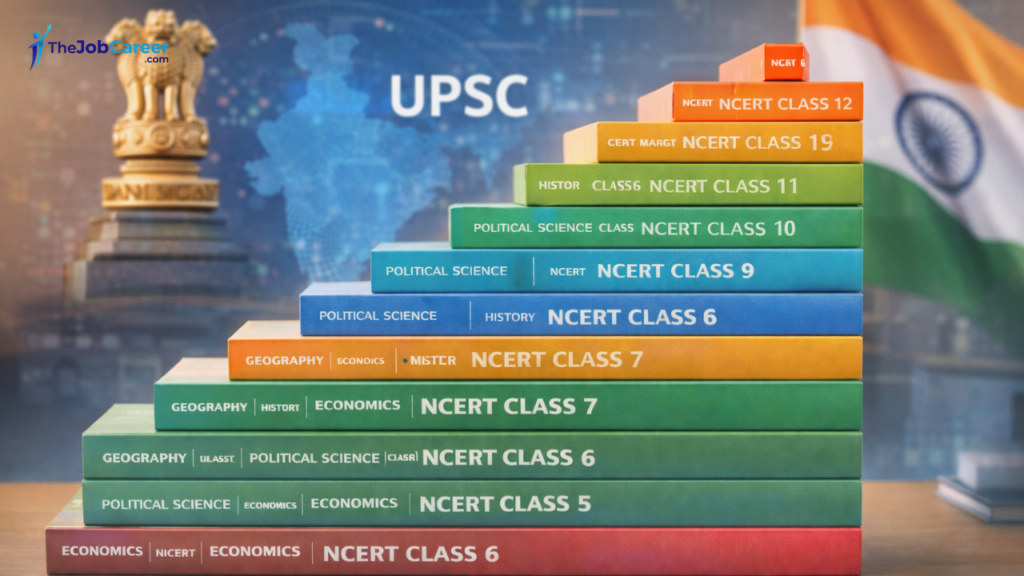
NCERT textbooks form the backbone of UPSC preparation. These books are written in simple language, cover fundamental concepts clearly, and align with the UPSC syllabus. Every successful aspirant emphasizes the importance of NCERTs.
Why NCERTs Are Important
UPSC questions, especially in Prelims, are often directly based on or inspired by NCERT content. The conceptual clarity you gain from NCERTs helps in understanding advanced topics. These books provide a strong foundation across History, Geography, Polity, Economy, Science, and Environment.
Many toppers have publicly stated that they read NCERTs multiple times. The books are not just for beginners but serve as excellent revision material even in the final months before the examination.
Class-wise NCERT Reading Plan
The NCERT reading strategy should be systematic and comprehensive. Here is a subject-wise breakdown:
History
Start with Class 6 to 12 NCERT History books. These cover Ancient India, Medieval India, and Modern India comprehensively.
Class 6: Our Pasts I Class 7: Our Pasts II Class 8: Our Pasts III (focus on Modern India chapters) Class 9: India and the Contemporary World I Class 10: India and the Contemporary World II Class 11: Themes in Indian History (Part I, II, III) Class 12: Themes in Indian History (Part I, II, III)
For Modern Indian History, the Class 11 and 12 books are extremely important. Make detailed notes as you read.
Geography
Geography NCERTs cover both physical and human geography, essential for GS Paper I and Geography optional.
Class 6: The Earth Our Habitat Class 7: Our Environment Class 8: Resources and Development Class 9: Contemporary India I Class 10: Contemporary India II Class 11: Fundamentals of Physical Geography Class 11: India Physical Environment Class 12: Fundamentals of Human Geography Class 12: India People and Economy
The Class 11 and 12 Geography books are crucial for both Prelims and Mains. Focus on understanding concepts rather than rote learning.
Polity
Indian Polity is one of the high-weightage subjects in UPSC. NCERT Class 9 to 12 Political Science books provide a good introduction.
Class 9: Democratic Politics I Class 10: Democratic Politics II Class 11: Indian Constitution at Work Class 11: Political Theory Class 12: Contemporary World Politics Class 12: Politics in India since Independence
After completing these, move to M. Laxmikanth’s Indian Polity, which is the standard reference book.
Economy
Economics can be challenging for non-commerce students. NCERTs simplify the basics.
Class 9: Economics Class 10: Economics Class 11: Indian Economic Development Class 12: Macro Economics Class 12: Micro Economics (optional, but helpful)
After NCERTs, refer to the Economic Survey and Union Budget documents for current economic issues.
Science
General Science questions in Prelims are often from Class 6 to 10 NCERTs.
Class 6 to 10: Science NCERTs (focus on Biology, Physics, Chemistry basics) Class 11 Biology: For Environment and Ecology chapters
Do not skip Class 6 and 7 Science books. Many Prelims questions come from these foundational classes.
Environment and Ecology
Class 12 Biology (Environmental chapters) Class 11 Geography (Climate and Vegetation chapters)
Additionally, refer to the NIOS material on Environment for comprehensive coverage.
NCERT Reading Tips
First Reading: Read thoroughly to understand concepts. Do not take notes yet. Second Reading: Make concise notes. Highlight important points. Third Reading: Revise your notes. This should be a quick revision before Prelims.
Maintain separate notebooks for each subject. Use diagrams, flowcharts, and tables to make notes visually appealing and easier to revise.
Current Affairs: The Game Changer
Current affairs constitute a significant portion of both Prelims and Mains. A strong grip on current events can give you a decisive edge.
Newspaper Reading Strategy
The Hindu and Indian Express are the most recommended newspapers for UPSC preparation. Reading a newspaper daily is non-negotiable.
How to Read The Hindu Effectively
Do not read the newspaper like a casual reader. Your approach should be analytical.
Editorials: Read all editorials. Understand the issue, multiple perspectives, and government’s stance. Make notes of important points.
National News: Focus on government schemes, policy changes, and significant events.
International News: Prioritize India’s relations with neighboring countries, major global developments.
Economy and Business: Budget, economic reforms, RBI policies, and economic indicators.
Science and Technology: New discoveries, space missions, health issues.
Environment: Climate change initiatives, biodiversity conservation, pollution control measures.
Skip entertainment, sports (unless nationally significant), and crime news.
Making Newspaper Notes
Many aspirants waste time making elaborate notes from newspapers. Instead, maintain a simple system:
Underline or highlight important points while reading. At the end of the week, quickly jot down major topics in a diary. Use monthly current affairs magazines for structured revision.
Monthly Current Affairs Magazines
Magazines like Vision IAS, Drishti IAS, and Vajiram & Ravi provide monthly compilations of current affairs. These are helpful for structured revision.
How to Use These Magazines:
Read the magazine once thoroughly. Revise important topics before Prelims and Mains. Use these as a ready reference for revision in the last month.
Do not depend solely on magazines. They are supplements to newspaper reading, not replacements.
Government Reports and Publications
Certain government reports are crucial for UPSC Mains and should be read selectively:
Economic Survey: Published before the Union Budget, it analyzes the economic performance of the country.
Union Budget: Understand budget allocations, new schemes, and fiscal policy direction.
Yojana and Kurukshetra Magazines: Published by the Government of India, these magazines cover development issues.
India Year Book: A comprehensive source for factual information about India.
NITI Aayog Reports: Policies related to development, SDGs, and strategic planning.
Ministry Reports: Annual reports of key ministries like Home, External Affairs, Environment.
Current Affairs Integration with Static Syllabus
One of the most important skills in UPSC preparation is linking current affairs with static topics. For instance:
If there is news about a Supreme Court judgment, link it to relevant constitutional articles (Polity).
If a new scheme for farmers is announced, understand it in the context of agriculture policies (GS Paper III).
Environmental issues should be studied with concepts from Geography and Ecology.
This integrated approach ensures that your answers in Mains are enriched with both contemporary relevance and conceptual depth.
Creating a Study Plan: The Roadmap
A well-structured study plan is essential for covering the vast UPSC syllabus efficiently. Here is a phase-wise preparation strategy.
Phase 1: Foundation Building (4-6 Months)
This phase focuses on NCERTs and basic conceptual understanding.
Complete all NCERT books (Class 6 to 12) for History, Geography, Polity, Economy, Science. Start reading one newspaper daily. Make concise notes subject-wise. Do not attempt mock tests yet.
Dedicate approximately 6-8 hours daily if you are a full-time aspirant.
Phase 2: Standard Books and Advanced Reading (4-6 Months)
After completing NCERTs, move to standard reference books.
Polity: M. Laxmikanth’s Indian Polity Modern History: Spectrum Modern Indian History, Bipin Chandra’s India’s Struggle for Independence Geography: G.C. Leong, Certificate Physical and Human Geography Economy: Ramesh Singh Indian Economy, NCERT Class 11 and 12 Environment: Shankar IAS Environment Ethics: Lexicon for Ethics (for GS IV) Optional Subject: Start reading standard books for your chosen optional
Continue newspaper reading and maintain current affairs notes.
Phase 3: Test Series and Revision (3-4 Months)
This is the most crucial phase before Prelims.
Join a reputed test series (Vision IAS, Insights, Forum IAS). Attempt one mock test every week. Analyze your mistakes thoroughly. Revise NCERTs and standard books. Focus on current affairs compilation.
Phase 4: Final Revision (1 Month Before Prelims)
Revise your notes daily. Attempt previous year question papers. Revise current affairs magazines. Do not start any new topic.
Time Table Example for Full-Time Aspirants
| Time | Activity |
|---|---|
| 6:00 AM – 7:00 AM | Newspaper Reading (The Hindu) |
| 7:00 AM – 8:00 AM | Breakfast and Break |
| 8:00 AM – 11:00 AM | Subject Study (NCERT/Standard Books) |
| 11:00 AM – 11:30 AM | Short Break |
| 11:30 AM – 1:30 PM | Subject Study Continued |
| 1:30 PM – 2:30 PM | Lunch Break |
| 2:30 PM – 5:00 PM | Optional Subject Preparation |
| 5:00 PM – 5:30 PM | Tea Break |
| 5:30 PM – 7:30 PM | Current Affairs / Revision |
| 7:30 PM – 8:30 PM | Dinner and Relaxation |
| 8:30 PM – 10:30 PM | Answer Writing Practice / Notes Making |
| 10:30 PM – 11:00 PM | Revision of the Day |
| 11:00 PM | Sleep |
Adjust this schedule based on your personal preferences and peak productivity hours. Consistency is more important than the number of hours.
Important Resources and Study Material
Online Resources
UPSC Official Website: For syllabus, previous year papers, and notifications. PRS India: For understanding bills, policies, and parliamentary proceedings. PIB (Press Information Bureau): Government press releases and schemes. Rajya Sabha TV and Lok Sabha TV: Debates and discussions on current issues.
YouTube Channels
Several YouTube channels offer quality content for UPSC preparation:
Unacademy Study IQ Vision IAS Mrunal Patel (Economy and Geography) Sleepy Classes (Optional subjects)
Use these channels as supplements to your self-study, not as primary sources.
Coaching vs Self-Study
This is a common dilemma among aspirants. The truth is that both approaches have their merits.
Coaching Benefits: Structured syllabus coverage, peer learning, regular tests, motivation. Self-Study Benefits: Flexible schedule, cost-effective, personalized pace.
Many successful candidates adopt a hybrid approach: self-study for most subjects and coaching for Optional or specific weak areas like Answer Writing.
Common Mistakes to Avoid
Over-Reading: Reading too many books creates confusion. Stick to standard sources.
Ignoring Revision: No matter how much you study, without revision, retention is poor.
Skipping Answer Writing Practice: Mains is a written exam. Practice writing answers regularly.
Neglecting Health: UPSC preparation is a marathon, not a sprint. Maintain physical and mental health.
Comparing with Peers: Everyone has a different learning pace. Focus on your own progress.
Ignoring Previous Year Papers: Analyzing past papers gives insights into the exam pattern.
Conclusion
Preparing for UPSC Civil Services Examination is undoubtedly challenging, but with the right strategy, dedication, and consistent effort, success is achievable. The journey from a beginner to a selected candidate requires patience, perseverance, and a well-planned approach.
Start with a strong foundation using NCERTs, choose your optional subject wisely after thorough research, stay updated with current affairs through quality sources, and most importantly, believe in yourself. Remember that every topper was once a beginner who refused to give up.
The roadmap provided in this guide is based on the experiences of countless successful candidates. Customize it according to your strengths, weaknesses, and circumstances. Stay focused, stay motivated, and keep moving forward.
Your journey to becoming a civil servant starts today. Make every day count, and success will follow.
Disclaimer: This article is for informational purposes only. UPSC exam patterns and syllabus may change. Always refer to the official UPSC website for the latest updates.
About TheJobCareer: We provide comprehensive career guidance, job notifications, and exam preparation resources for aspirants across India. Subscribe to our newsletter for regular updates on government job opportunities and preparation tips.