
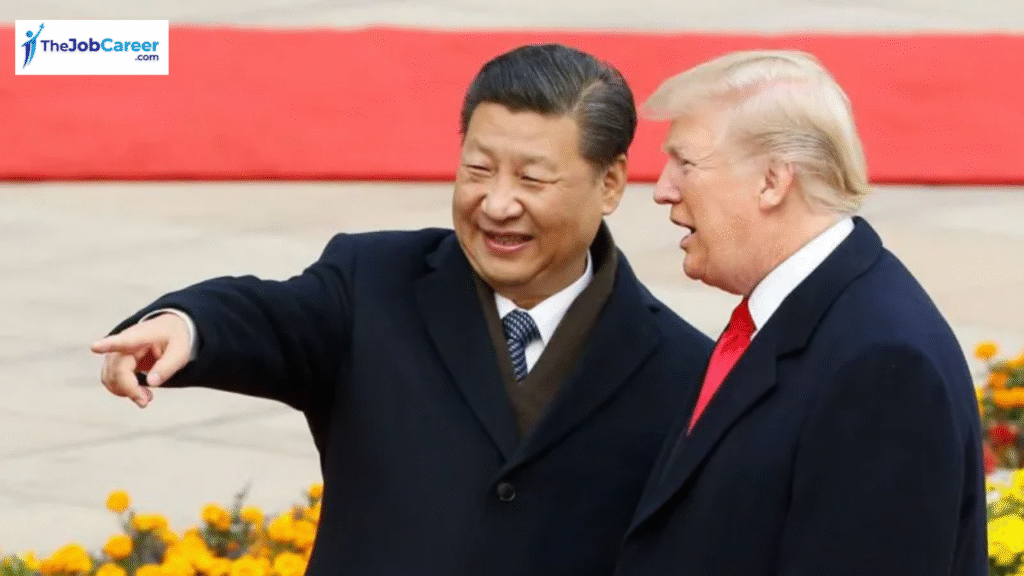

Trump to Impose 100% Tariff on Chinese Imports as Trade Tensions Escalate
The United States and China are once again locked in a high-stakes trade confrontation. In a new escalation of economic tensions, US President Donald Trump announced that his administration will impose an additional 100% tariff on imports from China starting next month. The move threatens to upend the fragile trade détente that had brought a temporary calm to relations between the world’s two largest economies.
A New Phase in the Trade War
In a post on social media, President Trump also revealed plans to implement export controls on critical software, a measure aimed at restricting China’s access to sensitive US technologies. The announcement comes just days after Beijing moved to tighten its export rules on rare earth minerals, materials crucial for manufacturing smartphones, electric vehicles, and advanced weapons systems.
Trump accused Beijing of “becoming very hostile” and attempting to “hold the world captive” through its control of rare earth production. The US president went so far as to threaten to pull out of a scheduled meeting with Chinese President Xi Jinping, though he later clarified that the summit was not officially canceled.
“I’m going to be there regardless,” Trump told reporters at the White House, leaving open the possibility of last-minute negotiations.
The announcement sent shockwaves through global financial markets. The S&P 500 fell 2.7%, marking its steepest one-day drop since April, as investors worried that another round of tariffs could disrupt supply chains, increase consumer prices, and dampen global economic growth.
China’s Rare Earth Leverage
Beijing’s recent decision to restrict exports of rare earth elements has become a key flashpoint in the dispute. China dominates global production of these minerals, which are essential components in electronics, batteries, renewable energy technologies, and defense systems.
When China last imposed such restrictions—after earlier rounds of US tariffs—it triggered panic among American manufacturers. Ford Motor Company, for instance, was forced to pause production temporarily due to shortages in critical materials.
This time, Beijing appears to be using its rare earth dominance as a strategic bargaining tool. Alongside export limits, Chinese regulators have launched a monopoly investigation into US chipmaker Qualcomm, a move that could delay the company’s acquisition of another semiconductor firm. Although Qualcomm is headquartered in the US, a large portion of its business is based in China, making it vulnerable to regulatory pressure.
China has also introduced new port fees on ships with ties to US companies, another signal of its readiness to retaliate economically.
“Some very strange things are happening in China,” Trump wrote online. “They are becoming very hostile.”
A Fragile Trade Truce Under Threat
The current escalation threatens to unravel the fragile truce that Washington and Beijing reached earlier this year. In May, both sides agreed to roll back triple-digit tariffs that had nearly frozen bilateral trade.
Under the existing arrangement, US tariffs on Chinese imports remained roughly 30% higher than at the start of the year, while Chinese tariffs on American goods stood at 10%. Despite these barriers, both countries continued to engage in diplomatic talks on issues ranging from agriculture and semiconductors to TikTok and rare earths.
The two nations had been expected to meet again this month at a summit in South Korea, but those plans are now uncertain. Trump’s latest comments suggest the meeting could be postponed or canceled entirely, depending on Beijing’s next steps.
Beijing’s Strategic Calculations
According to analysts, China’s recent actions are part of a broader strategy to seize leverage ahead of any future negotiations.
“President Xi is looking for ways to shape the upcoming talks,” said Jonathan Czin, a China fellow at the Brookings Institution. “The rare earths directive doesn’t take effect immediately—this is about signaling.”
Czin added that Beijing likely sees itself as having the upper hand in the standoff. “From China’s perspective, the Trump administration blinked during previous tariff escalations,” he said. “They believe they have a higher pain threshold.”
This assessment aligns with Beijing’s long-term approach: endure short-term economic pain to secure strategic independence in areas like semiconductor manufacturing and energy storage.
The US Response and Global Implications
The new 100% tariff on Chinese imports marks one of the most aggressive trade moves by the Trump administration since 2020. While intended to protect American industries, such a measure could also raise prices for US consumers and manufacturers who rely heavily on Chinese components.
Moreover, export controls on “critical software” could have far-reaching effects on the global technology supply chain, particularly for companies in artificial intelligence, cybersecurity, and cloud computing. These restrictions would likely prevent US firms from exporting advanced software or updates to Chinese customers, deepening the technological divide between the two countries.
According to Gracelin Baskaran, director of the Critical Minerals Security Program at the Center for Strategic and International Studies, the rare earths dispute could hit at the heart of US national security.
“Nothing makes America move like targeting our defense industry,” she said. “The US is going to have to negotiate because our options are limited. In an era of rising geopolitical tension and potential conflict, we need to build our industrial defense base.”
The Road Ahead: Negotiation or Confrontation?
While Trump’s rhetoric suggests confrontation, experts say negotiations remain possible. China’s new export restrictions will not take effect until December, leaving a short window for dialogue.
“Negotiations are likely imminent,” said Baskaran. “Who leads them and where they happen will be determined with time.”
Still, the stakes could not be higher. The world’s two largest economies together account for over 40% of global GDP, and renewed trade friction could ripple across supply chains from Silicon Valley to Shenzhen.
Conclusion
The reemergence of US-China trade tensions underscores how fragile the global economic balance remains in the era of technological competition. Trump’s decision to impose 100% tariffs and tighten export controls signals a shift toward economic nationalism, while China’s rare earth strategy highlights the vulnerabilities of global dependency.
Whether through confrontation or compromise, the coming months will define not only the next phase of US-China relations but also the future of global trade, technology, and security.