
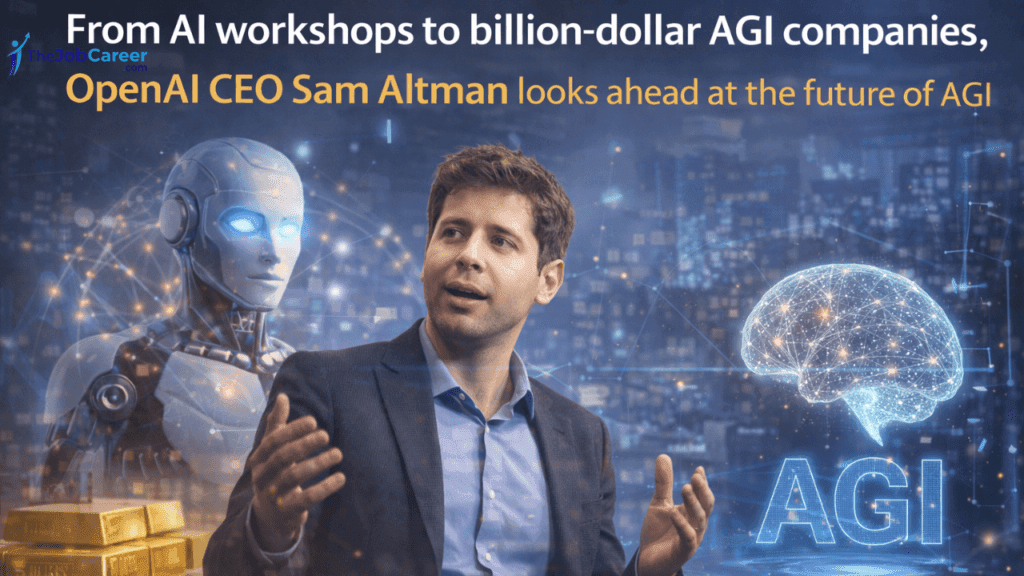

Sam Altman says AI still has a long way to go before it can run a company. (Image Source: Rowan Cheung/YouTube)
At OpenAI’s DevDay, CEO Sam Altman sat down with Rowan Cheung, founder of The Rundown AI, for a wide-ranging conversation about the future of artificial intelligence, the changing nature of work, and his thoughts on the next generation of innovators. The discussion, which lasted roughly half an hour, revealed Altman’s evolving vision for artificial general intelligence (AGI), his concerns about “AI work slop,” and why he feels a touch of envy toward today’s young entrepreneurs.
The Dawn of the One-Person and Zero-Person Company
In one of the most striking moments of the interview, Altman shared that he and his friends have a betting pool on when the world will see its first one-person, billion-dollar company—a venture built almost entirely through the leverage of AI tools. This idea reflects the growing reality that individuals, equipped with increasingly powerful AI systems, can now achieve what once required large teams and years of infrastructure.
However, Altman quickly added a caveat: the technology still isn’t advanced enough to run a company completely autonomously. Instead, he said, the conversation has now shifted toward an even more radical concept—the first “zero-person company.” In such an organization, every function—from ideation to product development to marketing—would be executed by AI agents.
While this may sound like science fiction, Altman believes it’s a matter of time. The future of AI, he implied, is one of extreme leverage, where human creativity and decision-making are amplified by intelligent systems capable of performing nearly all economically valuable tasks.
Redefining AGI and Its Impact on Human Progress
When asked about his definition of artificial general intelligence, Altman offered a practical, grounded perspective. For him, AGI isn’t an abstract ideal or a sudden leap—it’s when AI “outperforms humans at most economically valuable work.”
He acknowledged, though, that the concept remains “fuzzy”, since different experts envision AGI in very different ways. Some see it as machines that rival human cognition; others define it by measurable productivity outcomes. For Altman, the emphasis lies not on imitation of human thought, but on economic and scientific capability.
Altman suggested that AGI will play a key role in helping humans make both major breakthroughs and small but meaningful discoveries across disciplines like science, mathematics, and engineering. He described it as a tool that can offer “fresh perspectives” and accelerate innovation by eliminating the barriers of limited human bandwidth.
“I don’t want to overstate or understate it either,” he said. “But this is like the thing. The fact that we are at the very beginning of that, and that we are optimistic we’ll be able to push hard on it in the coming months and years—that is a big deal.”
His words reflect a recurring theme in Altman’s public comments: that AI’s real power lies in augmentation, not replacement. The technology may outperform humans at specific tasks, but its greatest contribution will likely be in expanding human potential and enabling entirely new forms of creativity and problem-solving.
The Rise of “AI Work Slop”
No modern discussion of AI would be complete without addressing its downsides. Altman turned candid when talking about what he and others call “AI work slop”—a term recently defined by Harvard Business Review as AI-generated content that appears polished but lacks real substance or value.
According to Altman, AI, like any tool, can be used both well and poorly. He cautioned that while the technology can dramatically increase efficiency, it can just as easily produce an overwhelming amount of mediocre, low-quality output.
“The economy is self-correcting,” he said. “People and companies that use tools to get more done will have more ability to influence the future than people who use it to slow organizations down and do less.”
His message was clear: the productivity gains promised by AI depend not on the tool itself, but on the intent and discipline of the user. In other words, AI is not a shortcut to excellence—it’s a multiplier of both good and bad work.
This idea echoes concerns across the tech and business world. As generative AI tools flood workplaces, content platforms, and classrooms, a growing share of material produced by humans and machines alike is indistinguishable but often shallow. The challenge, then, is not just creating faster, but creating better.
Gen Z and the New Era of Builders
When the conversation turned to Gen Z innovators, Altman’s tone shifted from analytical to almost nostalgic. Reflecting on his own experience as a Stanford dropout two decades ago, he said he was “envious of the current generation of 20-year-old dropouts” because of the sheer scale and accessibility of what they can now build.
“The amount of stuff they can build is incredibly wide,” he said, noting how today’s tools—AI models, open-source frameworks, global distribution platforms—enable young entrepreneurs to move from idea to execution with unprecedented speed.
By contrast, Altman admitted that his current responsibilities at OpenAI consume nearly all his mental energy. “The degree to which OpenAI is taking over all of my mental space, and I don’t get to go think about how to build a new startup, is a little bit sad,” he said with a laugh.
For many listeners, that statement underscored a broader truth about the current tech era: while AI is unlocking extraordinary creative freedom for some, it also demands intense focus from those at its helm. Altman’s wistful comment about “free mental space” was less about regret and more about admiration for those now entering the field unburdened by legacy constraints.
Looking Ahead: The Human Role in an AI-Driven Economy
Altman’s remarks at DevDay reveal both his optimism and realism about AI’s trajectory. He envisions a future where AI systems run autonomously, but also recognizes that human judgment, creativity, and ethics will remain central to how technology is deployed.
In his view, the key challenge for the next decade will be balancing automation with authenticity—ensuring that AI enhances human productivity without eroding the depth, originality, and purpose that define meaningful work.
Ultimately, Altman’s conversation with Rowan Cheung serves as a reminder that we’re standing at the edge of a profound transformation. The tools we build today will not only shape industries but also redefine what it means to create, collaborate, and even run a company.
And whether the next great startup is run by one person or none at all, one thing is clear: the future of work—and perhaps of human potential itself—is being rewritten by AI, one experiment at a time.