
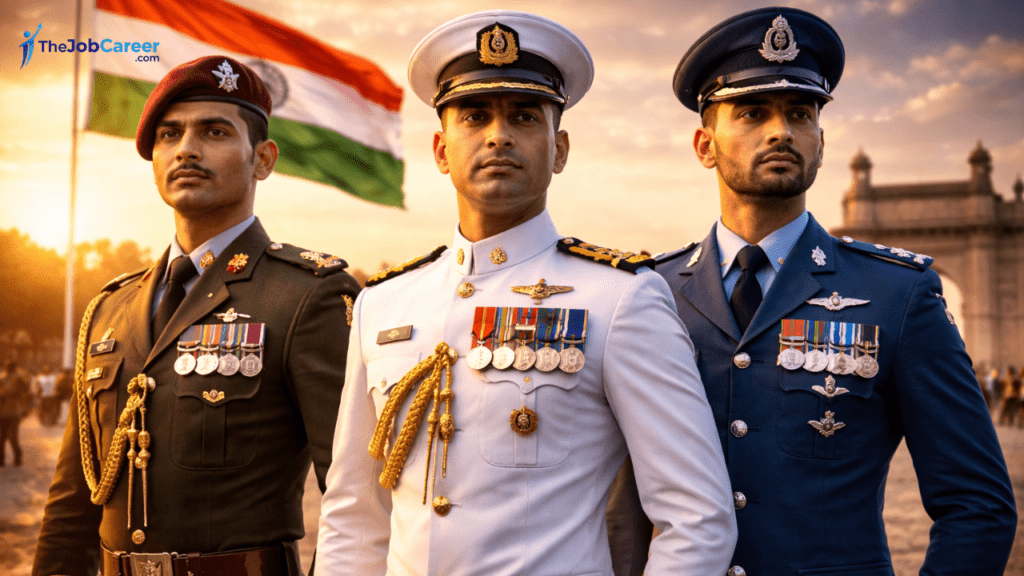

There is something about a career in the Indian Armed Forces that no other profession can replicate. The pride of wearing a uniform, the respect you command wherever you go, the brotherhood and camaraderie of serving alongside the finest people in the country, the adventure of postings across the Himalayas, deserts, seas, and skies — and the knowledge that your work directly protects 1.4 billion people. For millions of young Indians, joining the Army, Navy, or Air Force is not just a career choice. It is a calling.
In 2026, the Indian Armed Forces remain one of the most respected employers in the country. With a total strength of over 14 lakh active personnel, the military offers hundreds of different roles — from combat officers leading troops in Siachen to engineers maintaining aircraft carriers, from doctors serving in field hospitals to IT specialists securing cyber infrastructure. There is a path into the defence forces for graduates, 12th pass students, engineers, doctors, lawyers, pilots, and even those who have never thought of themselves as “military types.”
But here is what most people do not fully understand: there are more than 30 different entry schemes into the Indian Armed Forces across the three services, each with different eligibility criteria, selection processes, training periods, and career paths. Knowing which entry scheme fits your qualification, age, and career goals is the first and most critical step. This guide gives you the complete picture — every major entry route, salary structures, selection processes, training details, and career trajectories for the Indian Army, Navy, and Air Force in 2026.
Why Choose a Career in the Indian Defence Forces
Before getting into entry schemes and selection processes, it is worth understanding exactly what a defence career offers — because the benefits go far beyond what most civilian jobs can match.
Salary and Financial Benefits
Defence salaries in India are governed by the 7th Central Pay Commission and are among the most competitive government salaries available, especially when you factor in the comprehensive allowances and perks.
| Rank | Basic Pay | Military Service Pay | Gross Monthly (Approx.) |
|---|---|---|---|
| Lieutenant (Army/Navy/AF) | Rs. 56,100 | Rs. 15,500 | Rs. 90,000 — Rs. 1,05,000 |
| Captain / Lt. Commander | Rs. 61,300 | Rs. 15,500 | Rs. 1,00,000 — Rs. 1,20,000 |
| Major / Commander | Rs. 69,400 | Rs. 15,500 | Rs. 1,15,000 — Rs. 1,40,000 |
| Lieutenant Colonel | Rs. 1,21,200 | Rs. 15,500 | Rs. 1,70,000 — Rs. 2,00,000 |
| Colonel | Rs. 1,30,600 | Rs. 15,500 | Rs. 1,85,000 — Rs. 2,20,000 |
| Brigadier / Commodore | Rs. 1,39,600 | Rs. 15,500 | Rs. 2,00,000 — Rs. 2,40,000 |
| Major General / Rear Admiral | Rs. 1,44,200 | Rs. 15,500 | Rs. 2,20,000 — Rs. 2,60,000 |
Beyond basic salary, defence personnel receive:
- Free accommodation or HRA (House Rent Allowance) if not allotted quarters
- Field Area Allowance — up to Rs. 25,000 extra per month in operational areas
- Free medical treatment for self and family for lifetime — including post-retirement
- Leave Travel Concession (LTC) — air travel funded for family to any destination in India
- Canteen facilities (CSD) — groceries, electronics, vehicles at significantly subsidized prices
- Free children’s education in Kendriya Vidyalayas and Army/Navy/AF schools
- Pension after minimum qualifying service — approximately 50% of last drawn pay
- Ex-Servicemen’s benefits — reservation in government jobs, cheaper home loans, ECHS health card
- Group Insurance — Armed Forces Group Insurance Scheme with substantial life cover
- Adventure opportunities — mountaineering, skydiving, sailing, motorsport expeditions funded
Career Growth
The defence forces offer one of the most structured and merit-based promotion systems in any Indian career. Promotions are time-bound at junior levels and merit-based at senior levels. A Lieutenant Colonel with 13-14 years of service draws a salary comparable to a Director in a large corporation — and retires with a lifelong pension at age 54-58.
Respect and Purpose
This cannot be quantified but cannot be ignored. In every survey of most respected professions in India, defence personnel rank at or near the top. The sense of purpose that comes from serving the nation, protecting borders, and responding to natural disasters and emergencies gives a dimension to the career that most civilian jobs simply cannot offer.
Overview: Entry Routes Into the Indian Armed Forces
The Indian Armed Forces have two broad categories of entry — Officer Entry and Soldier/Sailor/Airman Entry. Understanding this distinction is fundamental.
Officer Entry: You join as a Commissioned Officer — a Lieutenant in the Army, Sub-Lieutenant in the Navy, or Flying Officer in the Air Force. Officers lead soldiers, sailors, and airmen. They plan operations, manage men and equipment, and carry the weight of command responsibility. Minimum qualification is graduation (with some exceptions).
Soldier/Sailor/Airman Entry: You join as an Other Rank (OR) — the backbone of the armed forces. These are the soldiers who man the frontlines, the sailors who operate ships, and the airmen who maintain aircraft. Minimum qualification ranges from 10th pass to 12th pass depending on the category.
The selection standards, training, responsibilities, career trajectories, and pay scales are significantly different between officers and soldiers. Both are equally important to the functioning of the armed forces — but the paths are distinct.
INDIAN ARMY: Complete Entry Guide 2026
Officer Entry Routes
1. NDA — National Defence Academy (Most Popular Route)
NDA is the most prestigious and competitive entry into the armed forces. After completing NDA training (3 years), cadets join their respective service academies for pre-commission training. NDA produces the finest officers who form the core leadership of the armed forces.
| Detail | Information |
|---|---|
| Conducted By | UPSC (twice a year — NDA I and NDA II) |
| Eligibility | 12th Pass or appearing (PCM for Navy/Air Force, any stream for Army) |
| Age | 16.5 to 19.5 years |
| Gender | Men and Women (Women admitted since 2022) |
| Vacancies (Annual) | Approx. 400 — 450 across Army, Navy, Air Force |
| Selection | Written Exam → SSB Interview → Medical |
| Training Duration | 3 years at NDA + 1 year at IMA/INA/AFA |
| Starting Rank | Lieutenant (Army) / Sub-Lieutenant (Navy) / Flying Officer (AF) |
NDA Written Exam Pattern:
| Paper | Subjects | Marks | Duration |
|---|---|---|---|
| Paper I | Mathematics | 300 | 2.5 hours |
| Paper II | General Ability Test (English + GK) | 600 | 2.5 hours |
| Total | 900 | 5 hours |
SSB Interview (5 Days): The Services Selection Board interview is one of the most thorough personality assessment processes in the world. It tests Officer Like Qualities (OLQs) — qualities like courage, initiative, intelligence, determination, and leadership — through psychological tests, group tasks, and a personal interview. Approximately 10-15% of SSB attendees are recommended.
Best Preparation Resources:
- Pathfinder NDA/NA by CDS Examination — comprehensive guide
- R.S. Aggarwal for Mathematics fundamentals
- NCERT books Class 11-12 for GK and Science sections
- Previous 10 years NDA papers — essential practice
Apply at: https://upsc.gov.in (NDA notification released twice a year)
2. CDS — Combined Defence Services Examination
CDS is the primary graduate-level entry into all three services. It is conducted by UPSC twice a year and opens doors to IMA (Indian Military Academy), OTA (Officers Training Academy), INA (Indian Naval Academy), and AFA (Air Force Academy).
| Detail | Information |
|---|---|
| Conducted By | UPSC (twice a year — CDS I and CDS II) |
| Eligibility | Graduate (discipline-specific per service) |
| Age | 19 to 25 years (IMA), 19 to 25 years (INA), 19 to 23 years (AFA), 19 to 25 years (OTA) |
| Gender | IMA/INA/AFA — Men only; OTA — Men and Women |
| Vacancies (Annual) | 350 — 450 across all academies |
| Selection | Written Exam → SSB Interview → Medical |
| Training Duration | 18 months (IMA) / 22 months (INA) / 74 weeks (AFA) / 11 months (OTA) |
CDS Exam Pattern:
| Paper | IMA/INA/AFA | OTA |
|---|---|---|
| English | 100 marks, 2 hours | 100 marks, 2 hours |
| GK | 100 marks, 2 hours | 100 marks, 2 hours |
| Mathematics | 100 marks, 2 hours | Not tested |
| Total | 300 marks | 200 marks |
Apply at: https://upsc.gov.in
3. TES — Technical Entry Scheme (Army)
TES is a direct entry into the Army for 12th pass students with PCM. Selected candidates undergo 5 years of training — 1 year at Army Cadet College followed by B.Tech at CME Pune, MCTE Mhow, or MCEME Secunderabad, then pre-commission training at IMA. They graduate as technical officers.
| Detail | Information |
|---|---|
| Eligibility | 12th Pass with PCM, minimum 70% aggregate |
| Age | 16.5 to 19.5 years |
| Vacancies (Annual) | 90 — 100 |
| Selection | SSB Interview → Merit in 12th PCM → Medical |
| Special Feature | No written exam — selection based on 12th marks and SSB |
| Degree Awarded | B.Tech on completion |
Apply at: https://joinindianarmy.nic.in
4. JAG — Judge Advocate General (Law Entry)
JAG entry is for law graduates who want to serve as legal officers in the Army. It is one of the few specialised entries that accepts law degree holders.
| Detail | Information |
|---|---|
| Eligibility | LLB with 55% marks (3-year after graduation or 5-year integrated) |
| Age | 21 to 27 years |
| Vacancies | 10 per batch (Men + Women) |
| Selection | SSB Interview → Medical |
| Notification | Twice a year |
5. Short Service Commission (NCC Special Entry)
For NCC ‘C’ Certificate holders (Senior Division), this is a direct SSB-based entry with no written examination required. Candidates with ‘C’ certificate and strong NCC background are given preference.
| Detail | Information |
|---|---|
| Eligibility | Graduate + NCC ‘C’ Certificate (Senior Division/Wing) |
| Age | 19 to 25 years |
| Selection | SSB Interview only (No written exam) |
| Note | This is one of the easiest routes for NCC holders |
ARMY: Soldier Entry Routes (Other Ranks)
6. Agniveer (Agnipath Scheme) — Army
Introduced in 2022, the Agnipath scheme is now the primary route for soldier entry into all three services. Agniveers serve for 4 years, after which 25% are selected for continued service as regular soldiers.
| Category | Qualification | Age | Monthly Pay (Year 1) | Seva Nidhi (After 4 Years) |
|---|---|---|---|---|
| General Duty (GD) | 10th Pass, 45% | 17.5 — 21 yrs | Rs. 30,000 | Rs. 11.71 lakh |
| Technical | 12th PCM, 50% | 17.5 — 21 yrs | Rs. 30,000 | Rs. 11.71 lakh |
| Clerk / SKT | 12th, 60% overall | 17.5 — 21 yrs | Rs. 30,000 | Rs. 11.71 lakh |
| Tradesman (10th) | 10th Pass | 17.5 — 21 yrs | Rs. 30,000 | Rs. 11.71 lakh |
| Tradesman (8th) | 8th Pass | 17.5 — 21 yrs | Rs. 30,000 | Rs. 11.71 lakh |
Selection Process: Online Common Entrance Exam (CEE) → Physical Fitness Test (PFT) → Medical Examination → Document Verification
Physical Standards for General Duty:
- Height: 170 cm (relaxation for hilly regions, Gorkhas, etc.)
- Chest: 77-82 cm (unexpanded/expanded)
- Weight: Proportionate to height
- 1.6 km run: Under 5 minutes 40 seconds
Apply at: https://joinindianarmy.nic.in
7. Army Rally Recruitment (Regular Soldiers — for retained 25%)
Soldiers who are retained after the Agniveer 4-year period continue as regular soldiers with full pension benefits and a career extending to 15-17 years of service (or longer for specialized categories).
INDIAN NAVY: Complete Entry Guide 2026
Navy Officer Entry Routes
8. NDA Entry — Navy (via UPSC NDA Exam)
Same as Army NDA entry through UPSC. Navy cadets at NDA complete the 3-year course and then proceed to Indian Naval Academy (INA) at Ezhimala, Kerala for a further year of naval training before commissioning as Sub-Lieutenants.
Qualification required for Navy: 12th with Physics and Mathematics (PCM)
9. University Entry Scheme (UES) — Navy
UES is specifically designed for final-year engineering students. It allows engineering students to appear for SSB in their final year and join the Navy after graduation without sitting for any written examination.
| Detail | Information |
|---|---|
| Eligibility | Final year B.Tech/B.E (specific branches: Mechanical, Electrical, Electronics, Computer Sc, etc.) |
| Age | Up to 24 years at time of joining |
| Selection | SSB Interview → Medical (No written exam) |
| Branches Accepted | Mechanical, Electrical/Electronics, Computer Science, IT, Naval Architecture |
| Vacancies | 50 — 60 per batch |
| Unique Advantage | No written exam — campus-based SSB process |
10. SSC (Short Service Commission) — Naval Armament Inspection Cadre (NAIC)
For engineering graduates who want a technical officer role in the Navy managing weapons, ammunition, and armament systems.
| Detail | Information |
|---|---|
| Eligibility | B.Tech (BE/Mechanical/Electrical/Electronics) with 60% |
| Age | 21 to 25 years |
| Selection | SSB Interview → Medical |
| Service Period | 10 years (extendable to 14 years) |
11. JAG Entry — Navy (Law)
For law graduates wanting to serve as legal officers in the Navy.
| Detail | Information |
|---|---|
| Eligibility | LLB with 55% |
| Age | 21 to 27 years |
| Selection | SSB Interview → Medical |
12. Education Officer — Navy
For postgraduate degree holders who want to serve as teaching faculty at Naval training establishments.
| Detail | Information |
|---|---|
| Eligibility | PG degree in Science, Maths, History, Geography, English, or Computer Science with 50% |
| Age | 21 to 25 years |
| Selection | SSB Interview → Medical |
Navy Sailor Entry Routes (Other Ranks)
13. Agniveer SSR — Senior Secondary Recruit
| Detail | Information |
|---|---|
| Qualification | 12th Pass with PCM and English, minimum 50% |
| Age | 17.5 to 21 years |
| Monthly Pay (Year 1) | Rs. 30,000 |
| Seva Nidhi (4 years) | Rs. 11.71 lakh |
| Roles | Sailor on ships, submarines, and shore establishments |
14. Agniveer MR — Matric Recruit
| Detail | Information |
|---|---|
| Qualification | 10th Pass |
| Age | 17.5 to 21 years |
| Monthly Pay (Year 1) | Rs. 30,000 |
| Roles | Cook, Steward, Hygienist on naval establishments and ships |
Selection (Both SSR and MR): Online Written Exam → Physical Fitness Test → Medical Examination
Apply at: https://www.joinindiannavy.gov.in
INDIAN AIR FORCE: Complete Entry Guide 2026
Air Force Officer Entry Routes
15. NDA Entry — Air Force
Same UPSC NDA examination route. Air Force cadets at NDA proceed to Air Force Academy (AFA) at Dundigal, Hyderabad for flying and ground duty officer training. PCM in 12th is mandatory for Air Force entry through NDA.
16. AFCAT — Air Force Common Admission Test
AFCAT is the Air Force’s own entrance examination conducted twice a year. It is the most widely used entry for graduate-level officers into the Air Force across Flying, Technical, and Ground Duty branches.
| Detail | Information |
|---|---|
| Conducted By | Indian Air Force (twice a year — AFCAT 01 and AFCAT 02) |
| Eligibility | Graduate (discipline-specific per branch) |
| Age | 20 to 24 years (Flying), 20 to 26 years (Technical and GD) |
| Gender | Men and Women |
| Vacancies (Annual) | 250 — 350 across branches |
| Application Fee | Rs. 250 |
AFCAT Exam Pattern:
| Section | Questions | Marks |
|---|---|---|
| General Awareness | 25 | 75 |
| Verbal Ability in English | 25 | 75 |
| Numerical Ability | 18 | 54 |
| Reasoning and Military Aptitude | 32 | 96 |
| Total | 100 | 300 |
Duration: 2 hours | Negative Marking: -1 for wrong answer
For Flying Branch: An additional EKT (Engineering Knowledge Test) is conducted.
Selection Process: AFCAT Online Exam → AFSB (Air Force Selection Board) Interview (5 days) → Medical Examination at IAF Medical establishments
Apply at: https://afcat.cdac.in
17. Flying Branch — Meteorology Entry
For science graduates who want to serve as Meteorology Officers in the Air Force — managing weather forecasting for flight operations.
| Detail | Information |
|---|---|
| Eligibility | Graduate with Physics and Mathematics at 12th and graduation level |
| Age | 20 to 26 years |
| Selection | AFCAT + AFSB Interview + Medical |
18. SSC Technical Entry — Air Force
For engineering graduates who want to serve in technical officer roles maintaining aircraft, engines, avionics, and equipment.
| Detail | Information |
|---|---|
| Eligibility | B.Tech (Mechanical, Electrical, Electronics, Computer Science, Instrumentation) |
| Percentage | 60% aggregate |
| Age | 20 to 26 years |
| Selection | AFCAT / University Interview → AFSB → Medical |
19. CDS Entry — Air Force (OTA)
Through the UPSC CDS examination, candidates can also join the Air Force through the OTA route as Ground Duty Officers in Administrative, Accounts, Logistics, Meteorology, and other non-flying branches.
Air Force Airman Entry Routes (Other Ranks)
20. Agniveer Vayu — Air Force (Most Popular AF Entry)
Agniveer Vayu is the entry point for airmen who maintain aircraft, operate Air Defence systems, and support Air Force operations on the ground.
| Group | Qualification | Roles |
|---|---|---|
| Science (X Group) | 12th PCM with English, 50% | Avionics, Mechanical, Weapons Technology |
| Other (Y Group) | 12th (any stream) with English | Administration, Logistics, Accounts, Police, Security |
| X and Y Both | 12th PCM + English | Can appear for both groups simultaneously |
| Detail | Information |
|---|---|
| Age | 17.5 to 21 years |
| Monthly Pay (Year 1) | Rs. 30,000 |
| Seva Nidhi (4 years) | Rs. 11.71 lakh |
| Selection | Online Exam → Physical Fitness Test → Medical |
Agniveer Vayu Online Exam:
| Subject | X Group | Y Group |
|---|---|---|
| English | Tested | Tested |
| Physics | Tested | Not tested |
| Mathematics | Tested | Not tested |
| Reasoning and GK | Tested | Tested |
Apply at: https://agnipathvayu.cdac.in
The SSB Interview: Everything You Need to Know
The Services Selection Board (SSB) interview is the gateway to officer commissioning in all three services. It is a 5-day process that evaluates whether you have the personality, intellect, and character to lead soldiers, sailors, and airmen. Understanding the SSB deeply is essential for every officer aspirant.
Day-by-Day SSB Process
Day 1: Screening Test The first day eliminates approximately 60-70% of candidates immediately. It involves:
- OIR (Officer Intelligence Rating) Test — verbal and non-verbal reasoning
- PPDT (Picture Perception and Description Test) — write a story about an image shown for 30 seconds, then narrate it in a group
Candidates who clear Day 1 screening continue to Day 2-5. Others are sent home the same evening.
Day 2: Psychological Tests
- TAT (Thematic Apperception Test) — 11 pictures + 1 blank, write a story for each in 4 minutes
- WAT (Word Association Test) — 60 words, one association per word in 15 seconds each
- SRT (Situation Reaction Test) — 60 situations, respond in 3 seconds mentally, write in booklet
- SDT (Self Description Test) — write what your parents, teachers, friends, and you yourself think about you
Day 3-4: Group Testing
- GD (Group Discussion) — two discussions in a group of 10-15
- GPE (Group Planning Exercise) — solve a common problem as a group
- PGT (Progressive Group Task) — cross obstacles as a team
- HGT (Half Group Task) — smaller group obstacle crossing
- Lecturette — 3-minute talk on a topic chosen from 4 options
- Individual Obstacles — 10 obstacles to cross individually with scoring
Day 5: Personal Interview and Conference
- Personal Interview — 30-45 minute interview with a Senior Assessor covering your life, education, family, career goals, current affairs, and leadership experiences
- Final Conference — all assessors meet together; you may be asked a few questions and dismissed
What SSB Assessors Are Looking For
SSB assesses 15 Officer Like Qualities (OLQs) across four dimensions:
| Dimension | OLQs |
|---|---|
| Planning and Organizing | Effective Intelligence, Reasoning Ability, Organizing Ability, Power of Expression |
| Social Adaptability | Social Adaptability, Cooperation, Sense of Responsibility |
| Dynamic | Self Confidence, Speed of Decision, Ability to Influence, Liveliness, Determination |
| Valour | Courage, Stamina, Initiative |
The key insight that most SSB coaching institutes misrepresent is this: SSB does not look for a performance. It looks for a consistent, genuine personality across all five days. Candidates who try to “act” like an officer are typically identified and rejected. The assessment looks for who you actually are — your natural reactions, your genuine thinking, your real social behavior.
SSB Preparation Strategy
6 months before:
- Read SSB-specific books — Arihant’s “How to Crack SSB Interview” and “SSB Interview: The Complete Guide” by Major D.P. Singh
- Follow current affairs daily — The Hindu, PIB, defence news
- Build physical fitness — 1.6 km run under 6 minutes, push-ups, pull-ups
3 months before:
- Practice TAT and WAT daily — write stories and word associations under time pressure
- Join mock SSB programs if possible — some coaching institutes in Delhi, Allahabad, and Bangalore offer these
- Work on public speaking and group discussion skills
- Develop genuine leadership experiences — lead projects, organize events, take initiative in college
Key advice: The candidates who crack SSB consistently are those who are genuinely well-read, physically fit, have led teams in real life, and communicate naturally and confidently. You cannot fake these qualities over 5 days.
Comparison: Army vs Navy vs Air Force
Choosing between the three services is a deeply personal decision. Here is an honest comparison to help you understand the differences.
| Factor | Army | Navy | Air Force |
|---|---|---|---|
| Lifestyle | Field postings, tough terrain, war-fighting | Ships and sea postings, shore establishments | Air bases, technical environment |
| Postings | Across India including borders and remote areas | Coastal cities (Mumbai, Vishakhapatnam, Kochi, Chennai) | Air bases across India |
| Work Type | Combat, logistics, engineering, intelligence | Ships, submarines, aviation, diving | Flying, maintenance, air defence |
| Physical Demands | Very High | High | Moderate-High |
| Family Life | Challenging due to remote postings | Moderate — sea duties affect family time | Generally better — most bases in cities |
| Pay | Equal across all services (same rank = same pay) | Equal | Equal |
| Prestige | Highest | Very High | Very High |
| Promotion Speed | Slower at senior levels | Similar to Army | Similar to Army |
| Adventure | Mountaineering, ski courses, Para SF | Deep sea diving, sailing, naval aviation | Flying, skydiving, aerobatics |
General Advice:
- If you want field adventure, leadership of men, and frontline action — Army
- If you are drawn to the sea, want to travel the world on ships, or are interested in naval aviation — Navy
- If you are passionate about flying or want a technical career in aerospace — Air Force
Medical Standards: What You Need to Know
Medical fitness is non-negotiable in defence recruitment. Many candidates clear the SSB and written exams only to be rejected at the medical stage. Knowing the medical standards in advance helps you address correctable issues before applying.
Common Medical Disqualifications
| Issue | Army | Navy | Air Force (Flying) |
|---|---|---|---|
| Vision (Uncorrected) | 6/6 in one eye, 6/18 in other (Correctable for some entries) | 6/6 in one eye | 6/6 in both eyes (No spectacles) |
| Colour Blindness | Disqualifying for most entries | Disqualifying | Disqualifying for flying |
| Flat Feet | Disqualifying | Disqualifying | Disqualifying |
| Hearing | Normal hearing required | Normal hearing required | Perfect hearing required |
| Tattoos | Permanent tattoos generally acceptable on forearm | Restrictions apply | Restrictions apply |
| BMI | Should be within normal range | Should be within normal range | Strict height-weight ratio |
For Flying Branch (Air Force): Vision requirements are the strictest. 6/6 uncorrected vision in both eyes is mandatory. Even laser eye surgery (LASIK) has restrictions — done before age 20 may be accepted in some cases, done after 20 requires careful evaluation.
Career Progression: What Happens After You Join
Officer Career Path (Army — Example)
| Rank | Time in Service | Pay Level |
|---|---|---|
| Lieutenant | 0 — 2 years | Level 10 |
| Captain | 2 years | Level 10B |
| Major | 6 years | Level 11 |
| Lieutenant Colonel | 13 years | Level 12A |
| Colonel | 15 — 26 years (selective) | Level 13 |
| Brigadier | Selective | Level 13A |
| Major General | Selective | Level 14 |
| Lieutenant General | Selective | Level 15-16 |
| General (COAS) | Top position | Level 18 |
Post-Retirement Benefits
Officers who serve for 20+ years retire with a pension of approximately 50% of last drawn pay — for life. They also receive:
- ECHS (Ex-Servicemen Contributory Health Scheme) — free medical for self and spouse for life
- Canteen facilities (CSD) continue post-retirement
- Priority in government job applications
- Various state government benefits for ex-servicemen
Second Career After Military Service
Many officers retire in their early 50s with full pension and then pursue highly successful second careers. Common paths include:
- Senior corporate security roles (Rs. 15-25 LPA)
- Government advisory positions
- Academic roles at defence colleges and universities
- Consulting in defence procurement and logistics
- Entrepreneurship funded by retirement savings and pension
Common Mistakes Candidates Make
Not checking age eligibility before preparing: Every entry scheme has a strict age window — often just 3-4 years wide. Many candidates spend months preparing only to discover they are too old for the entry they targeted. Check your age against every entry scheme before investing in preparation.
Ignoring physical fitness until exam time: Physical fitness in defence recruitment is not just about passing the fitness test. SSB assessors observe your physical bearing, energy levels, and confidence — all of which are influenced by your fitness. Start physical training 6-12 months before applying.
Treating SSB as a GD or MBA interview: SSB is fundamentally different from any civilian interview. Candidates who prepare by studying “SSB answers” and trying to perform a character are typically identified and rejected. Genuine preparation involves developing real leadership qualities, expanding your worldview through reading, and improving natural communication.
Applying for the wrong entry scheme: There are 30+ entry routes across three services. Each has different age limits, qualifications, and career paths. Many candidates apply for entries they are not suited for or miss better-fit entries entirely. Study all available entry schemes before deciding.
Giving up after one SSB failure: The SSB recommendation rate is approximately 10-15%. This means the majority of candidates who eventually crack it do so on their second, third, or even fourth attempt. Failure at SSB is not a verdict on your character — it is feedback. Analyse what the assessors likely observed, work on genuine self-improvement, and appear again.
Frequently Asked Questions
Q1: Can women join the Indian Armed Forces?
Yes. Women can join all three services through multiple routes. Women are eligible for NDA (since 2022), CDS (OTA), JAG entries, Medical Corps, Education Corps, and various Short Service Commission entries. As of 2025, women officers are eligible for Permanent Commission in several branches including Medical, Dental, Legal, Education, Signals, and Army Air Defence. The Agnipath scheme is currently limited to men for combat roles.
Q2: What is the difference between Permanent Commission and Short Service Commission?
Permanent Commission (PC) officers serve until the age of retirement (54-58 years depending on rank) and are eligible for full pension. Short Service Commission (SSC) officers serve for 10-14 years and may or may not be granted PC based on their performance and organizational needs. PC is considered more stable and lucrative long-term.
Q3: Is the Agnipath scheme permanent? Will it be changed?
The Agnipath scheme was introduced in 2022 and has been the subject of significant public debate. As of 2026, it remains the primary recruitment method for Other Ranks in all three services. The government has introduced various benefits for Agniveers after their 4-year tenure including reservations in CAPFs and state police forces. Whether the scheme will be modified further is a policy decision — check official government sources for the latest status.
Q4: Can I apply for defence jobs if I wear spectacles?
It depends on the entry and the service. For most Army and Navy officer entries, corrected vision (with spectacles or lenses) up to certain limits is acceptable. For Air Force Flying Branch, uncorrected 6/6 vision in both eyes is typically mandatory. For soldier entries (Agniveer GD), corrected vision up to specific limits is permitted. Check the specific medical standards in the official notification for each entry.
Q5: How many times can I appear for NDA, AFCAT, and CDS?
There is no official limit on the number of attempts for NDA, CDS, or AFCAT. However, the strict age windows limit the practical number of attempts. For NDA (age 16.5-19.5), you get approximately 4-6 attempts. For CDS and AFCAT (age 19-25), you get approximately 12 attempts over the age window since both are conducted twice a year.
Q6: What is the salary during training at NDA/IMA/INA/AFA?
During the training period at all academies, cadets receive a stipend. NDA cadets receive approximately Rs. 56,100 per month as stipend. After commissioning, the starting salary as Lieutenant/Sub-Lieutenant/Flying Officer is approximately Rs. 90,000-1,05,000 gross per month including all allowances.
Q7: What are the job prospects after leaving the Agniveer scheme?
Agniveers who complete 4 years of service receive the Rs. 11.71 lakh Seva Nidhi (tax-free). The government has announced several post-Agniveer benefits: 10% reservation in CAPFs (BSF, CRPF, CISF, ITBP, SSB), priority in state police recruitment in several states, preference in PSU jobs, and educational certificates for skills learned during service. The long-term effectiveness of these provisions is still being evaluated as the first batch of Agniveers completes their tenure in 2026.
Conclusion: Your Defence Career Action Plan for 2026
A career in the Indian Armed Forces is one of the most rewarding, well-compensated, and respected career paths available to any Indian. The entry routes are clearly defined, the selection processes are transparent, and the training is world-class. What stands between you and a commissioned officer or soldier role is preparation, physical fitness, and persistence.
Here is exactly what to do starting today:
- Identify the entry scheme that fits your current qualification, age, and career goals using this guide — today
- Check the official websites — joinindianarmy.nic.in, joinindiannavy.gov.in, afcat.cdac.in — for active notifications
- Start physical fitness training immediately — 1.6 km run, push-ups, pull-ups, chin-ups — today
- Begin reading one newspaper daily for current affairs and general awareness — this week
- For officer aspirants — buy one SSB preparation book and read it this month
- For NDA/AFCAT aspirants — take a diagnostic test to understand your current level in Mathematics, English, and GK
The armed forces are not looking for perfect candidates. They are looking for candidates with the right character, physical fitness, and intellectual foundation — individuals who can be developed into officers and soldiers who will serve with honour. That candidate could be you.
Start today. Serve with pride.
Jai Hind! 🇮🇳
Related Exam Articles:
- UPSC CSE 2026: Beginner’s Complete Roadmap
- SSC CGL 2026: Complete Preparation Guide
- RRB NTPC 2026: Complete Preparation Guide
- Top 10 Free Apps for Government Exam Preparation 2026
- Free vs Paid Coaching for Government Exams
Related Job Articles:
- April 2026 Job Calendar: Government & Private Openings
- 12th Pass Government Jobs 2026
- Government Jobs for Women 2026
- Diploma Holder Government Jobs 2026
- Fresher Jobs Rs. 20,000 Salary — No Experience Required
- Top 10 High Paying Jobs in India 2026
- How to Apply for Government Jobs in India
- 7 Common Job Frauds in India: Awareness Guide
- Latest Jobs February 2026
- March 2026 Job Calendar
Official Websites:
- Indian Army Recruitment: https://joinindianarmy.nic.in
- Indian Navy Recruitment: https://www.joinindiannavy.gov.in
- Air Force AFCAT: https://afcat.cdac.in
- Agniveer Vayu: https://agnipathvayu.cdac.in
- UPSC (NDA/CDS): https://upsc.gov.in
- SSB Preparation Resource: https://www.ssbcrack.com