
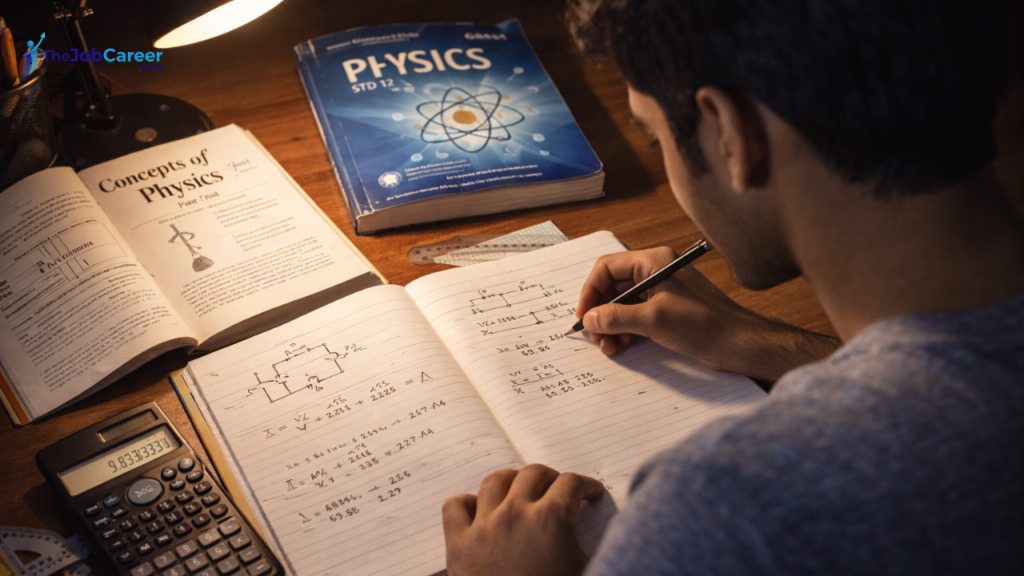

The Gujarat Secondary and Higher Secondary Education Board (GSEB) HSC (Higher Secondary Certificate) examination is one of the most crucial milestones for students in Gujarat. The Class 12 board examination not only determines your academic future — college admissions, entrance exam eligibility, scholarship opportunities — but also shapes your career trajectory for years to come.
With over 8 lakh students appearing for GSEB HSC exams annually across Science, Commerce, and Arts streams, the competition is intense and the pressure is real. However, with the right preparation strategy, time management, and understanding of the examination pattern, scoring 90%+ is entirely achievable.
This comprehensive guide covers everything you need to know about GSEB HSC Exam 2026 — from the complete exam timetable and paper pattern to subject-wise preparation strategies, marking schemes, GUJCET integration, career options after 12th, and common mistakes to avoid. Whether you’re targeting admission to top engineering colleges, medical colleges, or planning to pursue commerce or arts, this guide provides the roadmap to HSC success.
GSEB HSC 2026: Quick Overview
About Gujarat Board (GSEB)
Full Name: Gujarat Secondary and Higher Secondary Education Board Established: 1960 Headquarters: Gandhinagar, Gujarat Official Website: https://gseb.org
Board Functions:
- Conducts SSC (Class 10) and HSC (Class 12) examinations
- Prescribes syllabus and textbooks
- Declares results
- Issues certificates and marksheets
- Regulates affiliated schools in Gujarat
HSC Exam Statistics (2025)
Total Registered Students: 8.2 lakh+ Pass Percentage:
- Science: 74.53%
- General: 75.62%
- Overall: 75.24%
Toppers:
- Science: 99.67% (Highest)
- Commerce: 98.50%
- Arts: 96.33%
Streams Available
1. Science Stream:
- Physics, Chemistry, Mathematics/Biology
- English, Gujarati/Hindi
- Optional: Computer Science, Environmental Science
2. Commerce Stream:
- Accountancy, Economics, Business Studies/Organization of Commerce
- English, Gujarati/Hindi
- Optional: Mathematics, Statistics
3. Arts/General Stream:
- Economics, Sociology, Psychology, History, Political Science, Sanskrit, etc.
- English, Gujarati/Hindi
- Wide range of optional subjects
GSEB HSC Exam 2026: Important Dates
Tentative Schedule (Based on Previous Year Pattern)
| Event | Tentative Dates |
|---|---|
| Academic Session Start | June 2025 |
| Preliminary Exam (School-Level) | December 2025 — January 2026 |
| HSC Board Exam Application | November — December 2025 |
| Hall Ticket/Admit Card Release | February 2026 (2nd week) |
| HSC Board Exam (Theory) | March 2026 (2nd week to last week) |
| Practical Exams | February — March 2026 |
| Result Declaration | May 2026 (1st or 2nd week) |
| Supplementary Exam (if any) | June 2026 |
| Supplementary Result | July 2026 |
Official Announcement: Exact dates will be announced by GSEB on their official website: https://gseb.org
GSEB HSC Exam Pattern 2026
Theory Examination Structure
Total Duration: Each paper: 3 hours Total Marks per Paper: 70 marks (Theory) Internal Assessment: 30 marks (varies by subject) Total per Subject: 100 marks
Marking Scheme
Theory Paper: 70 marks
- Section-wise questions (A, B, C, D based on difficulty)
- MCQ, Short Answer, Long Answer formats
- Choice given in certain sections
Internal Assessment: 30 marks
- Semester-wise internal exams: 10 marks
- Practical/Project work: 10 marks
- Assignments/Viva: 10 marks (Distribution varies by subject type)
Paper Pattern by Stream
Science Stream (Example: Physics):
| Section | Type | Marks | Questions |
|---|---|---|---|
| Section A | MCQ (Objective) | 14 marks | 14 questions (1 mark each) |
| Section B | Very Short Answer | 18 marks | 9 questions (2 marks each) |
| Section C | Short Answer | 24 marks | 6 questions (4 marks each, attempt any 4) |
| Section D | Long Answer | 14 marks | 2 questions (7 marks each, attempt any 1) |
| Total | 70 marks |
Note: Pattern is similar across Science subjects (Physics, Chemistry, Mathematics, Biology) with subject-specific variations.
Commerce Stream (Example: Accountancy):
| Section | Type | Marks |
|---|---|---|
| Section A | Objective Questions | 12-15 marks |
| Section B | Short Answer | 20-25 marks |
| Section C | Long Answer/Problems | 30-35 marks |
| Total | 70 marks |
Arts/General Stream:
Mostly descriptive pattern with short answer and essay-type questions.
Language Papers (English, Gujarati, Hindi)
Composition:
- Reading comprehension
- Grammar and vocabulary
- Writing skills (essay, letter, report)
- Literature (prose, poetry, drama)
Total: 70 marks (Theory) + 30 marks (Internal) = 100 marks
GSEB HSC Exam 2026: Tentative Timetable
Science Stream Timetable
| Date | Day | Subject | Time |
|---|---|---|---|
| March 6, 2026 | Thursday | Physics (027) | 10:30 AM — 1:30 PM |
| March 8, 2026 | Saturday | Chemistry (028) | 10:30 AM — 1:30 PM |
| March 10, 2026 | Monday | English (002) | 10:30 AM — 1:30 PM |
| March 12, 2026 | Wednesday | Mathematics (041) / Biology (044) | 10:30 AM — 1:30 PM |
| March 15, 2026 | Saturday | Gujarati (001) / Hindi (003) | 10:30 AM — 1:30 PM |
| March 18, 2026 | Tuesday | Additional Subject (if any) | 10:30 AM — 1:30 PM |
Commerce Stream Timetable
| Date | Day | Subject | Time |
|---|---|---|---|
| March 6, 2026 | Thursday | Accountancy (051) | 10:30 AM — 1:30 PM |
| March 8, 2026 | Saturday | Economics (030) | 10:30 AM — 1:30 PM |
| March 10, 2026 | Monday | English (002) | 10:30 AM — 1:30 PM |
| March 12, 2026 | Wednesday | Business Studies (054) / Organization of Commerce (055) | 10:30 AM — 1:30 PM |
| March 15, 2026 | Saturday | Gujarati (001) / Hindi (003) | 10:30 AM — 1:30 PM |
| March 18, 2026 | Tuesday | Mathematics (041) / Statistics (048) | 10:30 AM — 1:30 PM |
Note: This is a tentative timetable based on previous year patterns. Official timetable will be released by GSEB in December 2025-January 2026.
Subject-Wise Preparation Strategy
Physics Preparation Strategy
Syllabus Highlights:
Part 1 (Semester 1):
- Electrostatics
- Current Electricity
- Magnetic Effects of Electric Current
- Magnetism and Matter
- Electromagnetic Induction and Alternating Currents
- Electromagnetic Waves
Part 2 (Semester 2):
- Ray Optics and Optical Instruments
- Wave Optics
- Dual Nature of Radiation and Matter
- Atoms and Nuclei
- Electronic Devices
- Communication Systems
High-Scoring Topics:
| Topic | Weightage | Difficulty |
|---|---|---|
| Current Electricity | 10-12 marks | Medium |
| Electromagnetic Induction | 8-10 marks | Medium |
| Ray Optics | 10-12 marks | Easy-Medium |
| Electronic Devices | 8-10 marks | Medium |
| Nuclei (Radioactivity) | 6-8 marks | Medium |
Preparation Tips:
Numerical Problems:
- Practice 20-25 numericals daily from each chapter
- Focus on NCERT exemplar problems
- Understand concepts, don’t memorize formulas blindly
- Make a formula sheet for quick revision
Theory Questions:
- Diagrams are crucial (ray diagrams, circuit diagrams)
- Definitions and laws must be precise
- Working principle of devices asked frequently
- Previous year questions repeat patterns
Recommended Books:
- NCERT Physics (Class 11 + 12)
- GSEB Textbook (mandatory for board pattern)
- H.C. Verma (for concept clarity)
- Previous 5 years GSEB question papers
Chemistry Preparation Strategy
Syllabus Coverage:
Physical Chemistry (High weightage):
- Solid State, Solutions
- Electrochemistry
- Chemical Kinetics
- Surface Chemistry
Inorganic Chemistry (Moderate weightage):
- d and f Block Elements
- Coordination Compounds
- Metallurgy
Organic Chemistry (High weightage):
- Haloalkanes and Haloarenes
- Alcohols, Phenols, Ethers
- Aldehydes, Ketones, Carboxylic Acids
- Amines
- Biomolecules, Polymers
Preparation Strategy:
Physical Chemistry:
- Numericals from Electrochemistry and Chemical Kinetics are scoring
- Understand concepts > rote learning
- Practice numerical daily (10-15 problems)
Inorganic Chemistry:
- Make concise notes for reactions and properties
- Color-based identifications important
- Lanthanides and Actinides: table format revision
Organic Chemistry:
- Name reactions are crucial (Reimer-Tiemann, Friedel-Crafts, Aldol, etc.)
- Mechanisms asked in long-answer questions
- Practice converting one compound to another
Recommended Resources:
- NCERT Chemistry (Class 11 + 12)
- GSEB Textbook
- O.P. Tandon (for Inorganic)
- M.S. Chauhan (for Organic)
Mathematics Preparation Strategy
High Weightage Chapters:
| Chapter | Marks | Importance |
|---|---|---|
| Calculus (Integration, Differentiation, AOD) | 20-25 marks | ⭐⭐⭐⭐⭐ |
| Vectors and 3D Geometry | 10-12 marks | ⭐⭐⭐⭐ |
| Probability | 8-10 marks | ⭐⭐⭐⭐ |
| Matrices and Determinants | 8-10 marks | ⭐⭐⭐⭐ |
| Relations and Functions | 6-8 marks | ⭐⭐⭐ |
Preparation Tips:
Integration (Most Important):
- Practice 50-60 integration problems
- Master: Integration by parts, substitution, partial fractions
- Definite integration properties are crucial
Vectors and 3D:
- Understand direction cosines, direction ratios clearly
- Equation of line, plane, angle between them
- Shortest distance problems
Practice Strategy:
- Solve NCERT exercises completely (80% board questions from NCERT pattern)
- Previous 5 years GSEB papers (certain question types repeat)
- RD Sharma for extra practice
Biology Preparation Strategy
High-Scoring Units:
Botany:
- Reproduction in Plants (Sexual reproduction, pollination)
- Plant Growth and Development
- Ecology and Environment
Zoology:
- Human Reproduction
- Genetics and Evolution
- Biotechnology
Diagram-Based Topics (Easy Scoring):
- Draw and label: Flower structure, human reproductive system, DNA replication
- Diagrams carry 10-15 marks cumulatively across paper
- Practice drawing neat, labeled diagrams
Theory Preparation:
- NCERT is the Bible for Biology (90% theory from NCERT)
- Make concise notes for revision
- Important terms and definitions in bold
- Previous year questions show pattern repetition
Recommended Approach:
- Read NCERT thoroughly 2-3 times
- Make chapter-wise short notes
- Practice diagrams daily
- Solve previous 5 years papers
English Preparation Strategy
Paper Structure:
Section A: Reading (15 marks)
- Unseen passages (2-3 passages)
- Comprehension questions
Section B: Writing Skills (25 marks)
- Notice, Advertisement writing
- Letter writing (Formal/Informal)
- Essay writing
- Report writing
Section C: Grammar (15 marks)
- Transformation of sentences
- Voice change, Narration
- Prepositions, Articles, Modals
Section D: Literature (15 marks)
- Prose, Poetry comprehension
- Character analysis
- Theme-based questions
Scoring Strategy:
Reading Comprehension:
- Read passage twice before answering
- Underline keywords
- Answers should be in your own words (avoid copying)
Writing Skills (Highest marks section):
- Practice formats: Letter, Notice, Report
- Essay: Introduction (2-3 lines), Body (4-5 paragraphs), Conclusion (2-3 lines)
- Word limit adherence crucial
Grammar:
- Learn rules clearly
- Practice daily (20-25 questions)
- Tenses, Voice, Narration most important
Gujarati/Hindi Preparation
Focus Areas:
- Grammar rules (Vyakaran)
- Essay writing (Nibandh)
- Letter writing (Patra Lekhan)
- Story writing
- Comprehension (Gadyansh, Padyansh)
- Literature from prescribed textbook
Scoring Tips:
- Handwriting matters in language papers
- Write in clean, legible script
- Presentation and structure important in essay
Commerce Subjects Strategy
Accountancy:
High-Weightage Topics:
- Partnership Accounts (admission, retirement, dissolution)
- Company Accounts (shares, debentures)
- Cash Flow Statement
- Ratio Analysis
- Financial Statement Analysis
Preparation:
- Practice journal entries daily
- Understand logic behind each adjustment
- Previous year problems repeat patterns
- Format accuracy is crucial (marks deducted for format errors)
Business Studies:
Important Chapters:
- Principles of Management
- Business Environment
- Planning, Organizing, Staffing, Directing, Controlling
- Marketing Management
- Financial Management
- Consumer Protection
Preparation:
- Definition, features, importance pattern for each topic
- Case studies given in exam (apply concepts)
- Flowcharts and diagrams help in presentation
Economics:
Microeconomics:
- Theory of Consumer Behavior
- Production and Costs
- Market Forms
- Revenue concepts
Macroeconomics:
- National Income
- Money and Banking
- Government Budget
- Balance of Payments
Preparation:
- Diagrams are crucial (demand-supply curves, production possibility curve)
- Definitions should be precise
- Differentiate between similar concepts clearly
Practical Examination Guide
Science Practicals
Physics Practical (30 marks):
- Two experiments (8 marks each) = 16 marks
- Activity (4 marks)
- Viva voce (5 marks)
- Journal/Record (5 marks)
Important Experiments:
- Ohm’s Law verification
- Meter bridge
- Potentiometer
- Prism experiment (refractive index)
- Concave mirror/convex lens focal length
Tips:
- Practice experiments in lab thoroughly
- Understand theory behind each experiment
- Learn to read vernier caliper, screw gauge accurately
- Observation tables should be neat
- Graph drawing skills important
Chemistry Practical (30 marks):
- Salt analysis (Cation + Anion identification) = 8 marks
- Volumetric analysis (Titration) = 8 marks
- Content-based experiment = 6 marks
- Viva = 4 marks
- Record = 4 marks
Tips:
- Practice 15-20 salts before exam
- Titration reading accuracy crucial
- Remember colors of precipitates
- Equations and reactions must be known
Biology Practical (30 marks):
- Spotting (identification of specimens, slides) = 10-12 marks
- Experiments (starch test, transpiration, etc.) = 10 marks
- Viva = 5 marks
- Record = 5 marks
Tips:
- Practice slide identification under microscope
- Learn botanical/zoological specimens
- Diagrams from practical should match theory
- Record must be updated regularly
Time Management Strategy
Last 3 Months Before Exam
January 2026: Foundation Revision
- Complete entire syllabus revision (all subjects)
- Identify weak chapters
- Start solving previous year papers (1 paper per subject per week)
- Focus 60% on weak areas, 40% on strong areas
February 2026: Intensive Practice
- Solve at least 2 previous year papers per subject weekly
- Time yourself (practice in 3-hour blocks)
- Analyze mistakes thoroughly
- Revise high-weightage topics
- Complete practical exams
- Make short notes/formulas sheet for quick revision
March 2026 (Exam Month): Revision Mode
- DO NOT study new topics
- Revise only from short notes
- Solve 1 full paper every alternate day
- Revise formulas, definitions, diagrams daily
- Sleep 7-8 hours (crucial for memory retention)
- Stay calm, avoid panic
Daily Study Schedule (January-February)
For Science Students:
| Time | Activity |
|---|---|
| 6:00 AM — 7:00 AM | Wake up, freshen up, breakfast |
| 7:00 AM — 9:00 AM | Physics (numerical + theory) |
| 9:00 AM — 9:15 AM | Break |
| 9:15 AM — 11:15 AM | Chemistry (alternate physical/organic/inorganic) |
| 11:15 AM — 11:30 AM | Snack break |
| 11:30 AM — 1:30 PM | Mathematics (problem-solving) |
| 1:30 PM — 2:30 PM | Lunch + Rest |
| 2:30 PM — 4:00 PM | Biology / English (alternate days) |
| 4:00 PM — 5:00 PM | Gujarati/Hindi |
| 5:00 PM — 6:00 PM | Physical activity / relaxation |
| 6:00 PM — 7:00 PM | Revision of morning subjects |
| 7:00 PM — 8:00 PM | Dinner |
| 8:00 PM — 10:00 PM | Previous year paper practice / weak topics |
| 10:00 PM — 10:30 PM | Light revision, formula memorization |
| 10:30 PM — 6:00 AM | Sleep (7.5 hours minimum) |
Adjust this schedule based on your personal productivity peaks.
Scoring 90%+ in GSEB HSC: Proven Strategies
Subject-Wise Target Setting
| Stream | Subject | Realistic Target | How to Achieve |
|---|---|---|---|
| Science | Physics | 65/70 | Strong numericals + neat diagrams |
| Chemistry | 65/70 | All three branches balanced practice | |
| Mathematics | 68/70 | NCERT mastery + accuracy | |
| Biology | 66/70 | NCERT thorough reading + diagrams | |
| English | 75/100 | Writing skills + grammar practice | |
| Gujarati/Hindi | 80/100 | Language papers are scoring | |
| Total | 92-95% | Consistent effort |
Answer Writing Techniques
For Theory Questions:
Structure:
- Introduction (1-2 lines defining the concept)
- Main content (points in bullet format or paragraphs)
- Diagram (if applicable, always label properly)
- Conclusion (1 line summarizing)
Example (7-mark question):
- Write 7-8 points (each 1 mark)
- Include 1 diagram (1-2 marks)
- Neat presentation (0.5 marks bonus)
For Numerical Problems:
- Write given data clearly
- Write formula to be used
- Show step-by-step calculation (don’t skip steps)
- Box the final answer with proper units
- Partial marks awarded for method even if answer is wrong
Presentation Matters
Handwriting:
- Write legibly (examiner should read easily)
- Maintain consistent size
- Leave proper margins
Diagram Drawing:
- Use pencil for diagrams, pen for labels
- Draw neat, proportional diagrams
- Label all parts clearly
- Underline labels
Paper Presentation:
- Start each answer on a new line (not on same line as question)
- Use headings and subheadings
- Underline important points
- Leave 2-3 lines between answers
Common Mistakes to Avoid
During Preparation
❌ Starting late (January onwards is risky) ✅ Start serious preparation by November
❌ Ignoring NCERT (especially Science) ✅ NCERT is the foundation, master it first
❌ Not practicing previous years’ papers ✅ Solve minimum 5 years papers for each subject
❌ Weak in practicals ✅ Take practicals seriously, 30 marks per subject
❌ Skipping difficult chapters entirely ✅ Even if weak, attempt 2-3 questions from every chapter
During Examination
❌ Not reading instructions carefully ✅ Spend 5 minutes reading paper, identifying optional questions
❌ Spending too much time on one question ✅ Allocate time per question, move on if stuck
❌ Untidy presentation ✅ Neat handwriting and proper structure matter
❌ Leaving questions unattempted ✅ Attempt all questions, even if unsure (no negative marking)
❌ Not using full 3 hours ✅ Use entire time, revise answers, check silly mistakes
GUJCET Integration and Career Planning
What is GUJCET?
GUJCET: Gujarat Common Entrance Test Conducted by: GSEB For: Engineering and Pharmacy admissions in Gujarat
Exam Pattern:
- Physics, Chemistry, Mathematics/Biology
- Based on GSEB Class 11-12 syllabus
- Held typically in March-April (around same time as HSC exams)
Combined Preparation Strategy
Good News: If you prepare well for GSEB HSC, you’re automatically preparing for GUJCET.
Tips:
- GUJCET is MCQ format (HSC has descriptive too)
- Practice MCQs separately for GUJCET
- Speed and accuracy crucial in GUJCET
- Negative marking in GUJCET (not in HSC board exam)
Career Options After GSEB HSC
After Science Stream:
Engineering:
- Through GUJCET: Government engineering colleges in Gujarat
- Through JEE Main: NITs, IIITs, GFTIs across India
- Through JEE Advanced: IITs (if you clear JEE Main)
Medical:
- Through NEET: MBBS, BDS, AYUSH courses
- Government and private medical colleges
Other Options:
- B.Sc. in Physics, Chemistry, Mathematics, Biotechnology
- Integrated MSc programs
- Diploma courses
After Commerce Stream:
Professional Courses:
- CA (Chartered Accountancy)
- CS (Company Secretary)
- CMA (Cost and Management Accountancy)
Degree Courses:
- B.Com from colleges like St. Xavier’s, H.K. Commerce
- BBA (Bachelor of Business Administration)
- B.Com + CA (dual approach)
- Economics Honors
After Arts Stream:
Traditional:
- BA in Economics, Psychology, Sociology, History
- B.Ed (Bachelor of Education) for teaching
- Law (5-year integrated or 3-year LLB after graduation)
Modern:
- Mass Communication and Journalism
- Hotel Management
- Design (Fashion, Interior, Graphic)
- Digital Marketing
- Content Writing
For detailed career planning: Career After 12th: Complete Guide for Science, Commerce, Arts Students 2026
Result Declaration and Further Process
Result Date
Expected: May 2026 (1st or 2nd week) Announcement: GSEB announces exact date 2-3 days in advance
How to Check Result
Online:
- Visit GSEB official website: https://gseb.org
- Click on “Results” section
- Select “HSC (12th) Result 2026”
- Enter your seat number
- View and download result
Via SMS:
- Send SMS: GSEB12<space>SeatNumber to 56263
- Example: GSEB12 AB1234567
Understanding Your Marksheet
Components:
- Subject-wise marks (Theory + Internal = Total out of 100)
- Grade (if applicable)
- Total marks and percentage
- Pass/Fail status
- Distinction/First Class/Second Class classification
Percentage Calculation: Total marks obtained / Total marks (usually 600 for 6 subjects) × 100
Classification:
- Distinction: 75% and above
- First Class: 60-74%
- Second Class: 50-59%
- Pass: 35-49%
Re-Evaluation and Verification
If unsatisfied with marks:
Verification: Get answer sheets rechecked for totaling errors (does not involve re-evaluation) Fee: Rs. 100-200 per subject Timeline: Apply within 15 days of result declaration
Re-Evaluation: Answer sheets re-checked by different examiner Fee: Rs. 500-700 per subject (varies) Success Rate: Low (only if genuine marking errors)
Supplementary Examination
Who can appear:
- Students who failed in 1-2 subjects
- Students wanting to improve marks
When: June-July 2026 Result: July 2026
Important Resources and Links
Official GSEB Resources
Website: https://gseb.org Syllabus: Download latest syllabus PDF from GSEB website Sample Papers: GSEB releases sample papers on website Previous Year Papers: Available in “Past Papers” section
Recommended Books and Study Material
For All Subjects:
- GSEB Textbooks (primary resource)
- NCERT Textbooks (especially Science)
- Previous 5-10 years GSEB question papers
Additional References:
- Science: H.C. Verma (Physics), M.S. Chauhan (Chemistry), RD Sharma (Math)
- Commerce: T.S. Grewal (Accountancy), NCERT (Business Studies, Economics)
Online Resources
Free Resources:
- NCERT Books: https://ncert.nic.in
- Khan Academy (Science and Math concepts)
- YouTube channels for GSEB preparation
Gujarati Medium Resources:
- Several YouTube channels provide Gujarati medium explanations
- GSEB e-library
Coaching and Tuition
If considering coaching:
- Evaluate need subject-wise (take coaching only for weak subjects)
- Self-study with NCERT + GSEB books often sufficient for 90%+
- Coaching useful for Mathematics and Science numericals
For coaching comparison: Free vs Paid Coaching for Government Exams: What Actually Works in 2026?
Mental Health and Exam Stress Management
Dealing with Board Exam Pressure
Reality Check:
- Board exams are important but not the end of life
- One exam doesn’t define your entire future
- Thousands succeed after failures, setbacks, and unexpected results
Stress Management Techniques:
During Preparation:
- Take regular breaks (Pomodoro: 25 min study, 5 min break)
- Physical exercise daily (30 minutes minimum)
- Sleep 7-8 hours (compromising sleep reduces retention)
- Avoid social media during study hours
- Talk to family/friends when stressed
Night Before Exam:
- Light revision only (formulas, short notes)
- Don’t study new topics
- Sleep by 10-10:30 PM
- Keep documents ready (admit card, pen, pencil, etc.)
Exam Day:
- Eat light breakfast
- Reach center 30-45 minutes early
- Avoid discussing syllabus with peers (creates anxiety)
- Read paper carefully before starting
For Parents
How to Support:
- Avoid comparing with others (“Sharma ji ka beta” syndrome)
- Create stress-free environment at home
- Ensure nutritious meals
- Give space, don’t micromanage
- Appreciate efforts, not just marks
- Be available for emotional support
Frequently Asked Questions
Q1: Is 90% achievable in GSEB HSC?
Yes, absolutely. 8-10% students score 90%+ every year. Keys: Thorough NCERT/GSEB textbook mastery, previous year paper practice, neat presentation, and consistent effort from November onwards.
Q2: Which stream has the highest passing percentage?
General/Arts stream typically has marginally higher pass percentage (75-78%) compared to Science (73-76%). However, distinction rate is higher in Science and Commerce.
Q3: Can I give improvement exam if I want higher percentage?
Yes, GSEB allows improvement/supplementary exam in June-July. You can appear for subjects where you want to improve marks. Better of the two marks (original or improvement) is considered.
Q4: Is GSEB HSC score valid for admissions outside Gujarat?
Yes, GSEB is a recognized board. Your HSC marks are valid for admissions anywhere in India (universities, colleges, entrance exams).
Q5: How is GSEB scoring compared to CBSE?
GSEB scoring is considered slightly lenient compared to CBSE in theoretical papers. However, for competitive exams like JEE/NEET, board marks don’t matter much; entrance exam rank matters.
Q6: What if I fail in one subject?
You’ll have to appear for supplementary exam in that subject (June-July). Your result will be declared after supplementary exam. You can join college after clearing the supplementary.
Conclusion: Your Success Roadmap
GSEB HSC 2026 is a significant milestone, but with strategic preparation, time management, and consistent effort, success is entirely within your reach. Remember these key points:
Start Early: November 2025 is not too early; January 2026 is too late. Master Basics: NCERT and GSEB textbooks are your foundation. Practice Papers: Previous years’ papers reveal patterns and improve time management. Stay Healthy: Physical and mental health directly impact academic performance. Stay Focused: Avoid distractions, especially social media during preparation months.
Your 90%+ scorecard is just a few months of dedicated preparation away. Make a plan, stick to it, and execute with discipline. Success will follow.
All the best for GSEB HSC Exam 2026! 🎓
Official Links:
- GSEB Official Website: https://gseb.org
- NCERT Textbooks: https://ncert.nic.in
- Gujarat Education Department: https://www.gujarateducation.gov.in
Disclaimer: Exam dates, pattern, and marking scheme are based on previous year information and are subject to change. Always refer to official GSEB notifications for confirmed details.