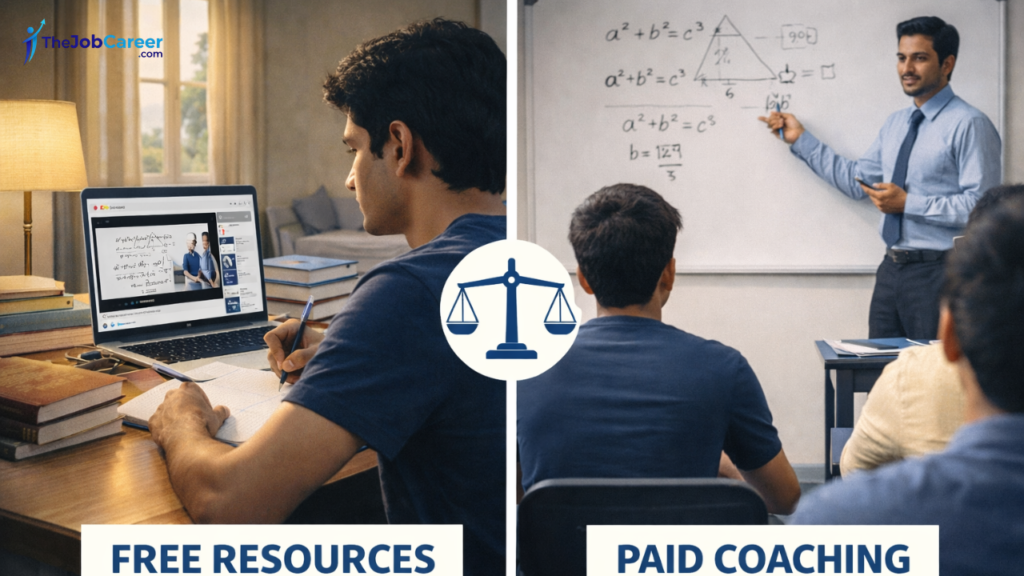

One of the most debated questions among government job aspirants is whether coaching is necessary for success. With the proliferation of free resources on YouTube, mobile apps, and online platforms, alongside traditional coaching institutes charging lakhs of rupees, aspirants face a dilemma: should they invest in paid coaching or rely on free resources?
The year 2026 has brought unprecedented access to quality educational content. From YouTube channels offering complete course coverage to mobile apps providing thousands of practice questions, free resources have democratized exam preparation. Simultaneously, coaching institutes have evolved, offering online classes, personalized mentorship, and advanced analytics to track student progress.
This comprehensive guide analyzes the effectiveness of free versus paid coaching for government exams, examining success rates, cost-benefit analysis, and helping you make an informed decision based on your learning style, financial situation, and exam requirements.
The Coaching Landscape in 2026
The government exam preparation ecosystem has transformed dramatically over the past few years. Understanding the current landscape helps in making better choices.
Evolution of Coaching Culture
Traditional Coaching Institutes (Pre-2020):
Physical classroom-based coaching was the primary mode of preparation. Students relocated to cities like Delhi, Bangalore, Hyderabad, and Allahabad for coaching. Fees ranged from Rs. 50,000 to Rs. 2 lakhs for comprehensive programs. Limited accessibility for students from tier-2 and tier-3 cities.
Post-Pandemic Shift (2020-2024):
COVID-19 accelerated digital transformation. Coaching institutes moved online, offering recorded and live classes. Hybrid models emerged combining online and offline instruction. Free content became mainstream with YouTube channels gaining millions of subscribers.
Current Scenario (2026):
Blended learning has become the norm. Students combine free YouTube content with paid test series. Mobile apps offer gamified learning experiences. AI-powered personalized learning platforms have emerged. Regional language content has expanded significantly.
Types of Coaching Available
Free Resources:
YouTube channels offering complete syllabus coverage Government initiatives like SWAYAM, DIKSHA platforms Free mobile apps with practice questions and current affairs Telegram and WhatsApp study groups Free PDFs and study material from various websites Free mock tests from multiple platforms (limited quantity)
Budget-Friendly Paid Options:
Online test series only (Rs. 500-3,000) Mobile app subscriptions (Rs. 200-500 per month) Subject-specific short courses (Rs. 1,000-5,000) Single exam focused programs (Rs. 5,000-15,000)
Premium Paid Coaching:
Comprehensive offline coaching (Rs. 50,000-2,00,000) Premium online coaching with mentorship (Rs. 20,000-80,000) Hybrid programs with both modes (Rs. 40,000-1,50,000) One-on-one personal coaching (Rs. 1,00,000+)
YouTube Channels vs Coaching Institutes: Detailed Comparison
Understanding the strengths and limitations of each helps in making informed choices.
YouTube Channels for Government Exam Preparation
Advantages:
Free and Accessible: No financial burden, available 24/7 from anywhere. Students from economically weaker sections can access quality education.
Flexible Learning: Watch at your own pace, pause, rewind, and rewatch difficult concepts. No fixed schedule constraints.
Diverse Teaching Styles: Multiple teachers explaining the same concept differently. Choose instructors whose teaching style matches your learning style.
Updated Content: Regular uploads on current affairs and recent exam patterns. Quick response to pattern changes and new syllabus additions.
No Peer Pressure: Learn without comparison with batch mates. Comfortable environment at home.
Popular YouTube Channels for Government Exams:
For SSC Exams: Study IQ Education (Hindi and English content) Adda247 (SSC focused playlists) Dear Sir (Mathematics simplified) Exampur (Comprehensive SSC coverage)
For Banking Exams: Adda247 (Banking dedicated content) Gradeup (Banking and SSC) Banking Wallah (Focused on banking only) Study Smart (English and Banking Awareness)
For UPSC Civil Services: Unacademy IAS (Free content on YouTube) Drishti IAS (Current affairs and optional subjects) Vision IAS (Test series discussion) Study IQ UPSC (Complete UPSC coverage)
For Railway Exams: Exampur Railway (RRB focused) Adda247 Railway Utkarsh Classes (Railway and SSC)
Official channels: https://www.youtube.com (search for specific channels)
Disadvantages:
Lack of Structure: Hundreds of videos without clear learning path. Students often get confused about where to start and what sequence to follow.
Distraction Risk: YouTube algorithm suggests unrelated videos. Easy to waste time browsing instead of studying.
No Personalized Attention: Cannot ask questions or get doubts cleared immediately. One-size-fits-all approach may not suit everyone.
Inconsistent Quality: Quality varies significantly across channels. Some channels prioritize views over educational value.
No Accountability: Easy to procrastinate without deadlines or peer pressure. No one tracking your progress.
Limited Practice Material: Video lectures alone are insufficient; extensive practice is needed separately.
Traditional Coaching Institutes
Advantages:
Structured Curriculum: Systematic syllabus coverage with defined timeline. Clear roadmap from basics to advanced topics.
Doubt Clearing: Immediate clarification of doubts during or after class. Personal interaction with faculty.
Peer Learning: Study groups and peer motivation. Healthy competition pushing you to perform better. Discussion and knowledge sharing with fellow aspirants.
Discipline and Accountability: Fixed schedule enforcing regularity. Attendance tracking and progress monitoring. Parents can track student’s attendance and performance.
Comprehensive Study Material: Printed notes, practice questions, and previous year papers. Curated content saving research time.
Regular Testing: Weekly, monthly, and full-length mock tests. Performance analysis and ranking. Identification of weak areas.
Expert Faculty: Experienced teachers understanding exam patterns. Shortcuts, tricks, and exam strategies.
Placement Support: Some institutes offer interview preparation and placement assistance. Alumni network and mentorship.
Disadvantages:
High Cost: Significant financial investment (Rs. 50,000-2,00,000). Additional costs: accommodation, food, travel if relocating.
Fixed Schedule: May not suit working professionals or students with other commitments. Inflexible timings.
Location Constraint: Good coaching institutes concentrated in metro cities. Relocation necessary for many students.
Large Batch Size: Individual attention difficult in batches of 100-300 students. Shy students hesitate to ask questions.
Time Consumption: Commuting time to coaching center. Waiting time between classes.
Quality Variation: Not all faculty members equally competent. Marketing promises often differ from actual delivery.
Pressure and Stress: Competitive environment can be stressful. Comparison with high performers may demotivate some students.
Hybrid Approach: The Best of Both Worlds
Many successful candidates recommend combining free YouTube content with selected paid resources:
Example Combination:
Free YouTube videos for concept clarity and basic understanding. Paid test series for extensive practice and performance analysis. Coaching for subjects you find most difficult (e.g., Mathematics or English). Self-study with free resources for strong subjects.
This approach optimizes cost while ensuring comprehensive preparation.
Self-Study Success Rate: Data and Analysis
Understanding success rates helps in setting realistic expectations and making informed decisions.
Statistical Overview
Self-Study Success:
According to various surveys and toppers’ backgrounds:
- 30-40% of successful candidates in SSC CGL, IBPS PO, and Railway exams prepared primarily through self-study with free resources.
- 10-15% of UPSC CSE selected candidates prepared without any coaching.
- Success rate has increased significantly post-2020 with better quality free content.
Coaching Success:
- 60-70% of successful candidates in competitive banking and SSC exams attended some form of coaching.
- 80-85% of UPSC selected candidates took coaching for at least one stage (Prelims, Mains, or Interview) or for optional subjects.
Important Clarification:
Success rate does not mean coaching guarantees success. Many students attend coaching but fail due to lack of personal effort. Many self-study candidates succeed because they are highly disciplined and motivated.
Factors Determining Self-Study Success
Educational Background:
Students from quality educational institutions (with strong fundamentals) find self-study easier. Engineering graduates often find quantitative aptitude and reasoning manageable without coaching. Students from vernacular medium struggle more with English, benefiting from coaching.
Learning Style:
Self-paced learners who can design their own study plan succeed well with self-study. Students requiring structure, deadlines, and external motivation benefit more from coaching.
Self-Discipline:
Highly disciplined individuals can follow a schedule without external pressure. Procrastinators need the accountability that coaching provides.
Access to Resources:
Students with good internet connectivity and devices can leverage free resources effectively. Those in remote areas with poor connectivity face challenges.
Financial Situation:
Financially constrained students have no choice but to rely on free resources, and many succeed through sheer determination.
Success Stories: Self-Study Toppers
Example 1: SSC CGL Topper (Rank 12, 2024)
Prepared entirely through YouTube channels and free PDFs. Investment: Rs. 1,500 (only test series subscription). Strategy: Watched Study IQ and Adda247 videos, solved previous year papers, practiced extensively. Key to Success: Made detailed notes, revised multiple times, maintained consistency.
Example 2: IBPS PO Selected Candidate (2025)
Used free YouTube content for concepts. Purchased Oliveboard test series for Rs. 999. Practiced daily from free apps. Total Investment: Rs. 1,500. Key to Success: Disciplined routine, daily practice, test analysis.
Example 3: UPSC CSE (Rank 245, 2024)
Self-studied using NCERTs, standard books, and free online resources. Took coaching only for optional subject (History) and interview guidance. Investment: Rs. 25,000 (optional coaching + interview guidance). Key to Success: Three attempts, learning from mistakes, extensive note-making and revision.
These examples show that self-study success is achievable but requires exceptional discipline, consistency, and smart resource utilization.
When Coaching is Necessary or Highly Beneficial
While free resources can suffice for many, certain situations strongly favor coaching.
Situations Where Coaching Helps Significantly
Weak Educational Foundation:
If your fundamentals in mathematics, English, or reasoning are weak, coaching provides structured learning from basics to advanced levels. Self-study requires strong basics; otherwise, understanding advanced concepts becomes difficult.
First Attempt at Competitive Exams:
Coaching helps understand exam patterns, marking schemes, difficulty levels, and attempting strategies. Experienced faculty guide you on how to prepare, what to prioritize, and how to manage time.
Specific Difficult Subjects:
Mathematics for non-mathematics students. English for vernacular medium students. Optional subjects in UPSC (subjects not studied in graduation).
Targeted coaching for weak areas while self-studying strong areas is a smart approach.
Lack of Study Material Clarity:
Overwhelmed by too many resources available online. Coaching provides curated material, eliminating confusion about what to study.
Time Constraint:
Working professionals or final-year students with limited preparation time. Coaching condenses the syllabus and focuses on high-yield topics, saving time.
Lack of Self-Discipline:
If you procrastinate frequently or struggle with consistency, coaching enforces discipline through regular classes and tests.
No Study Environment at Home:
Distractions at home (family, social media, household responsibilities). Coaching provides a dedicated study environment.
Interview Preparation:
UPSC, IBPS PO, and SSC CGL interviews require personality development, mock interviews, and feedback. Coaching institutes offer mock interview panels with experienced professionals.
Descriptive Paper Preparation:
Writing essays, letters, and précis for SSC CGL, IBPS PO, and other exams. Coaching faculty provide feedback on writing quality, structure, and language.
Exams Where Coaching is More Beneficial
UPSC Civil Services Examination:
Most aspirants benefit from coaching at some stage, especially for:
- Optional subjects (if not studied in graduation)
- Answer writing practice and feedback
- Current affairs compilation
- Interview preparation
Banking Exams (IBPS PO, SBI PO):
English section challenges many candidates; coaching helps. Data Interpretation requires shortcuts and tricks taught effectively in coaching. Interview preparation for personality development.
State Public Service Commissions:
State-specific syllabus and pattern. Local coaching institutes understand regional exam patterns better.
Exams Where Self-Study is Often Sufficient
SSC CHSL:
Syllabus is based on 10+2 level; most students can manage with free resources. Extensive free content available.
For preparation: SSC CHSL 2026: How to Prepare in 3 Months and Score 160+
Railway Group D:
Basic questions requiring practice rather than in-depth coaching. Physical efficiency test preparation done individually.
State Police Constable:
10th or 12th level questions. Physical training more important than academic coaching.
SSC GD Constable:
Similar to Railway Group D; basic preparation sufficient.
Budget-Friendly Coaching Options
Quality preparation does not always require spending lakhs. Here are cost-effective options.
Online Test Series (Rs. 500-3,000)
Benefits:
Extensive practice with thousands of questions. Performance analysis showing strengths and weaknesses. All-India ranking giving realistic assessment of competition.
Recommended Platforms:
Oliveboard: https://www.oliveboard.in (SSC, Banking, Railways) Testbook: https://testbook.com (All government exams) Adda247: https://www.adda247.com (Banking and SSC focused) Gradeup: https://gradeup.co (Comprehensive test series)
Cost: Rs. 500-2,500 for 6-month access to comprehensive test series.
Strategy:
Study concepts from free YouTube videos. Purchase test series for practice and evaluation. Analyze mistakes and revise weak areas.
Mobile App Subscriptions (Rs. 200-500 per month)
Features:
Daily quizzes and practice questions. Video lectures (recorded). Current affairs updates. Performance tracking.
Popular Apps:
Unacademy Learning App (Free and paid content) BYJU’s Exam Prep App Adda247 App Testbook App
Cost: Rs. 0-500 per month depending on features.
YouTube Premium for Ad-Free Learning (Rs. 129 per month)
Benefit:
Uninterrupted learning without distracting advertisements. Download videos to watch offline without internet. Background play while multitasking.
Cost: Rs. 129 per month (student discount available at Rs. 79).
Justification:
Improves focus and reduces study time wastage. Affordable investment enhancing free resource utilization.
Subject-Specific Short Courses (Rs. 1,000-5,000)
When to Consider:
Struggling with a specific subject despite self-study attempts. Need expert guidance for complex topics (e.g., Data Interpretation, English).
Options:
Udemy courses during sales (Rs. 399-799 per course). Unacademy Plus focused courses (Rs. 1,000-5,000 for 2-3 months). Coaching institute’s single subject crash course (Rs. 3,000-8,000).
Government Free Initiatives
SWAYAM Platform:
Free online courses by NPTEL, IITs, and central universities. Courses on quantitative aptitude, reasoning, English, and general studies.
Access: https://swayam.gov.in
DIKSHA Platform:
National digital infrastructure for teachers and students. Study materials for competitive exams.
Access: https://diksha.gov.in
National Career Service (NCS):
Free career counseling and skill development courses. Job notifications and preparation resources.
Access: https://www.ncs.gov.in
Library and Study Groups (Free)
Public Libraries:
Many cities have government libraries with free reading rooms. Quiet study environment without cost. Access to newspapers, magazines, and reference books.
Online Study Groups:
Telegram groups for doubt clearing and motivation. WhatsApp study groups with like-minded aspirants. Reddit communities for exam discussions.
Caution: Ensure groups are focused and not time-wasters.
Online vs Offline Coaching: Comprehensive Comparison
With hybrid models now common, understanding the differences helps in making the right choice.
Online Coaching
Advantages:
Cost-Effective: 30-50% cheaper than offline coaching. No relocation or accommodation expenses.
Flexibility: Study from home at convenient times. Recorded lectures allow learning at your own pace.
Access to Best Faculty: Not limited by geography; learn from top educators nationwide.
Time-Saving: No commute; utilize that time for additional study.
Personalized Learning: Watch difficult topics multiple times. Skip topics you already understand.
Technology Integration: Performance analytics and AI-based recommendations. Gamified learning and interactive quizzes.
Disadvantages:
Requires Self-Discipline: Easy to procrastinate without physical accountability. Distractions at home (family, social media, other activities).
Limited Interaction: Doubt clearing may be delayed (email, chat). No immediate clarification during live sessions with large batches.
Technical Issues: Internet connectivity problems disrupt classes. Device dependency (laptop, tablet, smartphone needed).
Lack of Study Environment: Home environment may not be conducive for serious study. No peer pressure or competition.
Screen Fatigue: Long hours on screen cause eye strain and fatigue.
Offline Coaching
Advantages:
Dedicated Study Environment: Classroom setting creates a serious study atmosphere. Free from home distractions.
Immediate Doubt Clearing: Raise hand and ask questions during or after class. Face-to-face interaction more effective for some learners.
Peer Learning and Motivation: Healthy competition with batch mates. Group study sessions and discussions.
Discipline and Routine: Fixed schedule enforces regularity. Physical presence ensures attendance.
Better Engagement: Direct eye contact and body language enhance learning. Less distraction compared to home environment.
Networking: Build friendships and support networks. Alumni connections for future guidance.
Disadvantages:
Higher Cost: Expensive compared to online coaching. Additional expenses: travel, food, accommodation (if relocating).
Fixed Schedule: Inflexible timings may clash with job or college. Miss classes if unwell or emergency arises.
Commute Time: 1-2 hours daily wasted in travel. Exhaustion from commuting.
Location Constraint: Must be in the city where coaching is located. Good coaching limited to metro cities.
Limited Revision: Cannot revisit lectures; must rely on notes.
Hybrid Coaching (Best of Both)
Many coaching institutes now offer hybrid models:
Structure:
Some classes offline (important topics, doubt clearing). Some classes online (routine topics, revisions). Online test series and performance tracking. Offline mock tests simulating actual exam environment.
Benefits:
Balance between flexibility and discipline. Cost-effective compared to fully offline. Better engagement than purely online.
Popular Hybrid Coaching Institutes:
Vajiram and Ravi (UPSC) Vision IAS (UPSC) Career Launcher (MBA and Banking) Time (CAT and Banking) Paramount Coaching (SSC and Railways)
Comparison Table: Online vs Offline Coaching
| Factor | Online Coaching | Offline Coaching | Hybrid Coaching |
|---|---|---|---|
| Cost | Rs. 20,000-60,000 | Rs. 50,000-2,00,000 | Rs. 40,000-1,20,000 |
| Flexibility | High (study anytime) | Low (fixed schedule) | Medium (some flexibility) |
| Study Environment | Home (distractions possible) | Dedicated classroom | Mix of both |
| Faculty Access | Limited (email, chat) | Immediate (face-to-face) | Both modes available |
| Doubt Clearing | Delayed or limited | Immediate | Immediate in offline sessions |
| Peer Learning | Limited | High | Medium to high |
| Commute Time | Zero | 1-2 hours daily | Occasional commute |
| Discipline Required | Very high (self-driven) | Medium (external push) | Medium to high |
| Revision Capability | Excellent (rewatch lectures) | Limited (only notes) | Good (recorded + notes) |
| Best For | Self-disciplined students, working professionals | Students needing structure, first-time aspirants | Balanced approach seekers |
Making the Right Choice: Decision Framework
Use this framework to decide what suits you best.
Self-Assessment Questions
Financial Situation:
Can you afford Rs. 50,000-2,00,000 for coaching? Is budget tight, requiring free or low-cost options?
Learning Style:
Do you learn better with structure and deadlines, or self-paced? Do you need someone to push you, or are you self-motivated?
Study Environment:
Do you have a quiet, distraction-free space at home? Are family members supportive of your preparation?
Educational Background:
Are your basics strong in quantitative aptitude, reasoning, and English? Did you excel in academics, or do you struggle with complex concepts?
Time Availability:
Are you a full-time aspirant, or preparing alongside job/college? Can you dedicate 8-10 hours daily, or limited to 4-5 hours?
Exam Complexity:
Which exam are you targeting? UPSC, Banking, SSC, Railways? Is it your first attempt, or are you re-attempting after a failure?
Decision Matrix
Choose Free Resources (YouTube + Free PDFs + Free Apps) if:
Budget is very tight (less than Rs. 5,000 for entire preparation). You are highly disciplined and self-motivated. Your basics are strong, and you understand concepts quickly. You have prepared for competitive exams before and know the pattern. You have 8-10 months or more for preparation (sufficient time).
Choose Budget-Friendly Paid Options (Test Series + Apps) if:
Budget is Rs. 5,000-20,000. You can learn concepts from free resources but need practice and evaluation. Self-disciplined but want performance tracking. You have 6-8 months for preparation.
Choose Online Coaching if:
Budget is Rs. 20,000-60,000. You want structured learning but need flexibility. You are a working professional or have other commitments. You live in a city without good offline coaching. You are comfortable with technology and online learning.
Choose Offline Coaching if:
Budget is Rs. 50,000-2,00,000. You lack self-discipline and need external accountability. You need immediate doubt clearing and faculty interaction. You are a first-time aspirant needing comprehensive guidance. Home environment is not conducive for study.
Choose Hybrid Coaching if:
Budget is Rs. 40,000-1,20,000. You want the best of both online and offline modes. You value flexibility but also want some peer interaction.
For related career guidance: How to Apply for Government Jobs in India – Step by Step
Practical Tips for Maximizing Free Resources
If choosing self-study with free resources, follow these strategies to maximize effectiveness.
Creating a Study Plan with Free Resources
Step 1: Identify Your Exam and Syllabus
Download the official syllabus from the exam conducting authority’s website. Break down the syllabus into subjects and topics.
Step 2: Search for Quality YouTube Channels
For each subject, identify 1-2 best channels based on:
- Views and subscriber count (popularity indicator)
- Comments feedback (quality indicator)
- Complete syllabus coverage
Stick to those channels; avoid hopping between too many.
Step 3: Create a Playlist
Organize videos topic-wise in YouTube playlists. Follow the playlist sequentially like a coaching syllabus.
Step 4: Note-Making
Make concise notes while watching videos. Handwritten notes improve retention.
Step 5: Practice with Free Resources
Download previous year papers from official websites. Use free apps like Testbook, Gradeup (limited free tests). Practice daily quizzes.
Step 6: Join Online Communities
Telegram groups for doubt clearing. Reddit forums for discussion. Avoid time-wasting groups; join only serious, study-focused communities.
Step 7: Purchase Affordable Test Series
After completing the syllabus, invest Rs. 500-1,500 in a test series. Appearing for tests without preparation is counterproductive.
Avoiding Common Self-Study Pitfalls
Avoiding YouTube Rabbit Holes:
Use browser extensions like “Distraction-Free YouTube” to hide recommendations. Watch videos in a dedicated study session, not casually browsing.
Maintaining Consistency:
Create a timetable and stick to it. Use habit-tracking apps to monitor daily progress.
Not Skipping Revision:
Self-study often leads to skipping revision due to lack of accountability. Schedule weekly revision sessions.
Not Avoiding Mock Tests:
Many self-study students skip tests, focusing only on learning. Regular tests are crucial for time management and exam temperament.
For preparation strategies: IBPS PO 2026: Complete Preparation Guide (Prelims + Mains + Interview)
Success Stories: Free Resources vs Paid Coaching
Real-life examples provide insights into what works.
Success Story 1: Rahul Kumar – IBPS PO (Self-Study)
Background: Engineering graduate from tier-2 college, family income Rs. 3 lakh annually.
Preparation: Could not afford coaching (Rs. 50,000+). Relied on Adda247 YouTube channel for concepts. Purchased Oliveboard test series for Rs. 999. Practiced daily, appeared for 30+ mock tests. Total investment: Rs. 1,500.
Result: Selected as Probationary Officer in Bank of Baroda.
Key Takeaway: Disciplined self-study with strategic use of affordable paid resources works.
Success Story 2: Priya Sharma – SSC CGL (Free + Budget Coaching)
Background: B.Com graduate, working in a private company.
Preparation: Watched Study IQ videos for Mathematics and Reasoning (free). Took English coaching for 3 months (Rs. 5,000). Purchased Adda247 test series (Rs. 1,200). Total investment: Rs. 6,200.
Result: Selected as Assistant in Central Secretariat Service.
Key Takeaway: Hybrid approach—free resources for strong subjects, coaching for weak areas.
Success Story 3: Amit Verma – UPSC CSE Rank 142 (Coaching)
Background: History graduate, middle-class family.
Preparation: Joined Vajiram and Ravi coaching for General Studies (Rs. 80,000). Took separate coaching for optional subject (Rs. 30,000). Purchased test series and study material (Rs. 15,000). Total investment: Rs. 1,25,000.
Result: Selected in first attempt.
Key Takeaway: For complex exams like UPSC, comprehensive coaching with expert guidance can be highly effective, especially for first-time aspirants.
Success Story 4: Neha Singh – RRB NTPC (Self-Study)
Background: 12th pass from rural area, limited financial resources.
Preparation: Used free YouTube channels (Exampur, Adda247). Downloaded free PDFs from coaching institute websites. Practiced with free app quizzes. Appeared for free mock tests available online. Total investment: Rs. 0.
Result: Selected as Junior Clerk in Indian Railways.
Key Takeaway: For exams with relatively straightforward syllabus, complete self-study is possible with dedication.
For related preparation: RRB NTPC 2026: Complete Preparation Guide (Exam Pattern, Syllabus, Strategy)
Frequently Asked Questions
Q1: Is coaching absolutely necessary to clear government exams?
No, coaching is not absolutely necessary. Many candidates clear exams through self-study using free resources. However, coaching can be helpful for those lacking discipline, needing structured guidance, or struggling with specific subjects.
Q2: Can I crack UPSC without coaching?
Yes, though challenging. About 10-15% of selected candidates prepare without coaching. It requires exceptional discipline, extensive reading, and proper guidance (from seniors, online forums, or mentors). Most aspirants benefit from coaching at some stage (Prelims, Mains, or Interview).
Q3: Are free YouTube channels sufficient for SSC and Banking exams?
For many candidates, yes. SSC CHSL, SSC GD, and Railway Group D can be cracked with free resources. For SSC CGL and IBPS PO, combining free YouTube content with paid test series is recommended for comprehensive preparation.
Q4: How do I choose between online and offline coaching?
Consider your learning style, budget, discipline level, and time availability. If self-disciplined and needing flexibility, choose online. If needing structure and immediate doubt clearing, choose offline. Hybrid is a balanced option.
Q5: Is spending Rs. 1-2 lakhs on coaching worth it?
It depends on your financial situation and exam. For UPSC, where career benefits are significant, investment may be justified if you can afford it. For SSC or Railways, explore budget-friendly options first. Never take loans for coaching; free and low-cost options exist.
Q6: What if I cannot afford any paid resources?
Rely entirely on free resources: YouTube, government websites (SWAYAM, DIKSHA), free PDFs, library, and free mobile apps. Many successful candidates have cleared exams with zero investment. Focus on consistency and hard work.
Q7: Should I buy test series if I am self-studying?
Yes, highly recommended. Test series cost Rs. 500-1,500 and provide extensive practice, performance analysis, and ranking. This is a high-return investment even for self-study candidates.
Conclusion
The free vs paid coaching debate does not have a one-size-fits-all answer. Success in government exams depends more on your consistency, effort, and smart utilization of resources rather than the amount spent on coaching.
In 2026, free resources have matured to a level where dedicated students can achieve success without spending a rupee. Simultaneously, coaching institutes offer value through structured learning, doubt clearing, and peer environment for those who need it.
The optimal approach for most aspirants is a hybrid model: leverage free YouTube content for conceptual learning, invest modestly in test series for practice and evaluation, and consider coaching only for specific weak areas or complex subjects.
Remember, coaching can guide you, but it cannot replace your personal effort. Whether you choose free resources, budget-friendly options, or premium coaching, your success ultimately depends on your dedication, consistency, and smart work.
Assess your situation honestly, choose the path that suits your learning style and financial capacity, and commit to it wholeheartedly. Your government job awaits.
Disclaimer: Coaching effectiveness varies by individual. Success rates mentioned are approximate based on surveys and may not reflect exact statistics. Choose based on your personal needs and circumstances.
About TheJobCareer: We provide comprehensive career guidance, latest job notifications, and exam preparation resources for aspirants across India. Subscribe to our newsletter for regular updates on government job opportunities and preparation tips.
Useful External Resources:
- SWAYAM Free Courses: https://swayam.gov.in
- DIKSHA Platform: https://diksha.gov.in
- National Career Service: https://www.ncs.gov.in
- Testbook (Test Series): https://testbook.com
- Oliveboard (Test Series): https://www.oliveboard.in
- Adda247 (Coaching + Test Series): https://www.adda247.com
- Unacademy Learning App: https://unacademy.com
- YouTube Education (Search Channels): https://www.youtube.com