
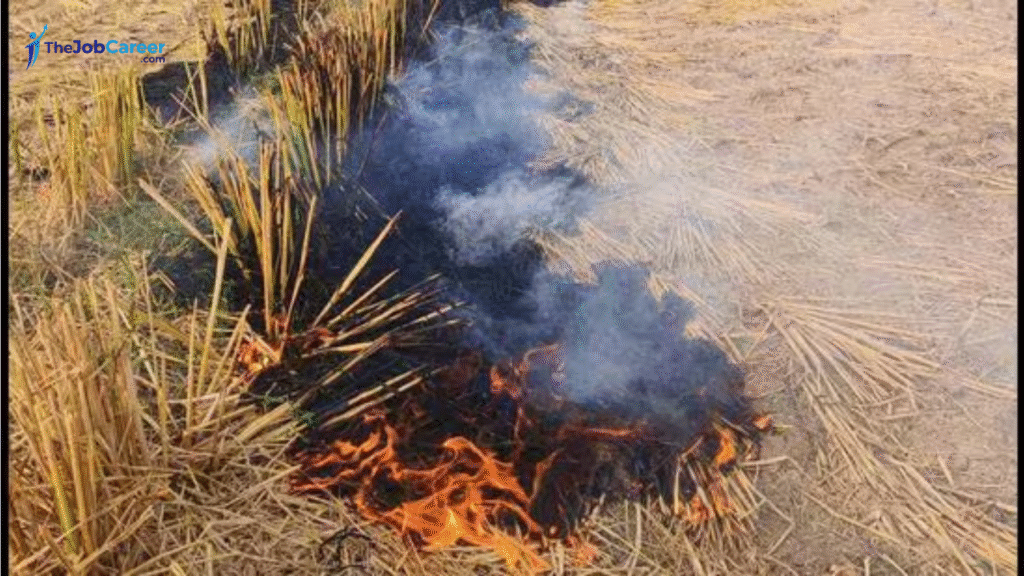

Delhi’s Air Pollution Tracker DSS Fails to Accurately Forecast Stubble Burning Impact, Say Officials
The Decision Support System (DSS) — the only available source apportionment tool that identifies how much each pollution source contributes to Delhi’s PM 2.5 levels — has failed to accurately forecast the impact of stubble burning this season, according to government officials and environmental experts.
Despite DSS projections in recent days showing stubble burning contributing over 30% to the Capital’s air pollution, actual readings based on verified satellite fire counts later in the day have shown contributions below 10%, officials confirmed.
Stubble Burning Forecasts Fall Short
The DSS, which operates under the Ministry of Earth Sciences (MoES) and is managed by the Indian Institute of Tropical Meteorology (IITM) in Pune, uses satellite fire data, emission inventories, and weather parameters to estimate pollution sources.
However, this season, the system’s predictions have been significantly off the mark. Officials familiar with the model’s operations said the timing of satellite passes and changing farm fire patterns in Punjab and Haryana have likely caused discrepancies in emission estimates.
“The biomass burning estimates for the next day are based on fire counts detected by the satellite in the afternoon. We convert this into an emission load and simulate it through the DSS model,” said an official associated with the DSS operations. “If the fires occur after the satellite pass time of 2.30 pm, they are missed, and we cannot estimate them accurately.”
The official added that this year’s stubble fires have not yet peaked, which might also explain the lower contribution recorded so far. “For the day’s actual count, the model captures satellite farm fires till 5 pm before releasing a revised figure,” the official said.
DSS Forecasts Vs Actual Data
On Monday, the DSS forecasted zero percent contribution from stubble burning to Delhi’s PM 2.5 levels. However, the actual fire count for the day was not released, prompting further scrutiny.
An IITM scientist confirmed that the team is investigating the mismatch.
“We are checking whether there were technical issues with the fire counts received from the satellite on Sunday,” the official said.
Historically, DSS data has shown much higher peaks during the crop residue burning season. Last year, the peak single-day contribution of stubble burning to Delhi’s pollution was 35.1% on November 1 and 35% on November 3 in both 2022 and 2023. In comparison, the peak reached 48% on November 6, 2021.
This year, however, forecasts have consistently overshot actual data, with even the most polluted days in November showing single-digit contributions from stubble burning.
Technical and Data-Related Limitations
Officials admit that the DSS has long struggled with data delays and model inaccuracies. On November 4, Hindustan Times reported that the DSS model had not been updated since October 31, and only resumed updates after queries were sent to IITM and the Ministry.
The DSS was officially reactivated on October 5 ahead of the winter pollution season, but it continues to depend on a 2021 emissions inventory, which experts say makes its forecasts less reliable.
An emissions inventory is essentially a database that records the amount of pollutants emitted from different sources (such as vehicles, industries, construction, and biomass burning) within a specific time frame and region. If such an inventory is outdated, the model’s pollution estimates can be grossly inaccurate.
“Using an outdated emissions inventory combined with current meteorological data can lead to significant forecasting errors,” said an IITM official, who requested anonymity.
Accuracy Concerns Raised Before
Last year, the Commission for Air Quality Management (CAQM) had also raised serious concerns about the DSS’s reliability. It temporarily suspended the system’s operations, directing IITM to make “specific technical improvements” to improve accuracy.
Following these interventions, DSS data was unavailable between November 29 and December 9, 2023, before being resumed.
Despite these warnings, the CAQM has not issued any official comment or directive this season regarding DSS’s functioning.
DSS vs Air Quality Early Warning System (AQEWS)
While both DSS and AQEWS operate under the Ministry of Earth Sciences, they serve different purposes. The DSS identifies the contribution of specific pollution sources, whereas the Air Quality Early Warning System (AQEWS) forecasts overall air quality levels for Delhi and the NCR region based on meteorological and dispersion models.
The two systems are not directly integrated, meaning that DSS inaccuracies do not affect the AQEWS forecasts, but they do limit policymakers’ ability to design targeted interventions.
Why DSS Is Falling Behind
According to experts, multiple factors are responsible for the DSS’s underperformance this season:
- Outdated Emissions Inventory (2021): Pollution sources in Delhi-NCR have changed significantly over the last four years, especially with industrial shifts, vehicular growth, and new construction activity.
- Missed Satellite Fire Counts: Satellite data collected before 2:30 pm misses late-afternoon farm fires, which are crucial during peak burning days.
- Changing Burning Patterns: Farmers in Punjab and Haryana have reportedly delayed harvesting due to weather fluctuations and government restrictions, leading to a prolonged but inconsistent fire season.
- Insufficient Ground Validation: DSS relies heavily on satellite data without adequate cross-verification from ground monitoring stations, reducing accuracy.
Experts Call for Transparency and Upgrades
Environmental experts and researchers have warned that DSS’s inaccuracies could undermine policy decisions during the peak pollution season in Delhi.
“Transparency is important when we talk about fighting pollution. But with an outdated emissions inventory and now missing or inaccurate stubble forecasts, the whole purpose of DSS is being defeated,” said Sunil Dahiya, lead analyst at the environmental think-tank Envirocatalysts.
He added that policymakers depend on accurate source apportionment to decide on emergency measures such as construction bans, traffic restrictions, and crop-residue management plans.
Without reliable data, identifying whether Delhi’s pollution spikes are due to local emissions or transboundary sources like stubble smoke becomes nearly impossible.
What Lies Ahead for DSS
Officials within IITM said that a new emissions inventory is being prepared and will likely be rolled out before the 2026 pollution season. The new dataset will integrate real-time industrial emissions, vehicular data, and updated stubble burning patterns using advanced satellite feeds from NASA and ISRO.
However, environmental analysts caution that unless the government invests in continuous data calibration, AI-driven modeling, and public data transparency, such systems risk becoming symbolic rather than effective.
“Air quality management needs predictive systems that evolve dynamically. Static models based on old data will only mislead policymakers,” said a Delhi-based environmental scientist.
Conclusion
The Decision Support System remains one of the most critical tools in India’s fight against air pollution, offering valuable insights into how much each source contributes to Delhi’s worsening smog. Yet, its inaccurate forecasts, data gaps, and outdated emission inventories have weakened its credibility this year.
As Delhi’s air quality continues to deteriorate in early winter, experts agree that improving data accuracy, model transparency, and system accountability must be a top priority for the Ministry of Earth Sciences and the CAQM.
Until then, the DSS’s forecasts may continue to misrepresent the true impact of stubble burning — leaving policymakers and citizens alike in the haze of uncertainty.