
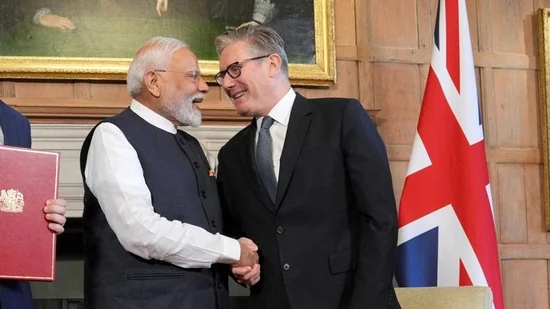

Political Significance of PM Keir Starmer’s Visit to India (October 2025)
1. Consolidating Strategic Gains Post-FTA
- The visit follows the signing of a partial Free Trade Agreement (FTA) in July 2025 during PM Modi’s UK trip.
- As Starmer’s first official visit to India as PM, it symbolises Labour’s commitment to India-UK ties and builds momentum for a comprehensive agreement.
- Aims to deepen cooperation under the India–UK Comprehensive Economic and Trade Agreement (CETA), with a focus on trade, investment, and regulatory alignment.
2. Advancing Strategic Partnership Beyond Trade
- Talks will align with the Vision 2035 roadmap, covering:
- Technology cooperation (AI, digital infrastructure, fintech, cybersecurity).
- Defence collaboration, transitioning from buyer-seller to joint co-development and innovation, based on a 10-year Defence Industrial Roadmap.
- Participation in the Global Fintech Fest in Mumbai signals joint innovation in digital finance.
3. Diplomatic Rebalancing in a Changing Global Context
- The visit occurs amid global trade tensions and rising US protectionism, positioning India and the UK as resilient strategic partners.
- Discussion expected on regional and global issues, including Indo-Pacific stability and economic security.
4. Sensitive Issues: Challenges Remain
- Khalistani extremism in the UK remains a flashpoint, especially following past protests and attacks on Indian diplomatic missions.
- Extradition deadlocks involving high-profile fugitives like Vijay Mallya and Nirav Modi continue to strain ties.
- Visa and migration tensions persist, despite limited progress via a Double Contributions Convention aimed at easing professional mobility.
- Ongoing friction due to India’s strategic autonomy, especially its ties with Russia and Iran, contrasts with UK positions on global conflicts like the Russia-Ukraine war.
5. Symbolism and Political Messaging
- The visit marks the first India visit by a Labour PM since Starmer took office in July 2024, underlining a shift from past ambivalence under Labour regarding India.
- Reinforces the idea of the “living bridge”—strong UK–India people-to-people ties, underpinned by the large Indian diaspora.
- Emphasises a reciprocal diplomatic relationship, reflecting continuity in bilateral priorities regardless of political leadership.
6. Domestic and Policy Constraints
- The UK’s internal political and immigration policies remain key obstacles to Indian priorities, especially around skilled labour mobility and student visas.
- For India, high tariffs and regulatory barriers remain sticking points for UK exporters, particularly in automobiles and alcohol.
Conclusion
PM Starmer’s visit represents a pivotal moment in redefining India-UK relations for a post-Brexit, multipolar world. While symbolic of deeper engagement and mutual commitment, it also brings to the surface long-standing structural and political challenges. The visit offers a platform to convert strategic intent into actionable outcomes, but progress hinges on both sides’ willingness to compromise on sensitive issues such as migration, legal services, extremism, and extradition.